Johnson and Mark Jellinek will join the Department of Earth, Environmental, and Planetary Sciences as professors.
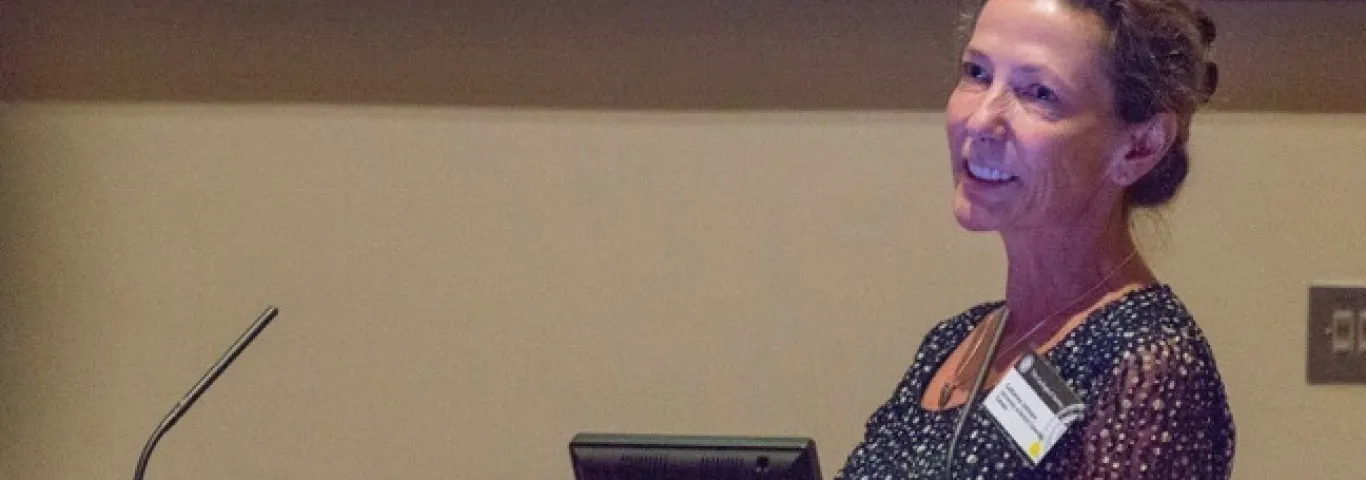
Catherine Johnson, a leading planetary scientist at the University of British Columbia (UBC) in Vancouver, will be the next director of the McDonnell Center for the Space Sciences.

Johnson and fellow scientist Mark Jellinek, her husband and longtime colleague at UBC, will also join the Department of Earth, Environmental, and Planetary Sciences (EEPS) in Arts & Sciences as professors beginning March 1. Jellinek is a geophysicist whose research focuses on volcanic eruption dynamics and their consequences for climate variability and how planetary interiors, climates, and landscapes evolve.
Johnson will succeed MCSS interim director William McKinnon, the Clark Way Harrison Distinguished Professor in Arts & Sciences, who has served in that role since 2025, when former director Bradley L. Jolliff retired. Johnson will be the center’s fifth director since it was established in 1974.
“Becoming director of the MCSS is an incredible honor and opportunity,” Johnson said. “I've always been interested in the aspects of space science that straddle multiple disciplines, and the center has long been an institutional leader in interdisciplinary research. I’m hoping to move the center in some new directions and build on its remarkable history.”
In 2025, the center celebrated 50 years of advancing space science research and training the next generation of leaders in the field at WashU. The center was established through a generous endowment from the late James S. McDonnell, an aviation pioneer and former chair of WashU’s Board of Trustees.
Johnson has frequently collaborated with MCSS researchers over the years, including former director Roger Phillips and current faculty member Paul Byrne, associate professor of Earth, environmental, and planetary sciences. “Paul and I were both involved in the MESSENGER mission to Mercury,” she said. “I’m very excited to get to know other people at the center, including researchers in astronomy and physics as well as EEPS.”

One of the world’s leading planetary scientists, Johnson is a member of the National Academy of Sciences and the American Academy of Arts and Sciences. She is also a fellow of the Royal Society of Canada. In 2019, she was awarded the Price Medal from the Royal Astronomical Society, which honors an investigation of “outstanding merit” on the formation and composition of the Earth and/or planets. She earned her bachelor’s degree at the University of Edinburgh and her doctorate at the Scripps Institution of Oceanography at the University of California San Diego.
“Catherine has deep knowledge of planetary interiors, including the origin and evolution of their magnetic fields and atmospheres, and geophysics generally,” McKinnon said. “Given the burgeoning interest by NASA and other space agencies in exploring the Moon and the terrestrial planets, her expertise will be extremely valuable and relevant going forward.”
“While we’re proud to have recently celebrated our 50th anniversary, we’re not a museum,” McKinnon added. “We’re focused on the future.”
Jellinek blends different areas of geophysics. He recently studied the formation of Martian valleys, the interplay between volcanism and glaciation in Antarctica, and the effects of volcanism on climate change and of climate change on volcanism.

“The breadth and depth of the work in the Department of Earth, Environmental, and Planetary Sciences, together with its strongly collegial culture, are major parts of what draws me to WashU,” Jellinek said. “WashU presents possibilities that are unavailable at most other places. I’m especially impressed by the range of funding mechanisms designed to support high-risk, high-reward projects with the potential to drive disruptive innovation.”
The arrival of Johnson and Jellinek next spring will be transformative for the Department of Earth, Environmental and Planetary Sciences, said Phil Skemer, a professor and interim chair of the department. “Catherine’s personable and collaborative leadership style will be a tremendous asset to the McDonnell Center for the Space Sciences, and the EEPS department as a whole,” he said. “I’m particularly enthusiastic about her plans for an EEPS-wide collaboration to investigate the enigmatic lunar ‘moonquakes’ detected during the Apollo missions.”
“Mark is an intellectually diverse scientist with interests spanning convection in planetary mantles to landscape evolution on Earth and Mars,” Skemer said. “His ability to work across multiple disciplines will open many new pathways for collaborative research in EEPS and across Arts & Sciences and McKelvey. I’m excited to welcome them both to WashU and the St. Louis region.”