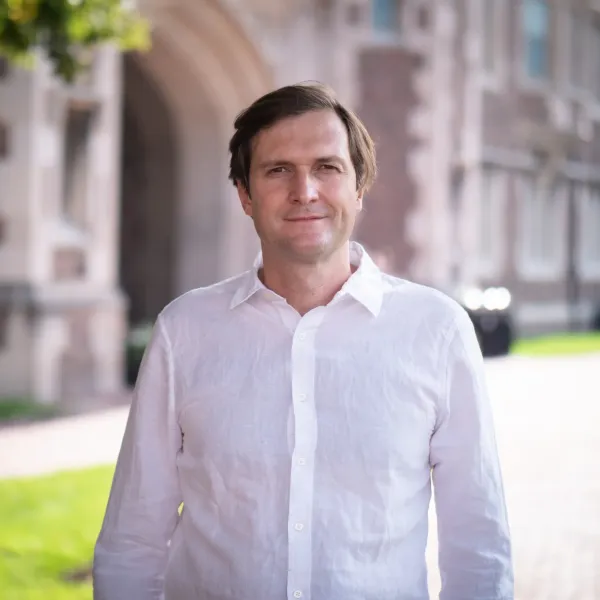
Ans Irfan and Bree Bode join the program as it reaches 100 declared majors. Each brings a distinct combination of professional and personal experiences, reflecting the breadth of public health as a multidisciplinary field.
Ans Irfan didn’t discover his passion for public health until he saw the shortcomings of clinical care.
Bree Bode didn’t recognize hers until she faced painful decisions about how to spend her young family’s limited food budget.
Like many public health practitioners, neither initially set out to pursue the field. But in separate moments of realization, they discovered how deeply public health is intertwined with the societal challenges that interested them most.
Their different paths ultimately brought them to WashU and the Program in Public Health & Society, where they joined the faculty this semester as the program’s newest professors of practice. Their arrival broadens the expertise of a growing program that encourages students to examine health and society through multiple disciplines.
Their appointments coincide with a milestone for the program, which has reached 100 declared majors just one year after introducing its major. Established as part of the Arts & Sciences Strategic Plan, the program is co-directed by T.R. Kidder, the Edward S. and Tedi Macias Professor, and Lindsay Stark, professor and director of undergraduate public health education.
“Professors Bode and Irfan are dynamic thinkers whose energetic teaching and scholarship embody the best of a liberal arts education,” Kidder said. “In their scholarship, teaching, and practice, both model the integrative thinking that public health requires and that a liberal arts education encourages. We are excited to have them as colleagues because they bring inquiry, curiosity, service to the community, and an abiding commitment to student success into the classroom.”
For Irfan, that commitment to interdisciplinary thinking began during medical school. Earning his medical degree at Xinjiang Medical University in China and providing care in places such as Pakistan revealed the limits of clinical medicine — and set him on an international journey to explore solutions beyond the doctor's office.
“These were patients that would keep coming back to us, with nothing ever fixing the system underneath it,” Irfan said. “They didn’t have food at home. They couldn’t afford their medication. They couldn’t refrigerate certain medications because they didn’t have electricity. I had to ask myself: at what point do I have to contend with those broader social dynamics, especially if I knew that a patient had to sell the very medication that I prescribed to them in order to feed themselves?”
Bode faced food insecurity firsthand as an undergraduate raising children. Her search for answers eventually drew her into public health research.
“I used different aspects of the social safety network: SNAP benefits, WIC benefits, and free school meals to make ends meet for me and my family,” Bode said. “As part of that, I took a nutrition class from a registered dietitian. All of a sudden, I was seeing the grocery store completely differently. I could go in and purchase fruits and vegetables with my social safety program, but all the advertisements in the store indicated that I could buy four 2-liter bottles of soda for $5 and nobody would care less if I did.”
Those experiences shaped their appreciation for the program's interdisciplinary approach, which places public health within the broader context of the liberal arts and recognizes the value of perspectives shaped by different cultures, communities, and circumstances.
“Pick an issue of your choice,” Irfan said. “I can give you all the data on the planet on this issue. But it's not going to move people. Things that move people are going to come from humanities, from stories, from people's narratives. They're all of those particular things that make us foundationally, fundamentally human. And that's what I think is distinct about this program.”
“I've been around a variety of public health programs,” Bode said. “There isn't one program like this one. This program brings together a variety of majors and minors to learn about public health & society. We invite really unique perspectives into these spaces which positions undergrads to be innovator thinkers, from there the sky is the limit!
Their professional backgrounds are equally varied.
Irfan has pursued health equity through work with Afghan refugees in Pakistan, Peace Corps service in the Philippines, and efforts to shape climate-health policy in the United States. In addition to his medical degree, he holds doctorates in public health, science, and education. Despite the breadth of his career, teaching has remained his first academic love — a commitment that brought him to WashU.
“I owe it to my students to do everything I can to help train them in a way that they will be better equipped to wrestle with these questions,” Irfan said.
Building on her early experiences navigating public assistance programs, Bode has focused her career on food justice and the social and economic factors shaping what children and families eat. Her experience includes working with the Michigan Fitness Foundation and research examining how nutrition assistance programs such as SNAP and WIC can better support access to healthy foods.
“We need to keep working in food systems and the policies that influence them so that our foods are nourishing us, not simply giving us calories to survive,” Bode said. For both Bode and Irfan, the classroom offers another opportunity to address the challenges that first drew them to public health. By bringing their experiences into conversations with students, they hope to cultivate a new generation of practitioners who understand that improving health requires looking beyond medicine to the systems, policies, and communities that shape people's lives.