
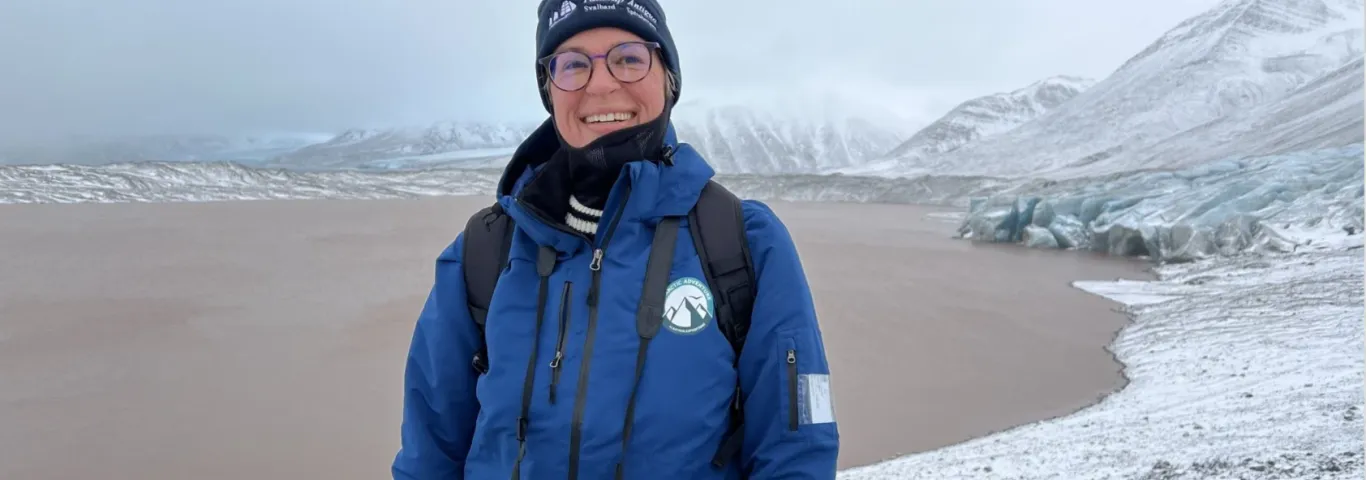
From “Moby-Dick” to the Northwest Passage, Blum follows literary questions beyond the archive and into the environments that shaped them.

Everything is “Moby-Dick,” according to Hester Blum.
Does the novel relate to oceanic studies? Obviously. Climate change and clean energy? Absolutely. “Moby-Dick” and “Heated Rivalry”? That, too.
Since she first read Herman Melville’s novel at 17, it has been a touchstone in her life and in her career as the Lynne Cooper Harvey Distinguished Professor of English and a professor of environmental studies.
“I think about ‘Moby-Dick’ every day,” Blum said. “Seriously, Melville could make me cry right now.”
For Blum, the novel continues to speak to each generation, opening onto questions of race, power, disability, queerness, labor, and the environment. That capacity to find new meaning in familiar texts has shaped a career that is both highly specialized and unusually wide-ranging.
Blum is a leading scholar of 19th-century U.S. literature and culture, the environmental humanities, and oceanic and polar studies. She joined WashU in 2025 after 22 years at Penn State University, and the Guggenheim Foundation, the National Endowment for the Humanities, and the Mellon Foundation have supported her work. Her two award-winning books examine how life at sea shaped what people read, wrote, and imagined. “The News at the Ends of the Earth” explores printed materials created by 19th- and early 20th-century polar explorers. “The View from the Masthead” considers how the shipboard lives of 19th-century sailors shaped their writing.

Blum’s work moves easily between specialized scholarship and public conversation. She founded C19: The Society of Nineteenth-Century Americanists and, in 2022, edited a new edition of “Moby-Dick” that emphasizes the novel’s relevance to contemporary questions. She recently developed a podcast about the novel with writer, actor, and comedian Rob Delaney, had a semifinal run on the “Jeopardy!” Professors Tournament, and is writing a nonfiction book about her love of Larry McMurtry’s “Lonesome Dove.”
“I think about ‘Moby-Dick’ every day. Seriously, Herman Melville could make me cry right now.” —Hester Blum

That expansive approach to scholarship took her beyond books and archives in 2019, when she joined the Northwest Passage Project, a National Science Foundation-supported expedition aboard a Swedish icebreaker bound for the Canadian Arctic. Scientists collected water, ice, and air samples to study the effects of climate change on the region. Blum served as the expedition’s Arctic historian and appeared in “Frozen Obsession,” a documentary about the journey.
The experience changed her sense of what humanities research could be. “I remember being on the icebreaker and thinking that I never wanted to go home, but also that I needed to reorient my sense of how to do research as a humanist,” Blum said. “It expanded the hopes and expectations I had for doing this kind of work.”
Beyond that, she joined research trips to Nunavut and the Northwest Territories’ Inuvialuit Settlement Region, traveled to Svalbard aboard the tall ship Antigua, visited the Antarctic Archipelago as a lecturer, and sailed aboard the Charles W. Morgan, the world’s last surviving 19th-century wooden whaleship.
Those excursions have given Blum a more visceral understanding of the environments inhabited by the sailors, explorers, and writers she studies. They have also placed her at the forefront of oceanic studies, sometimes called the blue humanities, a field that examines how oceans and waterways shape human thought, culture, and behavior.

“It’s been galvanizing to my sense of what it means to write and think and produce questions about art and writing while in the polar regions,” she said.
When asked to identify the thread connecting the many strands of her career, Blum points to the imperfect pursuit of knowledge. “I’m interested in how hard people work to understand how they come to know things — in their desire to ask questions and solve problems,” she said. “Part of that effort is accepting imperfection and failure. Knowledge will never be complete, which I find wonderful and exhilarating.”
That willingness to remain with uncertainty has guided Blum across disciplines, archives, and oceans. It has also led her to approach literature as a living field of inquiry, capable of changing how we understand history, the environment, and one another.
“I want things to be messy,” she said.


