
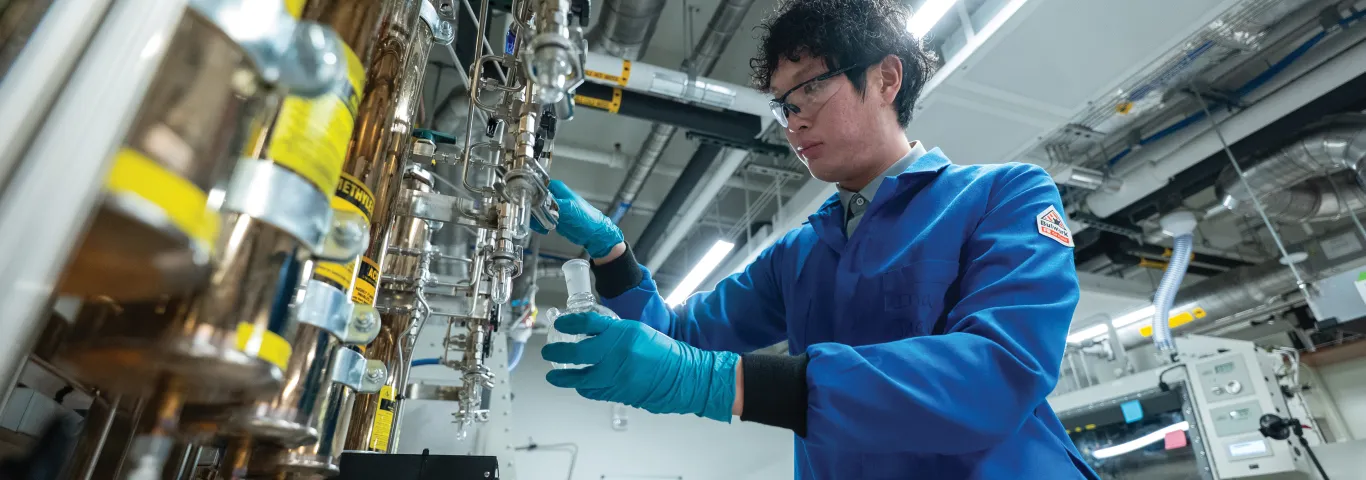
Zach Zheng uses AI to create metallic-organic compounds with potential applications far beyond the lab.
Zhiling “Zach” Zheng, an assistant professor of chemistry, has been on campus for less than a year, but his lab is already in high gear. Hired in 2025 as part of the Rules of Life Initiative, Zheng studies and develops metal-organic frameworks — spongelike crystals that can pull water from desert air, trap carbon dioxide, and potentially transform fields ranging from mining to medicine.
Metal-organic frameworks are a major focus in modern chemistry. Zheng’s mentor, Omar Yaghi, received the 2025 Nobel Prize in Chemistry for pioneering work on the materials. Zheng attended the award ceremony in Stockholm last December, and Yaghi highlighted Zheng’s research during his Nobel lecture.
As he builds his lab at WashU, Zheng is thinking not only about the future of the field, but also about mentorship, collaboration, and the kinds of scientific questions that first drew him to chemistry.

You create materials called metal-organic frameworks. What are those?
As the name suggests, metal-organic frameworks — we call them MOFs, pronounced “moffs” — are crystals that contain both metals and organic compounds. The great thing about MOFs is that they have a lot of empty spaces between the atoms, making them very porous and spongelike. The size of the pores depends on the materials used, so chemists can precisely engineer each MOF to fit a particular purpose.

What sorts of things can MOFs do?
Over the past three decades, since their discovery, MOFs have been used across a wide range of applications, including gas separation, catalysis of chemical reactions, and even food packaging. As a PhD student, I showed that MOF crystals can trap water from the air in Death Valley. At a large scale, this sort of technology could help support communities and farms in dry places. MOFs could also be used to pull pollutants from drinking water or rare earth metals from mining waste. Or they could absorb chemicals to house reactions in each little chamber within the crystal. I’m sure that there are many other applications that are waiting to be discovered.
How do you come up with new MOF possibilities?
I’m now using AI to explore different combinations of metals and organic molecules. There are millions of different organic compounds that could go into a MOF, and there’s also a wide range of possible metals, including copper, zinc, iron, and aluminum. No chemist could ever try every possible combination in the lab, but AI can suggest different combinations of metals and organic compounds in different ratios and predict how new MOFs might behave in various situations.
Once we’ve identified a potentially interesting or useful MOF, we create it in the laboratory. My group has developed about 10 new compounds since I started at WashU. We’re really showing off the muscle of AI in the laboratory. Some chemists do almost all of their work on computers, which is great. But, for me, AI is just one of my tools.
How has coming to WashU affected your work and research goals?
Joining WashU as part of the Rules of Life Initiative was a huge accomplishment for me. The whole point of the initiative is to encourage collaboration across the disciplines of chemistry, physics, and biology to explore fundamental questions about life. I look forward to those collaborations and conversations.
I’m also interested in collaborating with researchers at the Medical School to study possible clinical applications of MOFs. Perhaps a MOF capsule or implant could deliver antibiotics, chemotherapy, or even therapeutic gases to a targeted part of the body.
Your mentor Omar Yaghi was recently awarded the 2025 Nobel Prize for Chemistry. What did you learn about leading a lab from him?
Professor Yaghi was already a leading figure in the field when I joined his group as a PhD student, but he was very available and approachable. I had regular one-on-one meetings with him every week or so, and he always responded quickly to emails. My group is just getting started, but that’s the kind of leader I want to be. I want to help my students and postdocs succeed.
Header image: An artistic rendering of various MOFs. (Credit: courtesy of Zach Zheng)


