
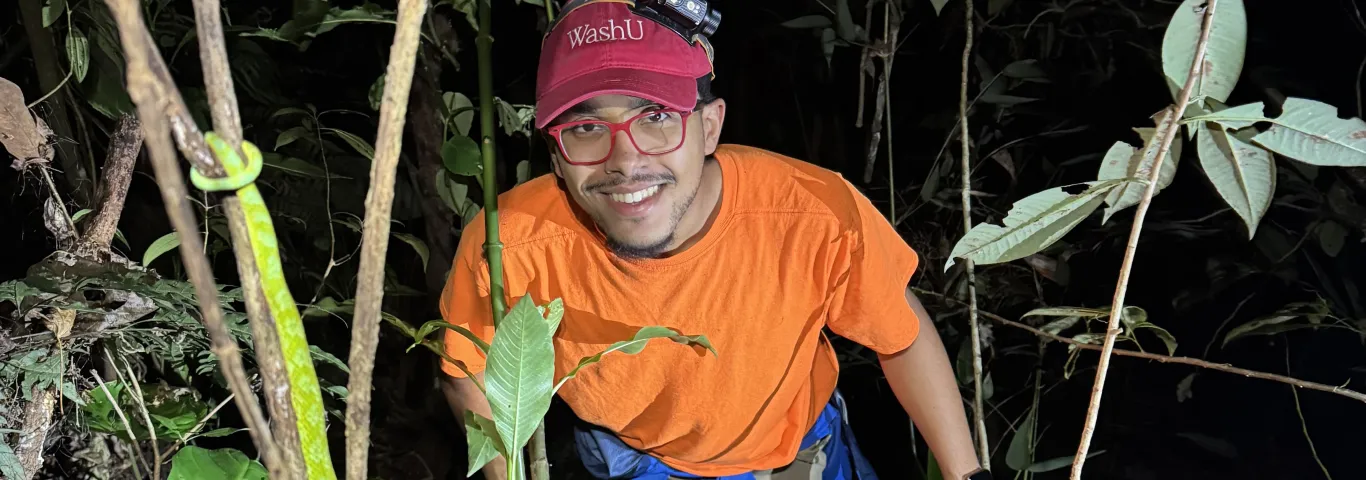
Guided by graduate student Tasman Ezra, a WashU undergraduate turns classroom skills into field research and gains a deeper understanding of what it means to be a scientist.

Before I met Tasman Ezra, a graduate student in the Department of Biology, I never imagined I would someday find myself searching for venomous snakes in a Honduran jungle in the middle of the night. But there we were, outfitted in boots, raincoats, and headlamps as we crept through the thick, wet vegetation looking for rare reptiles and amphibians that cannot be found anywhere else on Earth.
Outside of a class or two, I hadn’t done much scientific research during my first few years at WashU. I’ve always been passionate about both of my majors, biology and statistics. When I discovered the Predicting and Mitigating Human-Snake Conflict in Honduras research project through WashU’s Center for the Environment, I knew it would be a great fit.
Tasman, who works in the laboratories of Jonathan Losos and Elizabeth Mallott, served as my guide and mentor. With his help, I’ve learned to combine statistical research with on-the-ground jungle expeditions. For my statistical work, I obtain geographic data for various venomous snake species in Honduras. I then trained machine-learning models with climatic data to predict and map the likely distribution of each snake species. Then, I combine this data with other information, such as hospital locations and population density, to generate risk maps showing where conflict between snakes and humans is most likely to occur. I do this for each venomous snake species reported in Honduras, tweaking my code as needed.

The fieldwork in Honduras is another world. Throughout the midday and afternoon, Tasman and I would talk to the community about the importance of conservation. We spoke with locals who own land and officials who work directly for the ICF, or Instituto de Conservación Forestal.
But most of the work was done late at night. Tasman, other team members, and I would spend each night walking quietly through the jungle, looking for a flash of a snake, frog, or other herptile, the collective name for all reptiles and amphibians. Once we found a herptile, we would detail its behavior, location, the outside temperature, and the time of day — the same type of data I had been using to create these snake models. Observing these environments and animals in person improved my programming work. Instead of thinking of the climate and biome data as abstract variables, I could return to my work with a real visual of the animals and ecosystems I am modeling.
Tasman taught me that researchers need to be flexible. You can create a detailed plan, but the reality usually turns out to be different. I learned to be prepared to deviate from the plan during the research process, whether that means writing new code after running into an unexpected error message or shifting the focus from one type of amphibian to another after an unexpected rainstorm. I have also learned the importance of patience and determination. When I run code for my statistics coursework, my computer can usually complete anything within a few seconds. However, my species modeling programs can take hours. I have learned to optimize my time, anticipate my next steps, and remember that the result I expect may not be what I get.

This experience has made me grateful for the breadth of knowledge needed to complete my education at WashU. I had taken Spanish classes here mainly to fulfill requirements for my Arts & Sciences degree, but I ended up using what I learned to communicate and navigate in a Spanish-speaking country. Talking about these venomous snakes with the locals was the most meaningful experience of this whole research experience for me.
I hope that others at WashU can find and appreciate such opportunities. On any project, there are always going to be aspects that you feel confident about thanks to your rigorous studies. But no matter how prepared you are, there will be novel, exciting twists that you get to explore for the first time. If you’re feeling unsure, remember that your unique perspective and experiences will guide you through.


