
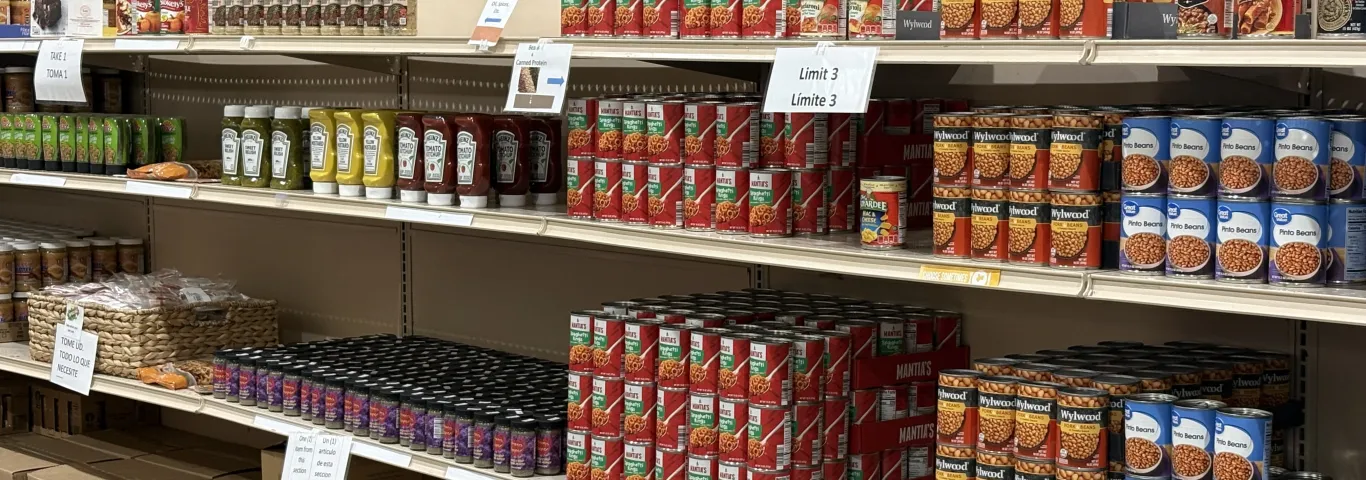
WashU’s St. Louis Policy Initiative is tracking where food pantries are located across the region to identify gaps in access and prepare for future shortages.
During the 2025 federal government shutdown, St. Louis food pantries faced a precarious moment.
The Supplemental Nutrition Assistance Program (SNAP) program, which provides crucial food benefits for low-income families, was set to lose its funding on November 1, 2025. With more than 47,000 households in St. Louis County and another 31,000 households in St. Louis City receiving SNAP benefits, the region’s food pantries braced for a potential surge in demand.
What no one could predict was where that demand would fall, or which pantries would be able to absorb it. There wasn’t comprehensive data available on where the need would be greatest, and it wasn’t clear which food pantries had the capacity to take on new clients.

“The government shutdown brought into focus the vulnerability of our region,” said Angela Gabel, executive director of the Ritenour Co-Care Food Pantry. “What crystallized was that we really need to have a plan in place for inevitable disasters, whether that’s a political disaster or an environmental disaster.”
While SNAP funding was restored in November, averting an immediate crisis, Gabel wanted to better understand the lay of the land before the next emergency arrived.
“The tools that exist can show us where food pantries are located,” Gabel said. “But we don’t know if that food pantry is taking new clients. We don’t know when that food pantry is open – that could be once a month, or once a week for two hours. And we don’t know what kind of food they provide. Pantries give out what they have, even if it’s just a box of carrots and tomato juice.”

To address those questions, Gabel and some of her fellow food pantry directors turned to the expertise of her husband, Matthew Gabel, a professor of political science at WashU. Alongside Andrew Reeves and Scott Krummenacher, Gabel leads the St. Louis Policy Initiative research group. His team helped to launch the St. Louis Dashboard, a powerful online tool that can cross-reference regional data from the U.S. census, election precincts, school districts, and more. Both Arts & Sciences and the Provost’s office have provided key support for this initiative.
Working with his St. Louis Policy Initiative colleagues and a team of scholars in the Weidenbaum Center, Gabel began developing a map designed to reveal “food pantry deserts” — areas where need far outstrips resources.
“Already with the map we’ve created, there are spots where you see those gaps,” Matthew Gabel said. “Just south of the city, around Mehlville, there’s a significant, relatively poor area with no food pantry. You see the same thing in northwest St. Louis and near Normandy. But when you look at the city, you can’t even see the ground; there are so many dots on the map for food pantries.”
Matthew Gabel describes the current draft as a “beta” version, reflecting the complexity of the data. A single map, he explains, can’t capture how access shifts day by day.
“One approach would be to say, ‘Here’s a map for Mondays,’” Matthew Gabel said. “If you live in this part of St. Louis, and you need food on a Monday, you’re in a food pantry desert. But if it’s a Tuesday, it’s not a food pantry desert, because there are four pantries open. You could have seven of these maps, one for each day of the week.”
The exercise underscores a larger point: Food access depends on timing, transportation, staffing, inventory, and funding, variables that can change quickly in a crisis.
Strategic planning tools like the pantry map are going to prove essential in the years to come, Angela Gabel said. While she can’t predict upcoming natural disasters or government shutdowns, she knows that the future of SNAP is extremely delicate.
“In October 2027, there will be a major shift in the way that SNAP is funded, and individual states will respond differently to it,” Angela Gabel said. “I would like to think that services will remain the same, but we must have a plan in place for anything that occurs.”


