
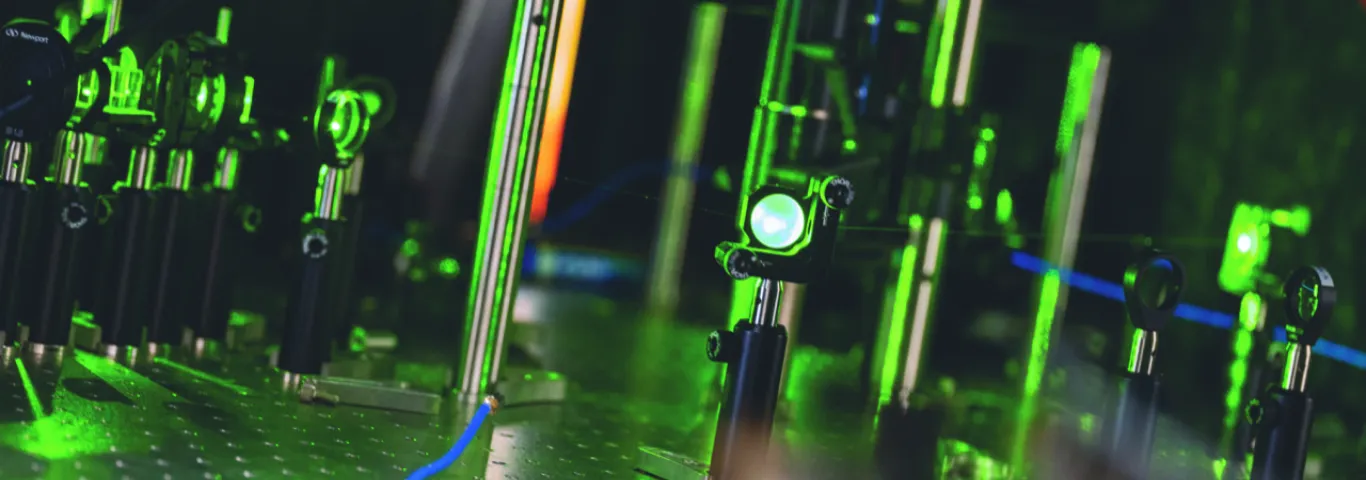
Arts & Sciences researchers use quantum technology to measure magnetization of a lunar sample from the Apollo 11 mission.

In an exercise that shows the potential of quantum sensing, Arts & Sciences researchers used their quantum diamond microscope — a device that runs on a flawed diamond crystal — to measure the magnetic properties of a tiny piece of Moon rock.
“The quantum diamond microscope is a unique device,” said Chong Zu, an assistant professor of physics and a fellow of the Center for Quantum Leaps. “We’ve shown that it can directly measure magnetic fields in a rock sample in ways that no other technology can do.”
The study, supported by the Center for Quantum Leaps and the National Science Foundation, including an NSF Research Traineeship Linking Quantum Sensing Technologies across Disciplines (NRT LinQ) research grant, was highlighted in Physical Review Applied. Co-authors include Chuanwei Zhang, the Wayman Crow Professor of Physics and co-director of the Center for Quantum Leaps; Zoltán Váci, a postdoctoral researcher in the Department of Earth, Environmental, and Planetary Sciences and a fellow of the McDonnell Center for the Space Sciences; undergraduate student Yue Yu; former undergraduate Yinyao Shi, AB ’24; and physics graduate students Changyu Yao, Yizhou Wang, and Zhongyuan Liu.
Quantum diamond microscopes (WashU owns two) rely on tiny flaws in a diamond crystal. Researchers create these imperfections by bombarding the diamond with nitrogen ions, knocking carbon atoms out of place. The resulting vacancies trap electrons that are extremely sensitive to changes in the surroundings, especially magnetic fields.
Unlike other sensing technologies, such as electron microscopes that infer magnetic fields through indirect measurements, the quantum diamond microscope measures magnetism directly. The technique is also noninvasive, meaning the sample remains intact while its hidden magnetic history is revealed.

WashU has long been a leader in lunar research, and the university is home to a significant portion of the Moon rocks returned by the Apollo 11 mission. The particular piece of rock used in this study came from the collection of Stanford University, but it still made sense to combine two of WashU’s strengths — quantum sensing and lunar science — into one study, Zu said.

The small lunar sample exhibited a faint magnetic field, a remnant of the much stronger field that once enveloped the entire Moon. Using a GPU-accelerated algorithm newly developed by the team, this signal was transformed into a detailed magnetization map, revealing a hidden record of the Moon’s ancient magnetic environment.
“Magnetism is an important part of the Moon’s history,” Zu said. “It once had its own magnetic field, but that field disappeared for reasons that aren’t clear to us.” Future tests using samples collected from other parts of the Moon could help shed light on the Moon’s magnetic history and perhaps explain why the magnetic field vanished.

Life on Earth is made possible, in part, by the strong magnetic field that shields the planet from harmful cosmic rays, Zu explained. Understanding the history and fate of magnetic fields on other planetary bodies could offer important insight into such protection that separates a living planet from a lifeless one, he said.
“I’m hoping we can use our microscope to help answer some important questions about the Moon,” Zu said. “Once NASA brings samples back from Mars, we could study those as well. It’s exciting to apply this quantum technology to planetary science.”
Header image: One of WashU’s quantum diamond microscopes


