
Across literature, history, psychology, and culture, students explore how societies shape what it means to be a kid.

Children are just mini adults. Children’s books are simple, unworthy of literary study. You don’t have to take children seriously until they become whoever it is they are going to be.
These are some of the myths and outdated assumptions that the minor in Children’s Studies challenges, according to Teaching Professor in English Amy Pawl. The interdisciplinary program, founded in 2008 by Gerald Early, the Merle Kling Professor of Modern Letters, examines the ways that various fields of inquiry are transformed when children are placed at the center. In 2023, the program was moved from the Center for the Humanities to the English department, where it is now housed.
Abram Van Engen, the Stanley Elkin Professor in the Humanities and English chair, sees the minor’s current home as a perfect fit. “By definition, children's literature is an interdisciplinary hub. It’s not just about English; it's psychology, it's education, it’s history, and many other subjects,” he said. “We are delighted to house the program to show that literature reaches out to all of these other things. Children's literature is just one way into the wider world of understanding childhood.”
Pawl, who has been involved with the program for many years and became the director in 2023, believes that it provides a rare perspective to undergraduates. As they take classes in many different disciplines over their course of study, they come to have a unique understanding of childhood. “I teach the senior seminar, and students arrive with the notion that children are centrally important beings who have their own ideas and agency.”
Though some students chose WashU specifically for the minor, others come to it another way. They find a class that interests them, and through that, discover both the field and the minor.

Nupur Shah, a senior studying philosophy-neuroscience-psychology on the pre-med track, didn’t know that children’s studies was offered at WashU until her sophomore year. But after her first course, “Interdisciplinary Introduction to Children’s Studies,” taught by lecturer Danielle Ridolfi, she was hooked and made it her minor. “If it were a major, I’d probably be doing that, too,” she said.
For her, there’s value in studying children through various disciplines, even those that don’t directly intersect with her hopes of working in medicine. “I’ve been able to see how the idea of a child has developed through history and across cultures,” she said. “It helps me step into the shoes of children and be more open-minded when thinking about how I interact with them as human beings.”
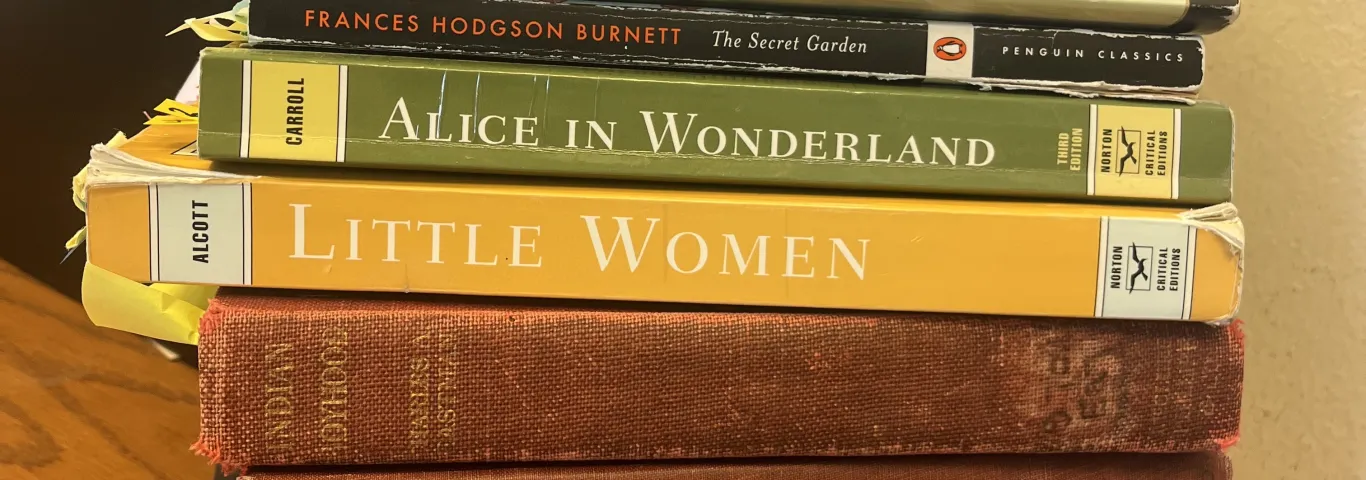
One of the most popular courses is “Golden Age of Children’s Literature,” taught by Pawl. The course covers British and American literature in the late 19th and early 20th centuries and touches on many genres. The class examines such classics as “Treasure Island,” “Alice in Wonderland,” and “Little Women,” and also reads less familiar works, including “The Brownies’ Book” and “Indian Boyhood.” Students are asked to explore the stories’ portrayals of children and the assumptions about childhood that shape them. Pawl encourages students to look at well-known works with new eyes.
“Children’s Studies helps me step into the shoes of children and be more open-minded when thinking about how I interact with them as human beings.” — Nupur Shah
Another popular children’s studies course is “Children’s Picture Books: Culture and Content,” taught by Ridolfi, a lecturer and professional children’s book illustrator. Other core courses are cross-listed under African and African American studies, American culture studies, psychology, and education.
The program’s newest initiative is the “Children’s Studies Bookshelf,” a physical shelf in the English department and a virtual one online. Each month, a curator from a different field selects books around a specific theme. The topics vary widely, but all featured titles are created for young readers. The first collection, curated by Pawl, is titled “New Girls in Motion: Trends in Progressive Era Popular Fiction (1900–1920)” and highlights adventurous stories about girls, a shift from the domestic and family-centered books aimed at girls in earlier periods.
Though many students in the program study English, there’s a wide variety of majors among students in the program, including anthropology, biology, education, and psychological and brain sciences.
Shah sees the minor as a complement to students of all disciplines. “As a STEM major, these classes provide balance,” she said. “Even if you don’t have a future working with children, we were all children once, and we all interact with them. I’ve been able to learn so much about myself and about growing up.”


