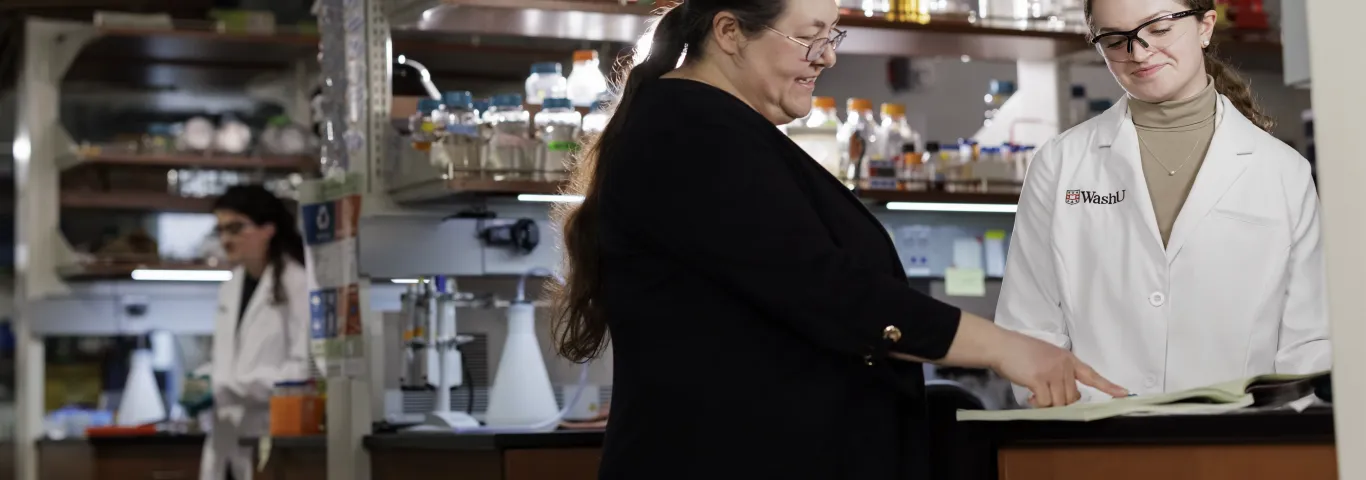
Meredith Jackrel and her team devised a new high-tech method to generate an enzyme that can break down misfolded proteins that cause neurodegenerative disease.
In an advance that could one day lead to new treatments for neurodegenerative diseases, Meredith Jackrel, an associate professor of chemistry, and her team have developed a method to rapidly produce and screen a class of “disaggregase” enzymes that can break down the misfolded proteins associated with ALS and Parkinson’s disease.
“Disaggregases have a lot of promise, but previous methods for producing and identifying them were extremely slow and tedious,” Jackrel said. “Our new method is a significant step forward.”
The study was published in the prestigious journal Molecular Cell. The lead author is Jeremy Ryan, PhD ’23, a former graduate student in Jackrel’s lab who is now a scientist at Bayer. Other co-authors include postdoctoral researcher Anuradhika Puri; staff scientist Macy Sprunger, PhD ’23; graduate students Karlie Miller, Madalyn Bochantine, and April Lopez; and several former undergraduate students.

Jackrel and her team focused on Hsp104, a disaggregase enzyme naturally found in yeast. The enzyme is known as a disaggregase because it can break apart aggregates of proteins. Yeast uses the enzyme for protection from heat and other stresses, but it also has the power to dissolve proteins, including TDP-43, a misfolded protein that clumps in the nervous systems of people with ALS, and α-synuclein, which accumulates in Parkinson’s patients. “Not only does Hsp104 break down the misfolded proteins, but it can also help them to refold, which can restore healthy cell functions,” Jackrel said.
Using an engineering strategy, the team produced a “library” where they introduced many different mutations into a region of Hsp104, and then introduced this library into yeast. In this way, each yeast cell makes a different version of Hsp104. Some varieties are more potent than others, but previous methods for identifying versions of Hsp104 with optimal features were tedious and impractical.
“You can grow yeast colonies on a plate and pick them up with a toothpick,” Jackrel said. Researchers can then use DNA sequencing to identify promising versions of Hsp104, but it’s a painstaking process that only allows them to analyze at most a few hundred versions at a time.
As described in the new paper, Jackrel and her team have found a way to rapidly produce, identify, and sort the versions of Hsp104 that can break down misfolded TDP-43 or α-synuclein. “We start with the wild-type Hsp104 gene, and then we introduce mutations to create tens of millions of variations,” Jackrel said. “We’re building a vast library of possibilities.” The team then used deep sequencing, a highly sensitive process that sequences many fragments of DNA all at the same time, to identify mutations. “We can essentially look at the entire population at once and see which versions of Hsp104 work well in some situations and not in others,” she said.
Not every version of Hsp104 in the new library will be any more effective than previously known varieties, but the new system allows researchers to analyze many more versions of Hsp104 at once, making it much easier to create and search for new and improved disaggregases, Jackrel said. The new versions that emerged from this process have several characteristics that make them more promising than earlier versions of Hsp104.
TDP-43 is already a top target for scientists and pharmaceutical companies. In addition to playing a fundamental role in ALS, it’s also associated with dementia, including some forms of Alzheimer’s disease. So far, efforts to develop drugs that clear the protein or slow disease progression have been unsuccessful.
It will likely take years of further experiments and fine-tuning before Hsp104 could be considered a potential therapy for ALS, Jackrel said.
“We know that buildups of misfolded TDP-43 and α-synuclein are important in the development of neurodegenerative disease, so anything that can reverse that buildup could be helpful,” Jackrel said. “Hsp104 could be a part of the answer, so this is a major accomplishment for our team.”