
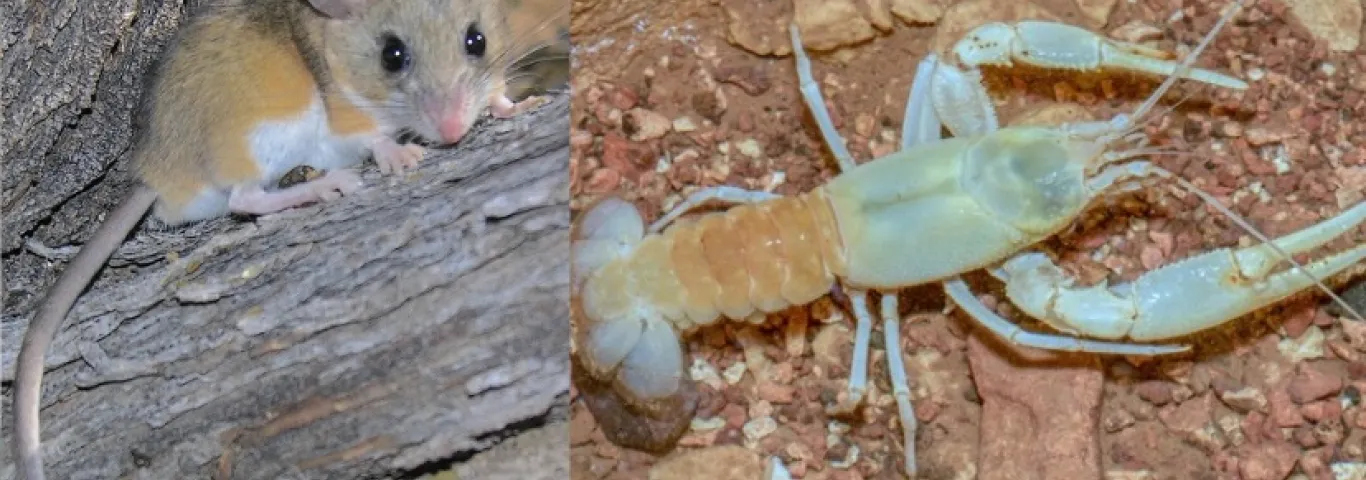
By studying two very different animals, Andreas Kautt is uncovering the genetic changes that help species adapt and diversify.
Deep in a cave in the Missouri Ozarks, a ghostly crustacean blindly grasps for food in total darkness. Illuminated by a flashlight, the Bristly Cave crayfish shines white and nearly translucent. Cut off from sunlight for thousands of generations, cave crayfish have lost their need for vision or pigment.

For spelunkers, cave crayfish are a rare sight. For Andreas “Andi” Kautt, an assistant professor of biology, they are an exciting example of evolution. “Missouri is a biodiversity hotspot for crayfish,” Kautt said. “We have about 40 different species in this state, including at least three separate species that have totally adapted to living in caves. How cool is that?”
Kautt arrived at WashU in 2024 after focusing his postdoctoral research on the genetic makeup of deer mice, the most abundant mammal in North America. Mice are still a key part of his scientific repertoire, but the move to St. Louis brought a new, very different creature to his attention. “I heard that Missouri is home to a lot of freshwater environments that support all sorts of crayfish, and I was immediately intrigued,” he said. “Crayfish turned out to be a great model for studying how animals adapt to their environment.”
At first glance, deer mice and crayfish could hardly be more different. One is a small, furry, terrestrial vertebrate; the other is an aquatic invertebrate that wears its skeleton on the outside. Yet they have more in common than their looks suggest. Both are small, both are often the most abundant animal where they live, and both are quietly essential to their ecosystems.
And both are strikingly diverse. Crayfish have diverged into species suited to crystal clear Ozark streams, muddy swamps and ditches, elaborate underground burrows, and lightless caves, while the billions of deer mice in North America vary just as dramatically across their range.
“You can find deer mice from coast to coast and from Mexico to Alaska, but they aren’t all the same,” Kautt said. “They have different coloration to help them blend in with their habitat, whether it’s prairie or forest.” Their behaviors, including boldness around predators, feeding strategies, and the ability and willingness to climb trees or dig burrows, also vary widely from population to population, exemplifying the flexibility and adaptability of the species.
For Kautt, that shared mix of abundance and diversity is exactly what makes deer mice and crayfish powerful tools for the same question: How does evolution generate diversity?
That diversity starts with the genes. Kautt is the co-author of an upcoming paper exploring the deer mouse pangenome, a comprehensive repertoire of the genetic makeup for a single species. A pangenome contains important genomic information that could be missing from so-called reference genomes collected from a single individual. In the case of deer mice, the full slate of genes underscores a remarkable variety befitting a species that can thrive in many different environments.

One of the most striking findings is the number of copies of a given gene from one mouse to the next. This copy-number variation is especially pronounced among olfactory receptor genes, the genes that build a mouse’s sense of smell. “For an animal that reads its world largely through scent, that is a tantalizing lead,” Kautt said. His lab is using this variation as an entry point to trace how differences in genes give rise to differences in neural circuits, and ultimately to differences in behaviors, such as avoiding predators, choosing habitats, or recognizing a mate.
At WashU, Kautt and his team remain deeply invested in the genetics and behaviors of mice, but they’re also exploring the genes of crayfish, animals with an equally compelling story. “As evolutionary biologists, we’re interested in how animals adapt and how species diverge,” he said. “Crayfish are especially interesting because multiple species have evolved separately to fit particular habitats.”
Kautt and his group are planning to generate genome assemblies for all of Missouri’s roughly 40 crayfish species. “We’ve already collected samples from every species, which is a key first step,” he said. “Very little work has been done on crayfish genomics, so that’s something that we’re excited to explore.”
The Bristly Cave crayfish looks much like the Salem Cave crayfish, and much like the blind, colorless cave crayfish found in other parts of the country. That resemblance points to one of evolution’s most remarkable phenomena: Cave life has arisen multiple times independently. Genome assemblies should finally make it possible to work out how Missouri’s cave crayfish are related, and to pinpoint which genes are lost, or simply switched off, as the animals give up their pigment and sight.
As some traits were lost, others were gained. For example, cave crayfish have especially long antennae, which likely help them find food in the dark. Further research is needed to see how living in darkness affects other fundamental qualities of crayfish, such as longevity and circadian rhythms.
Kautt hopes that a deep dive into crayfish genomics will help explain the wide range of behaviors as well as appearance. The crustaceans may not seem like deep thinkers, but different species have very different ways of going about their days. “Some crayfish live in crystal clear streams where they eat insects and decaying plants, while others live in mud burrows deep underground,” he said. Through careful comparison, Kautt aims to identify the genes and genetic variants that determine the lifestyles of every species.
Mice and crayfish may not have much else in common, but they both show the possibilities of evolution, and they both have a home in the Kautt lab. “We’ve already made surprising progress in the few years since I arrived,” he said. “I’m looking forward to the next steps.”


