
The graduate student works at the limits of pressure and temperature to create diamonds, advance quantum science, and launch a business venture.
Zack Rehfuss, a graduate student in the Department of Physics, relishes the wild and often unexpected ways that elements behave when pushed to their limits. That includes developing quantum sensors that can survive forces up to 300,000 times greater than Earth’s atmosphere, or studying materials at ultra-cool temperatures just north of absolute zero.
“If you think about it, the Earth isn’t the best laboratory for a lot of our research,” Rehfuss said. “Conditions in most of the universe aren’t anything like ours.”
Working closely with his advisor Sheng Ran, whom he met as an undergraduate at the University of California, San Diego, Rehfuss’ studies have become increasingly focused on the potential of diamonds.

With their unique physical properties, diamonds are one of the few materials that can withstand the brutal pressures and temperature shifts of Rehfuss’ Compton Hall laboratory. That durability makes them a critical part of two powerful microscopes that are leading WashU’s charge into the quantum realm.
“Diamond is the most thermally conductive solid material that exists,” Rehfuss said. “It’s also the hardest solid material, and it’s one of the most electrically insulating substances. It’s the perfect base for something that will never break, always stays the same temperature, and won’t short things electrically because it doesn’t conduct electricity.”
That fascination with diamonds has paid unexpected dividends for Rehfuss. In collaboration with other WashU students and faculty, he’s helped to develop a novel diamond fabrication technique that has led to an academic paper and — with the support of a National Science Foundation Research Traineeship (NRT) grant — a new startup.
At the core of Rehfuss’ work is electron beam lithography, a technique that uses a focused beam of electrons to etch nanoscale patterns onto materials. The method typically works on flat surfaces, but applying it to the faceted surface of a diamond required a new approach.
“When Kaiwen told me that Zack patterned his wedding vows on the faceted surface of a gemstone, I realized that their technology could be much more broadly applied than just high-pressure research.” —Kater Murch
Rehfuss teamed up with fellow graduate student Kaiwen Zheng, a specialist in precision fabrication, to develop a custom protocol that keeps the electron beam in focus across a three-dimensional surface.


“Instead of focusing the electron beam writer one time, we focus it several times with different dose profiles at different heights to write on a 3D object,” Rehfuss said.
The team also had to address charge buildup during lithography, since diamonds are powerful electrical insulators. They solved the problem by adding a carefully calibrated layer of metal.
Once the technique was working, Rehfuss created a demonstration piece that quickly caught the attention of Kater Murch, Zheng’s faculty advisor and then the co-director of WashU’s Center for Quantum Leaps.

“When Kaiwen told me that Zack patterned his wedding vows on the faceted surface of a gemstone, I realized that their technology could be much more broadly applied than just high-pressure research,” Murch said.
Murch connected Rehfuss and Zheng with WashU’s NSF-supported traineeship program, Linking Quantum Sensing Technologies across Disciplines (NRT LinQ), launched in 2022 with a $3 million National Science Foundation grant to help prepare graduate students for careers in the quantum sciences. Through the program, Rehfuss and Zheng received $25,000 and launched FacetLab, a company that custom manufactures patterned diamonds for scientific research. Rehfuss, Zheng, Murch, and Sheng Ran serve as the company’s co-founders.
“The NRT gave us a little bit of time and the resources to make this happen,” Rehfuss said.
FacetLab now works with a small roster of clients, though Rehfuss plans to keep the company relatively small while he and Zheng complete their degrees. He also sees potential for commercial jewelry applications, including custom inscriptions on diamonds, much like the wedding vows he etched during early testing of the technique.
“If someone wants to pay us for our services, we’re happy for that,” Rehfuss said. “But, to me, the science is much more important.”
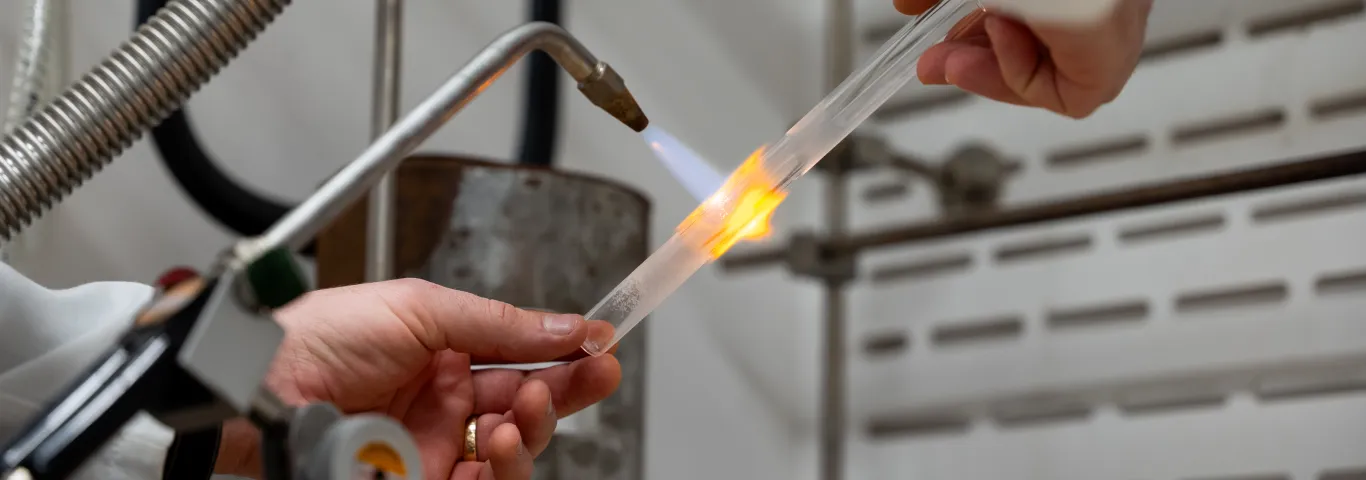
Header image: Rehfuss prepared a quartz tube for crystal growth in an inert argon environment. Sealing the materials this way prevents unwanted reactions with oxygen at high temperatures, allowing high quality single crystal samples to form for later study of their physical properties. (Credit: Sean Garcia)


