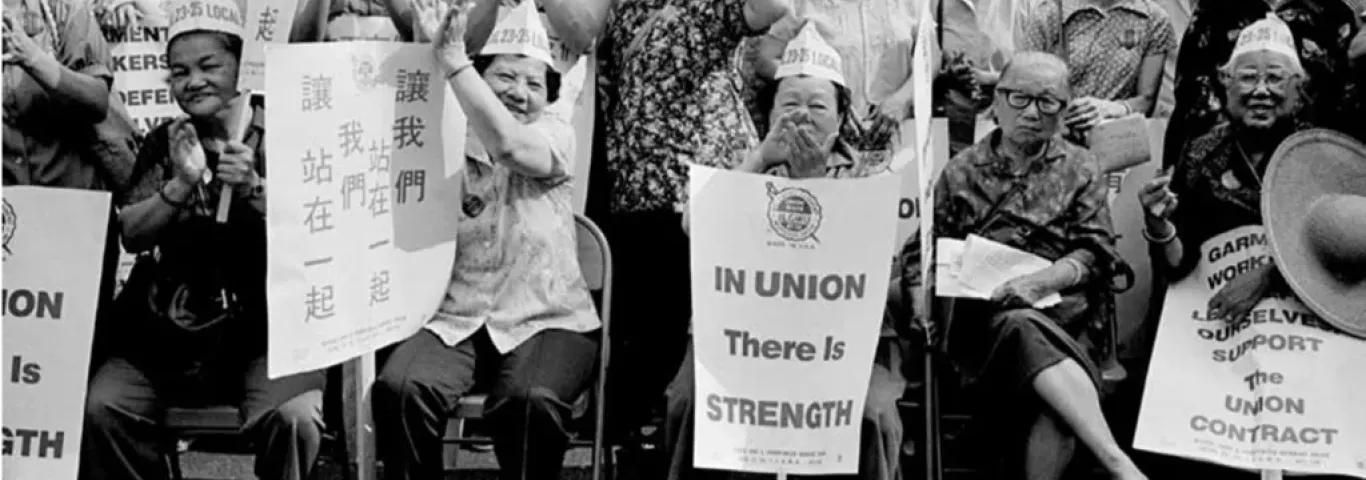
Undergraduate Maggie Lu delved into the largest and most successful Asian American strike and discovered personal links along the way.

Over the summer, Maggie Lu, a senior majoring in American Culture Studies and Sociology, used the Department of American Culture Studies’ Asian American Studies Summer Research Award to conduct archival research in New York. The department awards the grant each year to support summer research and travel, with applications due May 1. With additional support from the Lynne Cooper Harvey Undergraduate Scholars program, the experience sparked her senior thesis on the 1982 International Ladies’ Garment Workers’ Union Chinatown strike, a story that hit closer to home than she expected.
She spoke with the Ampersand about her research trip, what it’s like to do an undergraduate thesis, and how she plans to share her work with a larger audience.
How did you decide to pursue this type of research?
I started as a political science major, but I found I was less interested in quantitative research and more interested in social structures, which led me to sociology. Throughout my coursework, I discovered that I enjoyed the research skills used in sociology, while American Culture Studies and Asian American Studies (my minor) offered the kind of content that truly inspired me. I also loved a course I took in AMCS and history about the American labor movement, which is how I first heard about the 1982 International Ladies’ Garment Workers’ Union Chinatown strike. This topic combined my interest in labor studies with my focus on Asian American studies.
What did you find on your research trip?
I went to New York to visit the Tamiment Library at New York University and the Kheel Center for Labor-Management Documentation & Archives at Cornell University. There, I was able to review union records, oral histories, photographs, propaganda, and memorabilia. There were union newspapers and union songbooks translated from English to Mandarin. This was at the peak of union power, right before they started to lose influence when globalization and imports increased. This strike was a chance for the union to show what it could do, and for women workers to show what they could do, too.
What made this strike unusual?
This strike was the largest strike in Asian American history — not just the largest female-led, but overall, with 20,000 workers participating. And it was the most successful. It was also organized through unconventional means. The garment factories were incredibly communal spaces, where the female workers worked for the brothers-in-law, husbands, and fellow Chinese community members who owned the garment factories. Union presidents were often white men. So there was a clash between the family structure and the union organizing. It was a really difficult decision for the women to strike.
Much of the organizing was done in new ways. The union would broadcast over the radio frequency played in the factory and blast information about workers’ rights. They spread information over the phone and at grocery stores. They hosted events like skincare, hair, and cooking lessons, where women would hear about their rights.
“This strike was a chance for the union to show what it could do, and for women
workers to show what they could do, too.”
How did you deal with the language barrier?
Many of the union documents are translated, but I also have working proficiency in Mandarin, not to read, but when I hear it aloud. There are apps that help with that, but I also relied on my father, who is a native Mandarin speaker. He came to the United States in the 2000s to work as a chemist in the textile industry. I didn’t make that connection until I was midway through the project, and I mentioned something about a fiber, and he told me his company produced that fiber. It didn’t even occur to me that he was in the same industry as the strike.
He helped me find cultural nuances that I would have missed. For example, he was helping me translate some of the union songs, which are written in very flowery language. The English version was something like, “Remember that these funds are going to help run the house and raise the kids.” But when it was changed to Mandarin, my dad said it was more like, “Who will look out for the children’s education and the children’s future?” For Chinatown workers, who had made huge sacrifices in coming to the U.S. to ensure their children’s future, the most important thing wasn’t household management, it was ensuring the future success of their children. These little changes are enormously culturally relevant.
How has the Harvey Scholars program supported you in your thesis?
The Lynne Cooper Harvey Undergraduate Scholars program brings together AMCS majors who are all working on a senior thesis. It’s been wonderful in helping me take on the incredibly daunting task of a project that takes a whole year. We had to have our proposals done before the summer of our senior year, and as soon as the school year began, we started writing, with a certain number of pages due at different points along the way. We meet with our advisor and peers about every draft along the way. It’s probably the first time I’ve gotten such challenging critiques on my writing, but it’s because they want us to produce the best work. I’m incredibly grateful for this structure keeping me on track.
What’s next for you?
I’m considering taking some time off to work in the museum industry, which I did during the summer of 2025 at the Missouri History Museum. I think it’s vitally important to understand public history and how to communicate to an audience outside of academia. The Harvey Scholars program requires us to turn our work into a public-facing project, so I’m in the process of creating a miniature exhibition on campus of my work.
Eventually, I hope to attend graduate school. This research process showed me how much I enjoyed taking full ownership of my own research and diving deeply into a topic that truly resonates with me.