
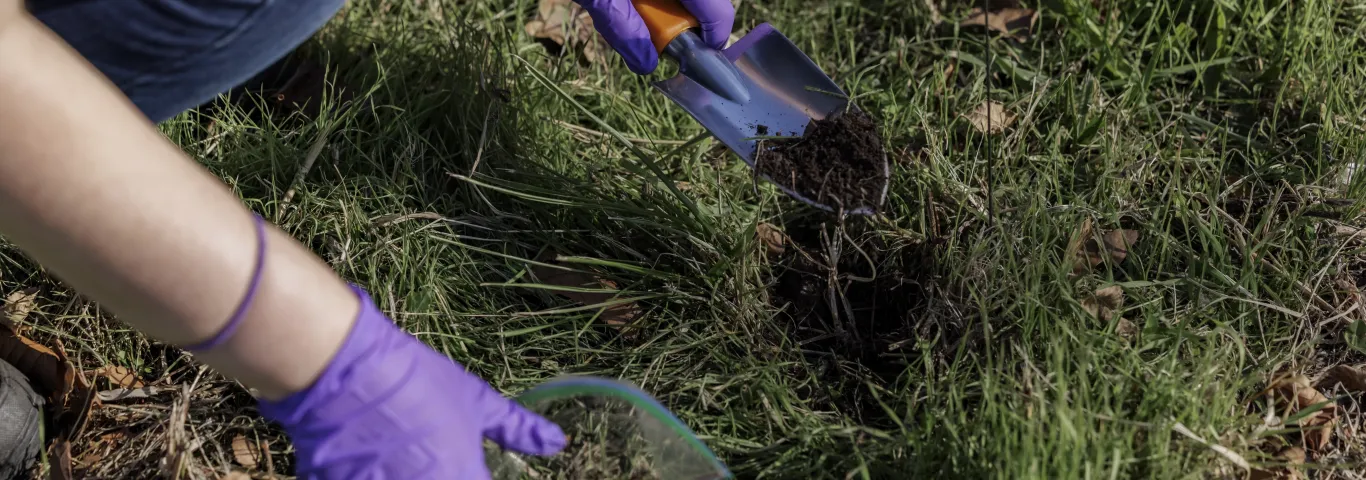
Jeffrey Catalano leads an effort to test lead levels in St. Louis soil.

The EF-3 tornado that touched down in Greater St. Louis last May left a 20-mile path of destruction. It knocked down trees, snapped power poles, and severely damaged hundreds of houses and apartment buildings from DeBaliviere Place to the North Riverfront, as well as the Wydown neighborhood in Clayton.
Much of the obvious debris has already been cleaned up, but the disaster may have left behind a hidden threat that could linger for many years. “We’re concerned that the tornado may have released lead into the community,” said Jeffrey Catalano, a professor of Earth, environmental, and planetary sciences. To address that concern, Catalano has joined CLEAN STL, a project that will test soil and air samples in the tornado’s path for lead, an insidious contaminant that is often left in the wake of floods, fires, and other destructive events.
CLEAN STL is the inaugural project of WashU Public Exchange, a new initiative of the Brown School that aims to harness the expertise of WashU researchers to address challenges across the city. Other CLEAN STL members include Sheretta Butler-Barnes from the Brown School, Dan Giammar and Jay Turner from the McKelvey School, and Matthew Bernstine from the Sam Fox School. The project is working in cooperation with St. Louis community groups representing neighborhoods in the tornado’s path. Better Family Life has been a key partner from the beginning, and 4theVille and LOVEtheLOU have also recently signed on to join the project.
With the help of a small team of undergraduate researchers trained to collect and analyze soil samples, Catalano hopes to clarify the levels of the invisible contaminant. “Lead exposure can be a serious but often overlooked consequence of a natural disaster,” Catalano said. “We can’t know the true impact of the tornado until we’ve tested the soil for lead.”
As Catalano explained, urban lead pollution has two major origins: leaded gasoline that fueled cars in past decades and leaded paint on old houses. Lead from car exhaust, paint chips, and house dust settles in the soil. From there, it can reach the children who walk, play, and breathe nearby. “We know that children who live near soil contaminated with lead have elevated levels of lead in their bloodstreams,” Catalano said. “Lead has been shown to impair cognitive development, so this is a significant threat.”
St. Louis has an abundance of old houses that were originally coated in lead paints, Catalano said. Those coats of paint pose little risk as long as they stay on walls and siding, especially if they’ve been covered with new coats of unleaded paint. But a windstorm that destroys houses could potentially release old bits of paint, creating a new hazard for local children.


In November, three WashU undergrads — Norah Alhusayni, a senior majoring in environmental biology; Ellie Kreft, a senior majoring in environmental science; and Charlie Rosser, a junior majoring in environmental science — started collecting soil samples in the Hamilton Heights neighborhood in support of Better Family Life, with future work planned in The Ville and other neighborhoods of North St. Louis.

“I signed up for the project because I’m really interested in environmental health issues, especially in marginalized communities,” Alhusayni said. “I saw this as an opportunity to do my small part to make a real impact.”
After receiving training in sample collection, Alhusayni and the other students meticulously gathered soil samples from affected neighborhoods. Following the principles of environmental analysis, they had to be precise about the location of each sample, the only way to clearly document any trends or variations between sample sites. The actual clumps of dirt were easy to collect, Alhusayni said. “The ground was wet, so we didn’t need to worry about inhaling any dust that might contain lead,” Alhusayni said.
Catalano’s team finished sampling nearly all of the properties in support of Better Family Life, with the remaining few sites to be sampled in February, followed by work in The Ville, weather permitting. He’s grateful to have help from Alhusayni and the other students who are all eager to go out in the community and get their gloves dirty. “All three of the students had taken my Soil Science course, and this was a great chance for them to get practical experience in the field,” Catalano said. “They all did great work.”
The actual sample analyses are ongoing, but Catalano hopes to have the first results in February. It’s too early to know if the tornado had any real effect on lead levels in St. Louis soils. If the tests reveal dangerous levels of lead in a neighborhood, the city could consider potential remedies, including removing or covering up the upper layers of soil. “We already know that lead levels are generally high throughout the city,” Catalano said. “We may find that the tornado didn’t worsen the situation, but it’s important to know for sure.”
Header image: The team gathered soil samples to test lead levels. (Credit: Whitney Curtis)


