
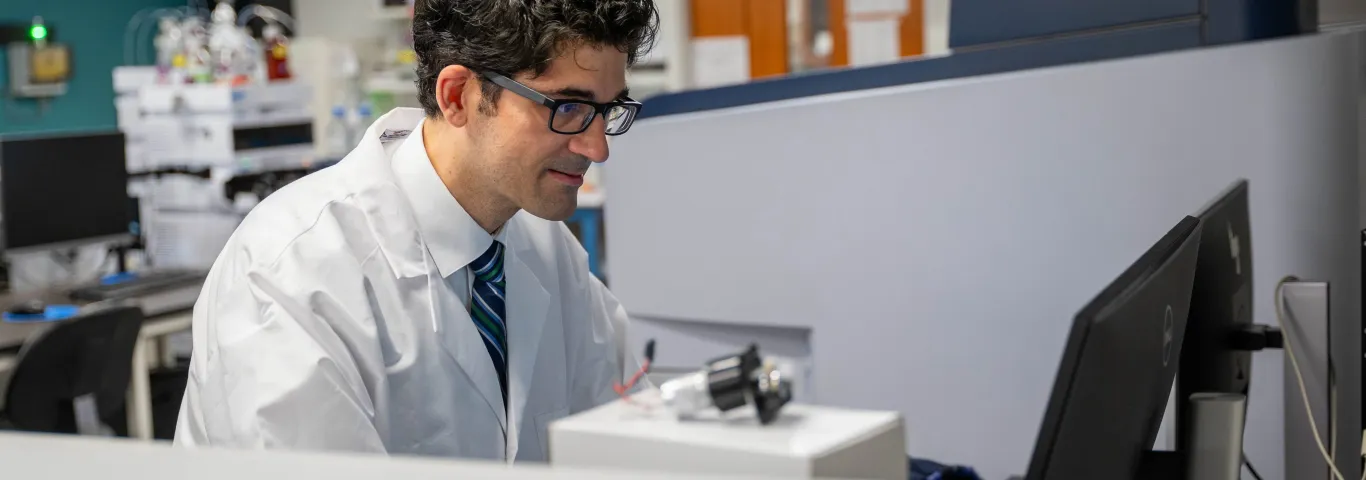
Cancer cells are ravenous eaters. Gary Patti is trying to turn their hunger against them.
By their nature, cancer cells have different nutritional needs than healthy cells.
“Cancer cells have a distinct metabolism,” said Gary Patti, the Michael and Tana Powell Professor of Chemistry and a professor of genetics and medicine at WashU Medicine.
Understanding those differences could open new possibilities for tracking and ultimately defeating the disease. That’s why Patti and others at Siteman Cancer Center, based at Barnes-Jewish Hospital and WashU Medicine, are turning their attention to a relatively new frontier of research: Cancer metabolomics, the comprehensive study of the small molecules that cancer cells either consume or produce as they attempt to grow and multiply.
Earlier this year, Patti and co-author Joe Rowles, a postdoctoral researcher in the Department of Chemistry and molecular oncology trainee in Siteman Cancer Center’s Cancer Biology Pathway Program, explored the latest research and most pressing questions in cancer metabolism in Nature Reviews Cancer.
Patti is an internationally recognized leader in mass spectrometry, a technology that makes it possible to identify and quantify specific molecules in a sample. With more than 20 mass spectrometers in his ultra-clean lab, Patti has the power to track even the tiniest of changes in the levels of cancer metabolites — small molecules involved in cellular metabolism. The challenge is determining which of those molecules can be targeted in the fight against cancer.
“The fact that cancer cells run distinct metabolic programs gives us two big opportunities,” Patti said. Metabolites could be used as markers to identify tumors, he explained. More importantly, a deeper understanding of cancer metabolism might lead to new drugs or dietary strategies that slow tumor growth while sparing healthy cells.
Tracking the metabolic needs of cancer cells is no simple task. For one thing, cancerous cells can act very differently depending on the context. “A cancer cell in a lab dish might use completely different nutrients than the same cell that’s growing in a mouse or a human,” Patti said. “One of the defining attributes of cancer cells is that they are very flexible.”
The complexity of tumors also poses a challenge. “A lung tumor, for example, might have dozens of cell types, and they aren’t all malignant,” Patti said. “Some of them, like immune cells, can actually be helpful.” It’s hard to zero in on the metabolites associated with the cancer cells and not with the other parts of the tumor, he explained, and it’s challenging to find a healthy comparison sample for experiments. “There’s no such thing as a healthy tumor.”
Patti and his team are collaborating with WashU Medicine researchers — including David Mutch, a professor of obstetrics and gynecology, and Yin Cao, an associate professor of surgery and medicine — to address these challenges. All three are research members at Siteman Cancer Center.
In ongoing experiments, they’re using isotopically labeled glucose to track the dynamics of tumor metabolism in patients. “WashU is a great place to do this kind of work, because the medical school has been a pioneer in developing innovative clinical tests using isotopes,” Patti said.

In many cases, it’s a cancer cell’s appetite that really sets it apart from healthy cells. “They generally consume many of the same things that healthy cells consume,” Patti said. “They just do it much faster.”
Still, a closer look at metabolomics data could lead to new dietary strategies to prevent and control cancers. “I'm very enthusiastic about the idea that we can leverage diet to improve the lives of cancer patients,” Patti said. To reach that point, metabolomics studies will have to expand to thousands of people with different diets, genetic profiles, and overall lifestyles. “We’ll need tons of data points to try to figure out how all of these different things are connected,” he said.
In 2024, Patti and co-authors reported in Nature that fructose — a sugar found in high-fructose corn syrup — can indirectly fuel tumor growth in mouse models of melanoma, breast cancer, and cervical cancer. Metabolomics studies found that the tumors were especially fond of a fructose product created in the liver.
The finding underscores the importance of close examination of the metabolic and nutritional pathways that allow cancer cells to flourish. “If you take cancer cells and put them in a dish and give them fructose, they won't use it,” Patti said. “But if you have a tumor and you eat tons of fructose, it makes the tumor grow, in some cases, four or five times faster.”
Patti is especially alarmed by the growing rates of cancer among young people, a surge that has yet to be fully explained. “Cancers are still fairly rare in that age group, but they’re becoming increasingly common,” Patti said. “It’s happening so quickly that it can’t be caused by genetics alone. There must be a lifestyle factor, and it might come down to diet.”
Cancer metabolomics may seem like a niche area of research, but the insights could ultimately tip the fight against cancer to our advantage. “It is not a new idea to fight cancer with dietary modifications, but it’s too complicated to design interventions based on simple studies of cancer cells alone in isolation,” Patti said. “We are excited that metabolomics data from human patients can provide the knowledge needed to sort out the complexity.”
Above all, Patti noted, cancer cells are greedy. And their greed could ultimately be their undoing.


