
In an increasingly digital world, how do physical places, public art, and monuments help communities preserve and understand difficult histories?
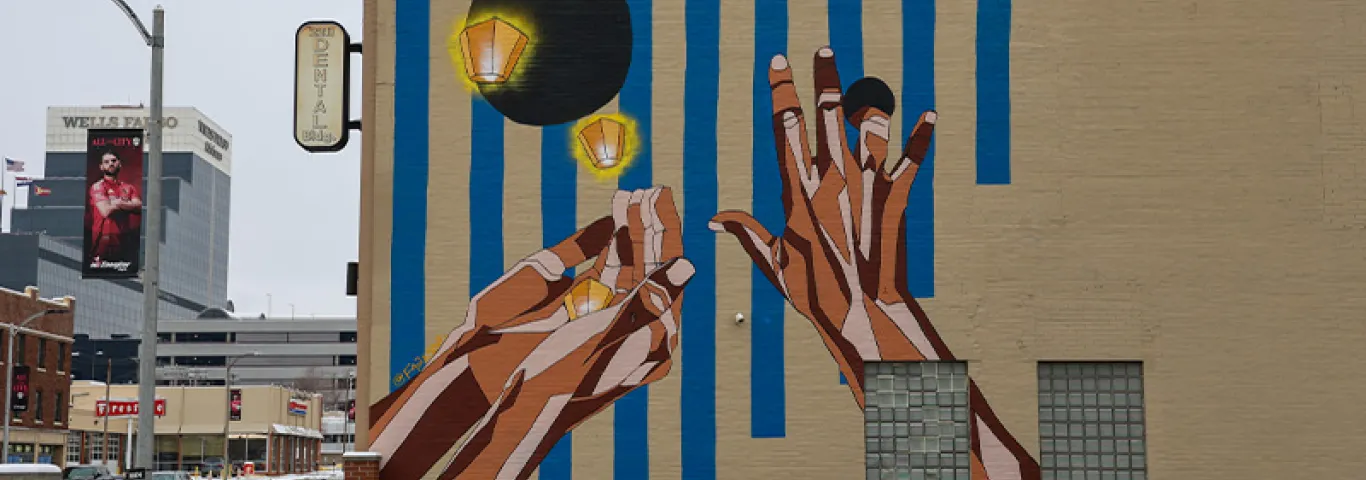
Two hands reach toward the sky, releasing paper lanterns that drift beyond the mural’s edges. Painted by alumna Fatou Kane, AB ’23, “Requiem of Light” appears on a building along Olive Street in downtown St. Louis. The mural commemorates the thousands of St. Louisans lost to COVID19 and is an enduring expression of the larger “Requiem of Light” memorial led by Rebecca Messbarger, a professor of Italian and public health. Through musical performance, interfaith prayer, personal testimony, and the lighting of lanterns at Forest Park's Grand Basin, the memorial brought together diverse communities in remembrance, mourning, and healing.
During the height of the pandemic, Messbarger, co-founder and former director of the medical humanities minor, reflected on the unresolved grief that followed the 1918 influenza pandemic. Drawing on her scholarship and teachings about contagion, she created the “Requiem of Light” as a vital public memorial through which the St. Louis community could acknowledge and process pandemic losses.
“Art is fundamental to repairing a broken community,” she said. “Data is important, medicine is important, but alone they won’t rebuild fractures; only storytelling will.”
Messbarger’s project is just one example of broader scholarship across Arts & Sciences that examines how memorials and commemorative landscapes help societies confront painful histories, sustain collective memory, and reckon with grief across generations.
Why physical places matter

Heidi Aronson Kolk, an associate professor in Sam Fox with an affiliate position in American Culture Studies, has spent her career examining the significance of shared historical objects and spaces. She studies the cultural politics of American public memory and how choices about material landscapes, architecture, and design reflect and redefine those politics.
In “Beauty in Enormous Bleakness,” she collaborated with Kelley Van Dyck Murphy, an assistant professor of architecture in Sam Fox, to document the vital contributions of Japanese American artists and architects to the postwar design landscape, many of whom produced significant works during or after their incarceration in WWII prison camps. Kolk and Murphy have sought to bring such submerged experiences into view, including by means of visual storytelling in public spaces, such as Olin Library and more recently, Lambert International Airport.
Building on that work, Kolk and Murphy developed “Dislocated,” an intensive travel seminar exploring Japanese American heritage sites across California. Sponsored by the American Culture Studies program, the course brought together 15 students from the arts, humanities, and social sciences. Over 17 days in the summer of 2025, they examined the history of Japanese American incarceration and its enduring consequences by engaging deeply with the material and memorial landscape.
As Kolk studied the careers of celebrated Japanese American architects, she recognized that their accomplishments could not be separated from the experience of wartime incarceration and its lasting effects on their lives.

“We need to make room in our storytelling for difficult histories as well as the things we want to celebrate,” she said.
For Kolk, place-based memory work matters in part because people experience history through their senses. Visiting a historic site can create a form of contact with the past that cannot be replicated through documents or digital records alone.
“There’s a powerful need to see, feel, and smell a place in a way that allows us to make some kind of contact with the past,” she said, and “to confront its enduring presence,” especially in the case of difficult or traumatic histories such as those associated with the war, which have largely been suppressed.
The longer Kolk has studied the subject, the more she has come to understand how visiting these places remains a necessary part of remembrance and reckoning—especially for people who endured incarceration and for their descendants. Public memory is fragile, she said, and the responsibility of preserving it often falls to those most directly affected by the history. The broader public has much to learn from their efforts, and from the communities of memory that have formed around them.
Going to places like the Manzanar National Historic Site, the location of a former incarceration camp near the edge of Death Valley whose fragments have survived in large measure because of advocacy by survivors and their families, may be “a profoundly unsettling experience,” Kolk said. “But it feels like a necessary and cathartic encounter,” especially when framed by the shared knowledge and understanding of the descendant community.
Commemoration that pays respect
In addition to providing places for remembrance and community gathering, public markers can reflect changing values and challenge the stories a society has chosen to preserve.
Geoff Ward, a sociologist and professor of African and African American studies, has advised many local communities as they have developed public commemorative projects. He was a member of the mayor’s Commemorative Landscape Taskforce in Clayton for several years, and works with other St. Louis community members in the local Community Remembrance Project partnering with the Equal Justice Initiative. He also helped advise Monument Lab’s National Monument Audit and the initial phase of their Re:Generation grant program. Ward, who also serves as director of the WashU and Slavery Project, studies how histories of racial violence shape later patterns of conflict, violence, and inequality.”
Sociologists use the term “racial socialization” to describe how people learn what it means to live in a racialized social system, including how to understand themselves and others through ideas about race. In that context, racial terror such as lynching, along with the absence of accountability for it, can reinforce racial hierarchies and shape how people and institutions behave for generations, Ward said. Similarly, the relative absence of monuments and memorials honoring women and people of color reinforces ideologies of sexism and racism.
Contemporary decisions about monuments cannot undo that violence, but Ward argues that commemoration can contribute to broader efforts toward recognition and repair.
“The idea that non-whites, in particular African-Americans, aren’t entitled to respect can potentially be counteracted by a commemorative intervention that pays respect, literally,” he said.
In 2026, Ward and David Cunningham, a professor of sociology, collaborated with the Reparative Justice Coalition of St. Louis as it sought to place a marker near the site in Valley Park where John Buckner was lynched from a bridge over the Meramec River in 1894.

The coalition could not get approval from the city to place the marker in the requested location — a Great Rivers Greenway trail passing under the bridge — and it now lies across the riverbank in a corner of Buder Park, where St. Louis County Parks supported its installation.
“If these were merely symbolic gestures that were of no consequence, they wouldn’t generate the kind of reactions they do,” Ward said. “I think it really speaks to the unfinished business of repair.”
Ward teaches WashU students to consider the role commemoration can play in public life. His first-year seminar “Monumental Anti-Racism” has become his most popular course. In one assignment, students often choose to study their hometown and design a memorial they believe would be meaningful to the community. The exercise asks them to consider whose stories are remembered, whose are overlooked, and how public memory shapes a community’s understanding of itself.
Ward said the course has also been a learning experience for him, offering insight into how communities across the country and around the world grapple with history and memory.
Along with Cunningham, he also co-teaches the Ampersand Program “Confronting the Past: Transformative Justice in St. Louis and Beyond.” In the initial offering of this yearlong program, they traveled with first-year students through the American South, visiting the National Civil Rights Museum at the Lorraine Motel, where the Rev. Dr. Martin Luther King Jr. was assassinated; memorials to Emmett Till in Mississippi; and the University of Mississippi, where they learned how the institution is confronting and commemorating its ties to slavery. These sites rank among the country’s most significant and contested commemorative landscapes.

“Students often have caricatures of places in their minds, shaped by media and prevailing narratives, and physically being there and experiencing a community complicates those assumptions,” Ward said. “It helps close the social distance between what we associate with a place, what it is actually like, and our sense of connection to it. We come to understand communities more fully — as they truly are, and as less foreign, distant, or unrelatable.”
When memory itself is contested
Debated commemorative spaces have become central to Cunningham’s recent research. Over the past year, he visited 113 communities where more than 150 Confederate monuments or related objects had been removed. What matters, he said, is not only that the objects are gone, but also what communities have chosen to put in their place.
Some sites remain visibly vacant. A bare outline marks where a monument once stood, sometimes with no grass even years after its removal, like a scar on the landscape. Others have installed public art that Cunningham says is “designed not to evoke any of the political history of the space.” A third — and the least common — approach directly acknowledges the site’s history. In Decatur, Georgia, for example, a Confederate obelisk that once stood in front of the original county courthouse has been replaced by a statue of civil rights leader John Lewis.
Many Confederate monuments were removed between 2017 and 2020 amid widespread protests against racial injustice and the growth of the Black Lives Matter movement. Cunningham sees that context as essential to understanding why communities acted when they did.
“In moments and sites of contestation, sparked by instances of fatal police violence like the killing of George Floyd in Minnesota or racist violence like the shooting at the Mother Emanuel AME church in South Carolina, Confederate objects can serve as focal points for activists and other concerned community members to advance broader claims about what a community should —and does—stand for,” he said.
A physical place where people can gather — be it a statue, monument, or public square — can help the public make visible connections between present-day violence and longer historical patterns. In that sense, Cunningham said, Confederate monuments can serve as sites of critical engagement that counter attempts to deny or minimize difficult histories.
“The monuments can provide a space of reaction in which people’s voices can be heard,” he said.
As Arts & Sciences scholars continue to examine how monuments, memorials, murals, and historic sites influence the stories communities tell about the past, these places will continue to serve multiple functions, holding grief, conflict, reflection, and dialogue simultaneously. “These are messy and complex histories,” Kolk said. “Even with seemingly ‘fixed’ plaques, exhibits, and monuments, there’s almost always some contention or contradiction — some struggle over meaning. As students of these histories, we have an obligation to acknowledge these multiple dimensions of public memory, and ask what they reveal to us about ourselves.”
Header image: “Requiem of Light,” a mural by alumna Fatou Kane, AB ’23, commemorates those who died during the COVID-19 pandemic. (Courtesy: Credit of Messbarger)


