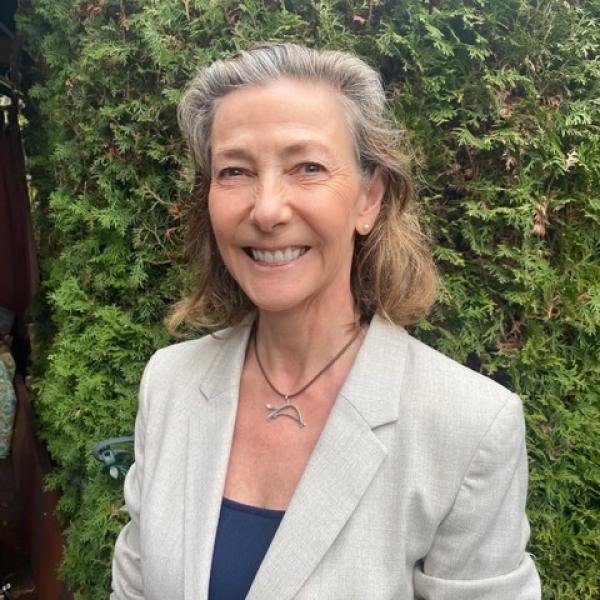
After initially pursuing biology, junior Vinisha Tripathi switched to a public health and society major with a biology minor. In the process, she found a way to pair the science of biology with the storytelling and human focus of public health.

In high school, Vinisha Tripathi was already drawn to biology. She had the opportunity to conduct research in the Breuss lab at the University of Colorado, an experience that strengthened her resolve to attend medical school. That goal hasn’t changed. But the path she plans to take to get there has.
When Tripathi arrived at WashU, she enrolled in “The Hallmarks of Cancer Care,” a four-semester Ampersand Program that explores cancer from a range of perspectives. During the program’s third semester, she took The Language of Cancer, a course that shifts the focus from the disease itself to the human stories behind it. For Tripathi, the course proved to be a turning point.
“I realized storytelling is what mattered the most. I know I want to be a clinical provider, but my goal is not just to treat patients; it's also to learn their stories and see how their specific background — where they’ve grown up, their traditions and beliefs — would influence my practice. How can I be the best doctor if the only perspective I can give them is through a medical lens?” she said.
Soon afterward, Tripathi switched her major, joining the new Program in Public Health & Society, which launched as a minor in 2024 and added a major in 2025. She was immediately drawn to the breadth of courses available, with offerings spanning fields from anthropology to business.
As a public health and society major, she interned at Siteman Cancer Center with the Program for the Elimination of Cancer Disparities (PECaD), where she contributed to health equity efforts aimed at reducing barriers to quality cancer care.
The experience allowed her to combine her biology background with public health’s focus on people and communities. She spoke with different patient populations, learned about their experiences, and created educational outreach materials tailored to their needs. Drawing on her own South Asian background, Tripathi was asked to develop a brochure focused on cancer prevention for South Asian communities.
She’s also a resident assistant and a biology research ambassador, roles that regularly put her in a position to advise younger students who are choosing their own academic paths. Her advice depends on where they are in that process.
For first-year students, she encourages them to take the unexpected course and let their curiosity guide them. For sophomores, her advice is to have the courage to change course, especially if they find themselves drawn to something they never expected to study.
“Don’t fight it,” she said. “Enjoy the thrill of the unknown.”
For Tripathi, choosing a major ultimately became an exercise in understanding what matters most to her. That self-knowledge, she said, will shape her approach to medicine and whatever work comes next.
“Arts & Sciences has taught me that you don’t have to know exactly where you are going. This is a place where I’ll find the resources to study what excites me, keeps me curious, and allows me to keep asking questions,” she said. “Whatever work or research I end up doing, my goal will be to focus on what impacts people, what motivates them, and how that can influence health care. To me, that’s the guiding principle.”
Still exploring your academic path? Stop by the Major-Minor Fair on Monday, Oct. 12, from 3 to 4:30 p.m. at the WashU Athletic Complex to meet faculty and staff and learn more about majors and minors across WashU.