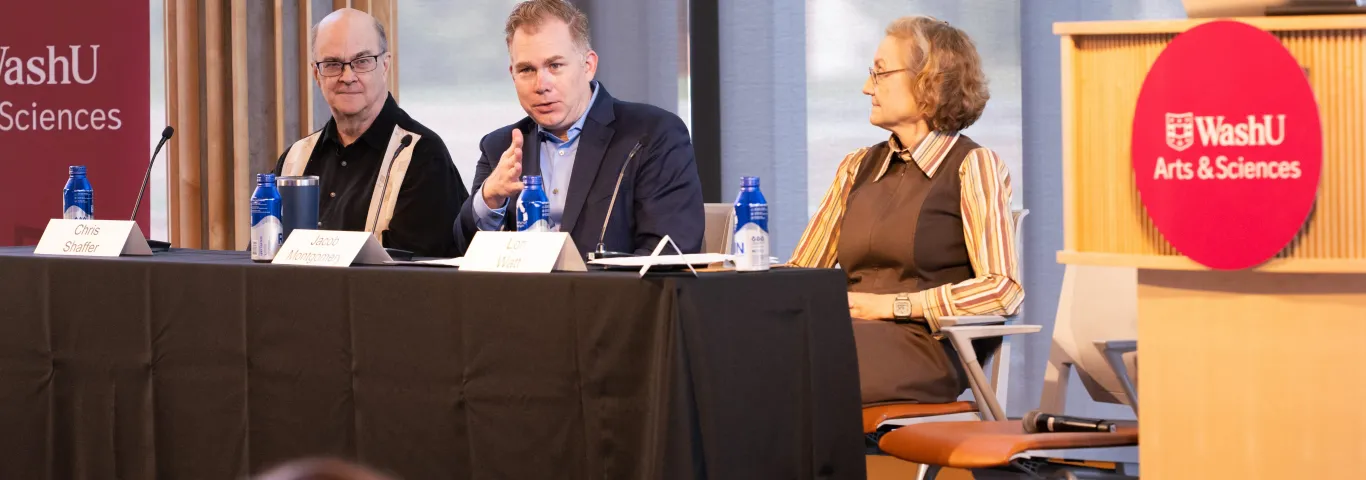
Recentering Student Learning in the Age of AI brought Arts & Sciences faculty and students together to consider how rapidly evolving technology is changing higher education.
Addressing an audience of WashU faculty, administrators, and students at the Clark-Fox Forum in Hillman Hall, Jeff Greene urged everyone in the room to take a collective deep breath about the future of artificial intelligence.
“I really want us to take a glass of ‘settle-down juice,’” said Greene, associate dean for research and faculty development at the School of Education at the University of North Carolina at Chapel Hill. “We have seen this before. The printing press obviously caused a lot of difficulties, but eventually it became a good thing. TV was purported to be the thing that was going to change education forever. And then it was VCRs. And then it was the internet.”
Greene’s keynote address at the Recentering Student Learning in the Age of AI symposium did not dismiss concerns about AI’s rapid evolution. Instead, it aimed to lower the temperature on a conversation that can easily veer into hype and doomsday scenarios.
“AI is, in essence, a tool,” Greene said. “I don’t want us to be in thrall of generative AI. I don’t want us to think that this is something we can’t control, that we can’t use to make beautiful things if we choose to.”
The symposium, presented by Arts & Sciences as part of WashU’s AI Perspectives Week, grew out of Arts & Sciences’ Principles on Artificial Intelligence and Undergraduate Student Learning, which place student learning — rather than the technology itself — at the center of conversations about AI.
“A central premise of the principles is that discussions of AI in higher education should begin not with the technology itself, but rather with student learning,” said Erin McGlothlin, vice dean of undergraduate affairs, in her opening remarks. “Our responsibility is to understand how evolving technologies affect students’ cognitive development and their acquisition of knowledge, capacities, and habits of mind. The rapid ubiquity of AI compels us to think more carefully about the purposes of undergraduate education and to ensure that our students continue to benefit from high-impact learning experiences.”
That focus shaped the central question of the day: How can WashU use tools such as ChatGPT, Claude, and Gemini to deepen student learning while setting appropriate guardrails?
The event featured faculty and student panels in which participants shared perspectives from the classroom and discussed how faculty and students can learn together as AI reshapes higher education.

Jacob Montgomery, a professor of political science, likened AI programs to “the worst form of helicopter parenting,” where a student asks a question and the AI attempts to solve the problem without requiring the student to engage in critical thought.
“We need to figure out a way to make these technologies work a little bit more like me in my imagined best moments,” Montgomery said. “Someone who’s patient, available, and can help students learn without giving them the answers.”
This year, Montgomery experimented with one possible solution: programming AI chatbots to answer student questions about his course syllabus and specific problem sets. The chatbots used the full set of course documents to quickly point students toward relevant material.
“What it won’t do is give the answers to problems,” Montgomery said. “What it will do is say, ‘Did you check slide 10 in lecture six?’ Or, ‘See this worksheet from class.’”
Lori Watt, an associate professor of history and global studies, emphasized the importance of faculty learning about AI alongside their students. In May, she participated in AI Corps, a weeklong course focused on implementing AI in the classroom, and she is part of an AI learning community this semester.

Watt said those opportunities have helped her think more intentionally about how AI is changing both teaching and students’ lives — and why faculty need to discuss those changes openly with students.
She also joked that she is “the human AI detector” and can often tell when a student has enlisted artificial assistance for essay writing. Her response, however, is not simply to police its use.
“It never occurred to me to try to punish students for doing this,” Watt said. “Instead, they get a far worse fate: long, sad messages from me. ‘The writing in this paper is very formal. It was hard to get a sense of the personality behind the work. In the future, might it be possible to write more in your own voice?’”
Those conversations, Watt suggested, can become an opportunity to consider what students gain from doing the work themselves and where AI does — and does not — fit into that process.
“Even though AI is transforming our world, I’ve been struck by how much academic work, especially in history, cannot be done by AI,” Watt said. “At a recent seminar, I heard about all kinds of archival research conducted by my colleagues this summer: traveling to a village in the Philippines, spending time in a basement in Wisconsin to work through a box of archives, or going in person to the homes of friends and families of biographical subjects.”
The balance Montgomery and Watt described reflects what Greene called “productive struggle”: students wrestling with material, making mistakes, and ultimately developing a stronger understanding of why the work matters and how to apply it.
“I think all of us in this room want our students to internalize understanding and be able to take it with them so they can do the work without generative AI,” Greene said. “That’s learning.”