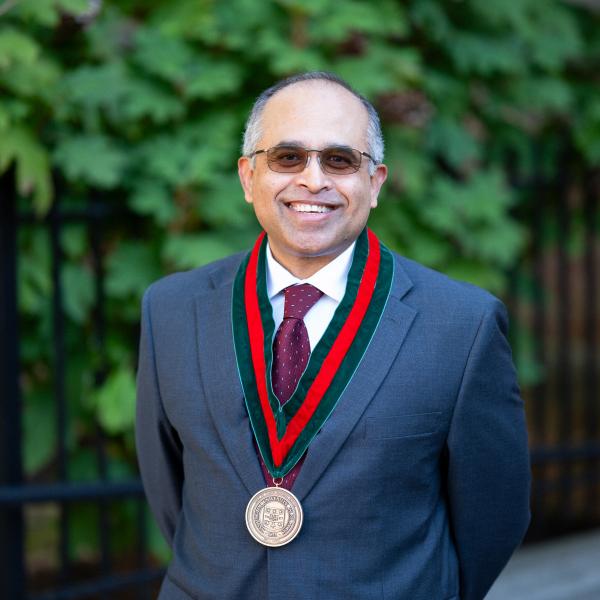
Brett Wick, chair of the Department of Mathematics, discusses the current state and future of mathematics careers and his department.

As the chair of the Department of Mathematics, Brett Wick, the newly installed Robert G. and Maxine W. Scheibe Professor of Mathematics, has a front-row view of a field in the midst of a revolution. As mathematicians pose new questions and explore new concepts, artificial intelligence is transforming the way they work. In September, OpenAI claimed to have solved one of the so-called Millennium Prize Problems, a set of mathematical challenges that have stumped researchers for decades. OpenAI recently released hundreds of proposed solutions to mathematical research problems.
Wick, who became chair in summer 2025, is paying attention to the moment. Beyond his teaching and administrative duties as chair, he explores the challenges and opportunities facing mathematicians in his blog Navigating Proof Space. Despite the changes underway, Wick sees a promising future for his students, faculty, and the profession.
He spoke with the Ampersand about his department, his outreach, and the continued need for math and mathematicians.
You’ve been chair of the math department for over a year. What are your priorities for the department?
In addition to the usual goals for any department chair — attracting and retaining top students and faculty — I’m working to raise the department’s visibility. We already have a strong national reputation, but I also want more people at WashU to know about the department and what we can offer them.
I also want to stay connected with our alumni. In April, I put together a newsletter highlighting the department’s accomplishments. Our faculty and students have been very successful in securing grants and support from the National Science Foundation and other agencies, an impressive accomplishment in the current climate. We also have more than our share of teaching awards and national honors. We aren’t a large department, but we punch above our weight.
What can your department offer to the rest of the university?
A strong mathematics department is essential not only for educating our own majors, but also for providing the mathematical foundation that students and researchers across the university increasingly need. Mathematics is not simply a collection of tools for solving problems in other disciplines. It also provides a way of thinking, identifying patterns, and developing entirely new ideas. Some of the most important applications of mathematics have come from work that was originally motivated by curiosity rather than any particular application.
In February, we hosted a Loeb Lecture jointly with the Department of Physics. Tadashi Tokieda, a mathematician at Stanford University, spoke with faculty and students in both math and physics. We're going to do something similar this coming spring with the biology department. Mathematical biology is becoming popular, and there are several mathematically inclined biologists at WashU. I know we can build stronger connections with that department and others across the university.
Math has been in the news. How did you respond to the OpenAI’s claim that they had solved a Millennium Problem?
It was exciting and scary at the same time. The math community had identified these problems as a north star to aim for, and to have one of them solved by a computational engine like ChatGPT was quite surprising.
I see ChatGPT and Claude and some of these other AI systems as highly capable collaborators. They have access to vast amounts of research literature. They can help with research computations and proof strategies. Mathematicians can use AI to streamline their work, but we still need people who can interpret the results and ensure that the process is valid. Mathematics is about more than producing correct proofs. It is also about asking the right questions, discovering unexpected connections, and developing new ways to think about problems.
How has AI changed math education?
At the undergraduate level, I think AI makes a strong foundation in mathematics more important, not less. Mathematics helps us understand the ideas underlying AI, but it also gives students the tools to evaluate what these systems produce. AI can generate a calculation, model, or prediction, but without mathematical understanding, it can be difficult to interpret the results, recognize the underlying assumptions, or know when to question them. Those skills are valuable across the university, not just for students majoring in mathematics.
At the graduate level, AI is changing how mathematical research is done. Problems that might once have formed the basis of a dissertation can now sometimes be approached with AI tools. That means we need to rethink aspects of advanced education while continuing to emphasize deep understanding, creativity, and independent mathematical judgment.
We also need to help students recognize the range of opportunities available to them, whether pursuing pure mathematics, working at the interface with other scientific disciplines, or applying their mathematical training in industry and other settings.
You write about math careers in your blog. What is the current state of the landscape?
A mathematics degree provides a strong foundation for a wide range of careers, and I believe there will continue to be significant opportunities for our students. The ability to think abstractly, reason carefully, and approach unfamiliar problems is needed across an enormous range of fields. Those skills aren't going to become obsolete simply because technology is changing. Some of our recent doctoral graduates have gone on to academic positions at universities. But academia is far from the only option. Math graduates can go into industry, consulting, or actuarial work. They can be entrepreneurs.
There's also a large amount of math that still goes into AI research. We’re using AI to solve scientific problems, but the ways that AI works are not completely understood mathematically. A lot of mathematicians can build their careers around studying the algorithms.
Why do you take the time to write a blog?
The blog gives me a way to process things that happen in research or in math careers. I recognize that some of the challenges that I’ve faced in my own work are universal. I think my readers feel informed and reassured that they aren’t alone.