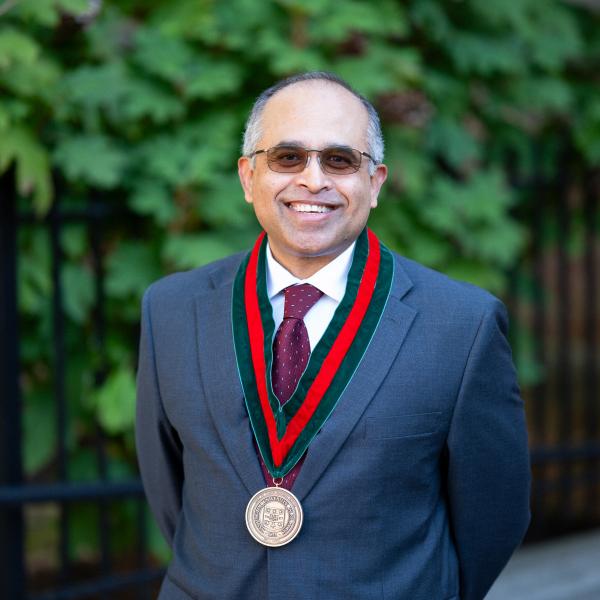
Buera’s research explores the macroeconomics of development and structural change.

Francisco J. Buera, the Sam B. Cook Professor of Economics, has been elected a fellow of the Econometric Society, an international organization dedicated to advancing economic theory through statistics and mathematics.
Buera, who joined WashU in 2017, is a consultant to the Federal Reserve Bank of Minneapolis and a research fellow at the Federal Reserve Bank of St. Louis. He also serves as a senior leader of Structural Transformation and Economic Growth (STEG), a joint research initiative between the Centre for Economic Policy Research (CEPR) and the United Kingdom’s Foreign, Commonwealth & Development Office (FCDO). The initiative seeks to improve understanding of structural change, productivity, and growth in low- and middle-income countries.
Buera is a macroeconomist whose research focuses on economic development, using quantitative models to examine how policies and markets interact across economies. He studies how access to credit affects the ability of businesses and individuals to invest and grow, as well as differences among people and firms, the role of technology, and structural change, such as the shift from agriculture to manufacturing and services.
In a current project, Buera and his collaborators are using large language models and information from Wikipedia to create a historical dataset tracking technological innovations across countries. By examining developments such as the invention of the printing press, they hope to understand how innovation and technological leadership have evolved over time. “It is less interesting to use AI to do things that we could have done before. But using LLMs to construct a data set about the advent of technologies, who invented them and where, who the leaders were, and why leadership changed, this can give a picture of innovation, and it’s exciting,” Buera said.
Fewer than 5% of economists are elected to the Econometric Society during their careers, an honor Buera said he is grateful to receive. Founded in 1930, the society has long championed the use of mathematical and statistical methods in economics. For Buera, the recognition is particularly meaningful given the organization's role in shaping economics as a rigorous social science.
“It’s a great honor to be recognized,” he said. “Especially among the international group of people that I respect and have studied for years.”