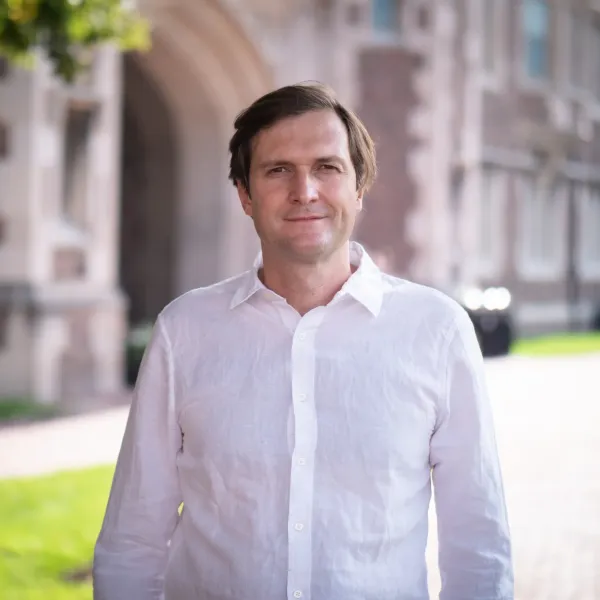
Physician, scientist, and entrepreneur Aashish Manglik, AB ’08, has founded multiple companies focused on identifying new targets and developing new therapies for cancer and other diseases.
When Aashish Manglik, AB ’08, first arrived on the WashU campus, he envisioned a future that combined science and medicine. That vision came true — and he can add entrepreneurship to the list.
A researcher studying the chemistry and molecular biology of human physiology, Manglik, MD, PhD, has founded or co-founded four separate pharmaceutical companies pursuing new approaches to treating cancer and other diseases.

One of those companies, Stipple Bio, has recently attracted more than $100 million in investments, supporting its approach to developing new cancer therapies. Enabled by Manglik’s research, the company is developing new ways to identify telltale proteins on surfaces of cancer cells, opening new possibilities for targeted therapies.
Developing new cancer treatments presents significant scientific challenges. Manglik, who is also a professor of pharmaceutical chemistry at the University of California San Francisco, brings both an academic and entrepreneurial perspective to the work.
His preparation started when he applied for early action admission at WashU. “I grew up in Des Moines, so a world-class institution relatively close to home seemed like a great option,” he said. “When I got accepted, I stopped considering other possibilities.”
He quickly immersed himself in research, receiving a prestigious Howard Hughes Medical Institute Undergraduate Research Fellowship as a freshman. Through that fellowship, he joined the lab of Jeff McKinney, then a professor at WashU Medicine. “I worked in that lab for nearly the entire time I was at WashU,” he said. “It was an incredible experience.”
In McKinney’s lab, Manglik studied the biology and genetic programming that helped salmonella and other gram-negative bacteria flourish within cancer cells, work that offered insights into both the bacteria and the disease. The experience also helped crystallize his career plans. “Being exposed to someone like Jeff convinced me pretty quickly I wanted to be a physician-scientist.”
Manglik originally planned to major only in biology, but his early chemistry courses convinced him to broaden his studies. “Richard Loomis taught an introductory chemistry course that really got me excited,” he said. “He really challenged students to think outside the normal bounds. Looking back, I’m really impressed by how much effort and dedication he put into that course.”
Soon after, Manglik decided to double major in biology and chemistry, a combination that gave him a strong foundation for basic research. “Training in chemistry helped me understand biology and medicine at a fundamental level,” he said.
He fondly remembers an organic chemistry course taught by Vladimir Birman, now an associate professor of chemistry. “He was a new hire at the time, and he had so much energy. He encouraged me to take more advanced courses in chemical synthesis. Those years were a foundational part of who I eventually became.”
Manglik also began earning recognition for his academic achievements at WashU. He received an honorable mention from the Barry M. Goldwater Foundation as a junior. The following year, he shared the Department of Biology’s Spector Prize for the best undergraduate honors thesis, “Mechanisms Mediating Salmonella-Cancer Cell Interactions.” In 2016, he received the National Institutes of Health Director’s Early Independence Award. In 2026, he received the Vilcek Prize for Creative Promise.
Throughout his career, Manglik has focused on finding new ways to treat disease at the cellular level. That goal ultimately drove him to co-found his first company, Ab Initio Biotherapeutics, in 2015 while he was still a graduate student at Stanford University. “I realized that it really takes a large-scale investment to have the kind of impact I wanted, and that can really only happen with a private entity.”
Stipple Bio, a company he co-founded in 2022, focuses on epitopes, small portions of larger proteins that that can be recognized by the immune system. The epitopes are scattered across each cancer cell’s surface like tiny dots on a stipple painting.
Certain epitopes are found only on cancer cells, so any drug that attacks the stipples — either directly or by stimulating antibodies in the immune system — could potentially kill cancer cells without harming healthy cells. Instead of focusing on just one target, the company considers every small dot that makes up the full picture.
“The company looks at cancer from a chemistry lens, which goes back to my training at WashU,” Manglik said. “The pharmaceutical industry can have a herd mentality, and there is often a tremendous amount of resources directed at just a few targets. At Stipple, we want to look for new possibilities.”
The approach has already led to one promising drug in the pipeline. Currently known as STP-100, the drug is still in the research stage and has not been tested on patients, but Manglik sees it as a promising candidate, perhaps the first of many. “Not only do we have a potential drug in the works, but we also have a platform that could potentially fill a pipeline with other possibilities,” he said.
Nearly 20 years after graduating from WashU, Manglik continues to approach his work with the same curiosity that shaped his undergraduate years. He remains involved in the day-to-day operations of his companies, regularly collaborating with research teams to explore new approaches to cancer treatment.
“I regularly meet with the research team to discuss the platform and approaches for finding targets,” he said. “It’s largely for my own education at this point.”