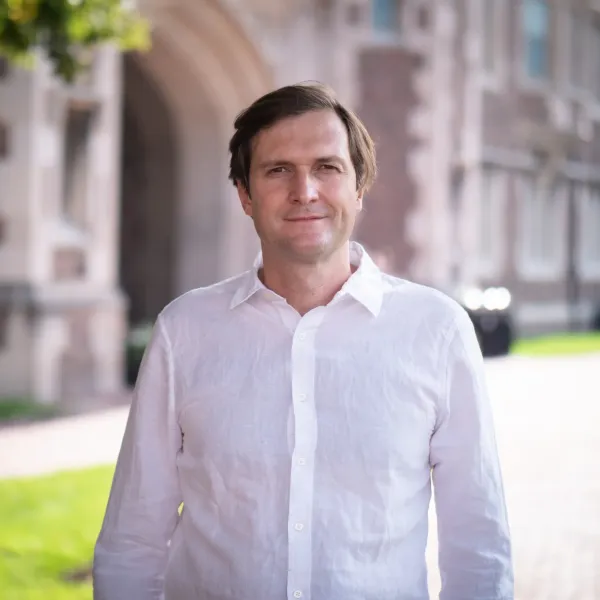
Historian Uluğ Kuzuoğlu and his students are turning historical records into an interactive map, revealing the lives and stories of Asian immigrants who helped shape St. Louis.
Kwang Lee’s story survives in fragments.
What little we know about him comes from scattered newspaper accounts. Born in southern China, he came to the United States by way of Cuba and worked in the cigar-making industry. He served in the U.S. Navy during the Civil War, eventually moving to St. Louis and receiving his naturalization papers in 1874.
Lee built a life here, owning a laundry business and becoming part of the community.
But in 1909, in a case that made national news, Lee was stripped of his citizenship and forced to leave the country. The dramatic reversal came amid an ongoing wave of anti-Chinese discrimination in the United States: the Chinese Exclusion Act of 1882 had closed the door to new Chinese immigrants in America, and also refused states the right to grant citizenship to resident Chinese aliens.

Lee made newspaper headlines in July 1909 as a cultural oddity: a Chinese Civil War veteran, with multiple scars and bullet wounds from his service, who was controversially registered to vote despite the Chinese Exclusion Act. Within a month, a fresh round of news stories appeared in papers across the country, declaring that Lee had been denaturalized by the United States District Court.
What happened next is lost to time, and many details of his case remain unclear. For Uluğ Kuzuoğlu, an associate professor of history at WashU, Lee’s life offers a window into a much larger history.
“To me, he represents both the global history of Chinese immigration and also the place St. Louis had within this global history,” Kuzuoğlu said.
Now, Kuzuoğlu is working to bring stories like Lee’s to light. With support from the Incubator for Transdisciplinary Futures, he has spearheaded the development of Asia In St. Louis, a new app that will allow users to explore the city’s Asian immigrant histories through an interactive, location-based map. By connecting historical records to the places where people lived, worked, and built communities, the app reveals a side of St. Louis that often goes overlooked.
“It’s kind of like Pokémon Go, at least that’s how I imagine it,” Kuzuoğlu said. “When you turn on the app, you can see all the history that surrounds you.”
That includes hidden historical gems, like the one found in the U-Haul building on Kingshighway. The otherwise nondescript building contains a sculpted ceiling designed by the famous Japanese-American artist Isamu Noguchi. Covered by a drop ceiling for decades, U-Haul uncovered and restored it in 2015.
The project draws on a wealth of existing research, including work conducted by the Missouri Historical Society’s STL Chinese American History Initiative and other local groups. Newspaper articles, interviews, personal journals, and business records provide the foundation for the historical locations and stories featured in the app.
The app will launch with locations relevant to St. Louis’ Chinese, Japanese and Filipino communities, with future versions of the app to include stories from Vietnamese, South Asian, and Middle Eastern immigrants.

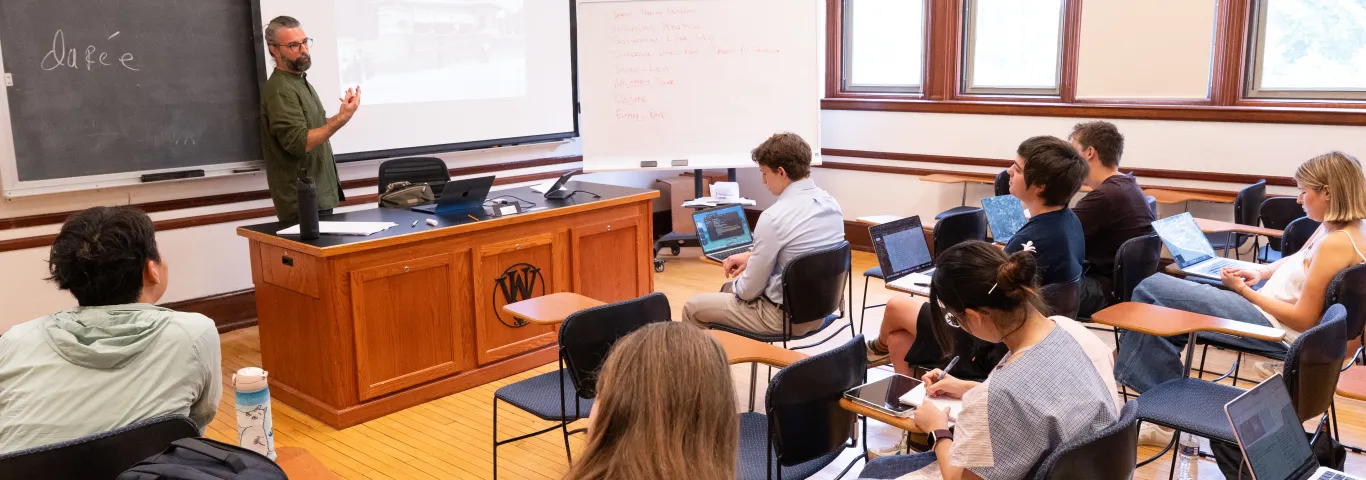
But bringing those records to life required more than plotting points on a map. Students in Kuzuoğlu’s fall 2026 Historical Methods course helped transform the source material into short, engaging narratives. Each week, students explored a different theme, from the 1904 World’s Fair to unsolved murders. Working with primary source documents, they pieced together stories of the city’s past while gaining firsthand experience with the challenges of historical research.
“As someone who’s not originally from St. Louis, being able to explore different parts of the city and its history has been really cool,” said Matthew Isaacs, a political science major. “You could really do this with any ethnic group. It’s prompted me to wonder about what else has occurred here, and to really get out of that WashU bubble.”
For Henry Rosenzweig, another student in the course, the project offered a new way to see the city he grew up in.
“Being from here, in high school we learned a lot about historical red-lining and early frontier development, but we didn't get as much about other groups who lived in St. Louis,” Rosenzweig said. “It’s interesting to wrap my head around the place that I grew up in, but in a wildly different sense.”
Turning those stories into an interactive experience presented another challenge: organizing thousands of historical data points into a map that users could easily navigate. Software engineer Eric Tabuchi has led the app’s technical development, working with Kuzuoğlu to organize the records and connect them to specific locations.
“The original spreadsheet Uluğ gave me had over 1500 locations on it,” Tabuchi said. “But then we had to find a way to clean the data to make sure that each historical site is unique, and that it’s not a place with the same name but active in different years.”
Kuzuoğlu will unveil the app Dec. 5 at Stories Buried, Stories Told: Entangled Histories of Asia and St. Louis, an all-day symposium exploring how Asian immigrant communities helped build and shape St. Louis. The app is currently in review for Apple and Google’s app stores, and should be ready for users to experience by Dec. 5, Kuzuoğlu said.
For Kuzuoğlu, the launch is just the beginning. He hopes the app will encourage people to look more closely at the histories surrounding them and, eventually, contribute stories of their own.
“The idea is to turn this into a public archive, where people can be involved to write the stories that they want to write about places that they care about,” Kuzuoğlu said. “I have no idea if it’s going to succeed, but I’m hopeful that people will find it as meaningful as I do.”