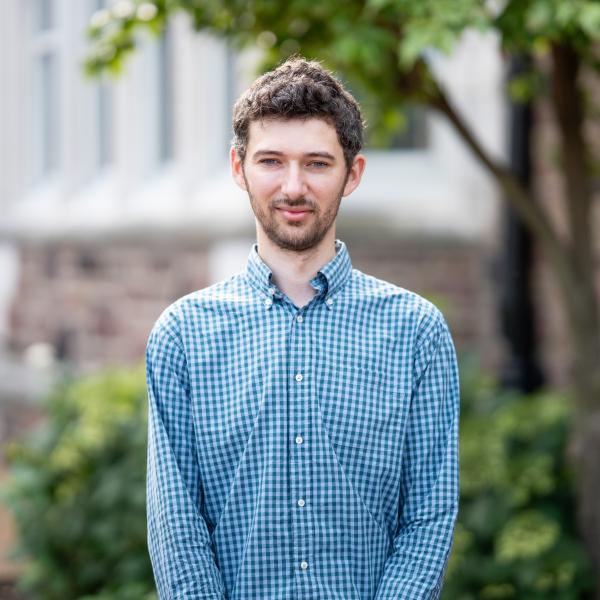
Heung reflects on life as a bilingual poet, his time at WashU, and the experience of publishing his first poetry collection.
Aiden Heung, MFA ’25, published his first poetry collection, “All There is to Lose,” in March 2026.
Heung is from a tiny village in the Tibet Autonomous Region of China — so small it’s known only as “915.” His journey from 915’s mountainous landscape to Shanghai and, ultimately, to WashU’s English department informs and inspires his poetry.
“At WashU, Aiden Heung devoted himself to learning everything he could,” said Mary Jo Bang, professor of English and a poet who recently collaborated with Heung on poetry readings on campus and in the St. Louis community. “The result is work that speaks in his own voice and reflects his experiences and preoccupations.”
That distinctive voice has quickly earned him recognition: He won the 2024 Four Way Books Levis Prize in Poetry, the 2025 Elinor Benedict Poetry Prize, and was a finalist of the 2025 DISQUIET international literary contest.
Heung recently spoke with the Ampersand about his work.

Can you tell us your journey to becoming a poet?
I was born in a very small Tibetan village and didn’t have a poetry education. I finished my marketing degree in China and worked in a paint factory and then as a traveling salesman. But I always knew I had stories to tell; I had so many emotions and feelings pent up inside of me. In school, I had a great English teacher who guided me to Western literature. I began to imitate — badly at first — Western poets, mostly from the Norton Anthology of English Literature. In 2014, I moved to Shanghai and found a community of poets who met regularly in a cafe, which helped me grow as a poet. Then I was accepted into the WashU MFA program.
What does your success mean to your family?
My parents don’t know I’m a poet. My first collection is dedicated to them and to my village, but they have no idea I write poetry. My country is very pragmatic, and writing poetry is not pragmatic. I will let my parents know, one day.
How would you describe your poetry?
I aim for my poems to be a terroristic pursuit of emotional truth. They aren’t a documentary of my experience; they are a sometimes-surreal reimagination of experience.
This book, “All There Is to Lose,” is about my village, the place I lived for the first 10 years of my life. The poems include many dominant images of natural landscape elements like mountains, the sky, and rivers. But unlike some poets, these aren’t beautiful to me. The landscape weighs on me, stirring memories of departure, of losing my grandmother, and of a place I can never really go back to. It’s about my journey of going back home to the place I love most, but somehow find myself unable to return to it in the same way.
What inspires your work, and as a bilingual poet, what’s your writing process like?
I’ve had different poets inspire me at different points in my life. When I first started reading poetry, my inspirations were Xu Lizhi, who was a factory worker like me, and Yu Xiuhua, a marginalized female poet who writes with complete honesty and intimacy. Lately, I’ve been into the work of Larry Levis, whose intense lyricism influences me.
I write in both languages, Mandarin and English. But I never write in one language and then translate into the other. The way English poets look at the world is so different from how Chinese poets do. It’s a beautiful thing to be between two languages and to draw from both. From Chinese poetry, I take the powerful use of images. From English poetry, I take the super-detailed specificity of the English language. Both enrich my writing.
When I write, I start with an image or a line. Sometimes it’s a memory I want to explore. I don’t dictate where the poem is going; I follow where the words take me. Then, I spend a lot of time reworking, correcting, and workshopping.

What was it like moving to St. Louis and attending the WashU MFA program?
Though I had a supportive poetry community in Shanghai, coming here broadened my understanding of English poetry. I feel very lucky that I had the chance to move to St. Louis, to work with the other poets in my cohort, and learn from my teachers Mary Jo Bang, Carl Phillips, and Eduardo Corral. Before coming here, I hadn’t had a full poetry education. At WashU, I gained a depth of understanding of the craft, history, and lineage of poetry. The lyrical exactness I learned from Mary Jo Bang helped me, in particular, in writing this collection.
What does it mean to have your first collection published, and what’s next?
It has been so enriching for me to be in St. Louis and write this. American culture has so many brave and diverse voices. The only challenge is that there are so many poets doing beautiful work, and I wish there were more platforms to showcase poetry.
As for my own work, the story is not finished yet, even with the publication of this collection. Some poets spend their whole lives writing on one subject over and over in different ways. I guess I’ll be one of those poets seeking the truth of my personal life. I’m still writing, whenever I can, aiming to write a poem a week. I don't care how bad that poem is. What is inside has to come out.