Lessons from the first three years of Arts & Sciences’ Incubator for Transdisciplinary Futures could hold the blueprint to further elevating WashU’s research enterprise.
For the Incubator for Transdisciplinary Futures to get off the ground, its co-directors first had to play matchmaker.
William Acree and Betsy Sinclair envisioned the Incubator as a framework for prototyping new research collaborations and learning configurations. To do this, they would have to bring together faculty from different disciplines to pursue new projects that would attract outside funding, lead to new courses, and make an enduring imprint on the spirit of collaboration at WashU.
With support and guidance from Feng Sheng Hu, the Richard G. Engelsmann Dean of Arts & Sciences, Acree and Sinclair had $2 million in seed funding to launch several new team-science projects. Hu had also set an ambitious goal of a tenfold return on investment. These ideas couldn’t just be fun or interesting on paper — they had to have a clear roadmap to secure additional funding, and they had to present a vision that could be transformative for research 10 or 20 years down the road.
“The Incubator was designed to be a blueprint for the ambitious, convergent research that could take place across all schools at WashU,” Hu said. “We wanted to provide a powerful launchpad for bold, impactful research and empower our faculty to think and work together in new ways.”
Before that could happen, Acree and Sinclair ran into the unexpected challenge of getting faculty from different fields in the same room.
“When we launched our first call for proposals in spring 2022, we were seeing another spike of COVID,” Acree said. “Betsy and I had wanted to get people together at a sort of ‘speed-meet’ event, which was going to help facilitate the initial conversations around team building. But we couldn’t do it because of the COVID outbreak.”

So, Acree and Sinclair turned to undergraduate students for inspiration.
“We wanted to go to undergrads because they see a cross-section of faculty that a lot of us don’t see,” Acree said. “We sent them a survey asking what their dream class would be and, if they could pick any combination of faculty members to teach it, who would they be?”
Nearly 300 responses came in. “Congratulations, you’ve been nominated,” Acree and Sinclair wrote to the faculty members singled out by students. “We want you to have a conversation with the other person who was named in this dream class request. If you want to have coffee to talk about potential connections, we’ll pay for it.”
Those conversations helped spark the Incubator’s first cohort of 13 funded collaborations.
Finding synergy
The renewed push for transdisciplinary research in Arts & Sciences arrived at the perfect time for physics professor Ralf Wessel.
In 2022, Wessel was entering a new phase of research following the graduation of several of his graduate students. He was fascinated by the intersection of artificial intelligence and neuroscience, particularly how AI processes information when compared with the human brain.

After receiving notice of the Incubator’s funding for new teams, Wessel reached out to colleagues interested in studying the interplay between artificial and biological brains.
“There were several people who were interested in this topic,” Wessel said. “The year 2022 is when AI really burst onto the scene everywhere.”
The group that formed launched a project called “Toward a Synergy between AI and Neuroscience,” and it initially included 15 faculty members representing five Arts & Sciences departments, as well as the McKelvey School of Engineering and the School of Medicine.
“The first thing we did was get to know each other through various social events,” Wessel said. “People enjoyed it, but it didn’t really spark. Our attendance dropped gradually. So, I realized, ‘Well, this is not sufficient. People aren’t getting enough out of it.’”
Instead, the group shifted to a smaller core team led by Wessel and fellow project leads Keith Hengen, associate professor of biology, and Likai Chen, associate professor of statistics and data science.
Wessel and assistant professor of neuroscience Tom Franken secured a $428,000 National Institutes of Health grant to compare how AI and primates process video imagery. In December, the group hosted a symposium on AI and mosaic art, sparking surprising collaborations between AI researchers and working artists — two groups that might not otherwise intersect.
Multi-layered impact
Wessel’s success is just one example of how Incubator projects are translating into substantial external funding. Teams studying human-wildlife virus transmission, cognitive health in older Latinx adults, and the Chicago Police Department’s body camera metadata all secured significant external funding to prolong the impact of their Incubator projects. Just over three years after the Incubator’s first cohort began their work, the teams have achieved their initial goal of a 10x return on investment, securing more than $20 million from outside funders.

The Incubator also fostered projects in mindfulness and immersive technology. The Mindfulness Science and Practice team expanded events on campus from a single Mindfulness Day in 2023 to a monthlong series in 2025. The Immersive Technology Collective brought demonstrations of virtual and augmented reality programs to students and faculty.
Ariela Schachter, associate professor of sociology, co-leads Moving Stories, a project documenting St. Louis migrant narratives through oral storytelling and art installations. With a team that included faculty from art history and archaeology, romance languages and literatures, and the Sam Fox School of Design & Visual Arts, Schachter’s experience stood apart.
“I’m trained to be a sociologist, and I do quantitative work,” Schachter said. “That’s not normally something you would think of as having a lot of alignment with the humanities. I don’t think I would have initiated this kind of collaboration on my own. But it’s been a great learning experience for building my connections and helping me to feel more plugged into WashU’s broader campus.”

Schachter said the Incubator gave a push to faculty who may have been sitting on the fence about transdisciplinary collaboration.
“There are people who are going to do transdisciplinary research no matter what,” Schachter said. “Then there are people who don’t see it as a part of their job, even if you put all the incentives out there. And then you have people like me, who just need the resources or the invitation to do it. I wasn’t opposed to research like this before; it just wasn’t on my radar.”
What’s next

Incubator-funded research continues to break new ground. Recently, Keith Hengen, an associate professor of biology, and his collaborator, Luis de Lecea of Stanford University, received $2.7 million from the National Institutes of Health to study how sleep can prevent or slow Alzheimer’s disease. Building on a paper that Hengen wrote with his AI & Neuroscience colleague Wessel, the team is using innovative approaches — including monitoring brain activity and testing the mental acuity of mice — to understand how sleep restores brain function. Hengen and de Lecea hope their findings will lead to targeted interventions to slow or prevent cognitive decline, underscoring the Incubator’s ongoing role in supporting ambitious, cross-disciplinary research.

“We never would have gotten to where we are without the Incubator,” Hengen said of the project.
Since the Incubator’s launch, Sinclair has been named assistant vice provost for digital transformation. Acree, who serves as vice dean of interdisciplinary initiatives and innovation — a role designed in part to amplify convergent innovation and the Incubator’s work — now co-directs the Incubator with Michael Frachetti, professor of archaeology, who succeeded Sinclair in the role.
“These days, higher education is being pushed in ways that are more aligned with the convergence of different disciplines,” Acree said. “The Incubator is something that Arts & Sciences and the university as a whole can point to and be very proud of.”
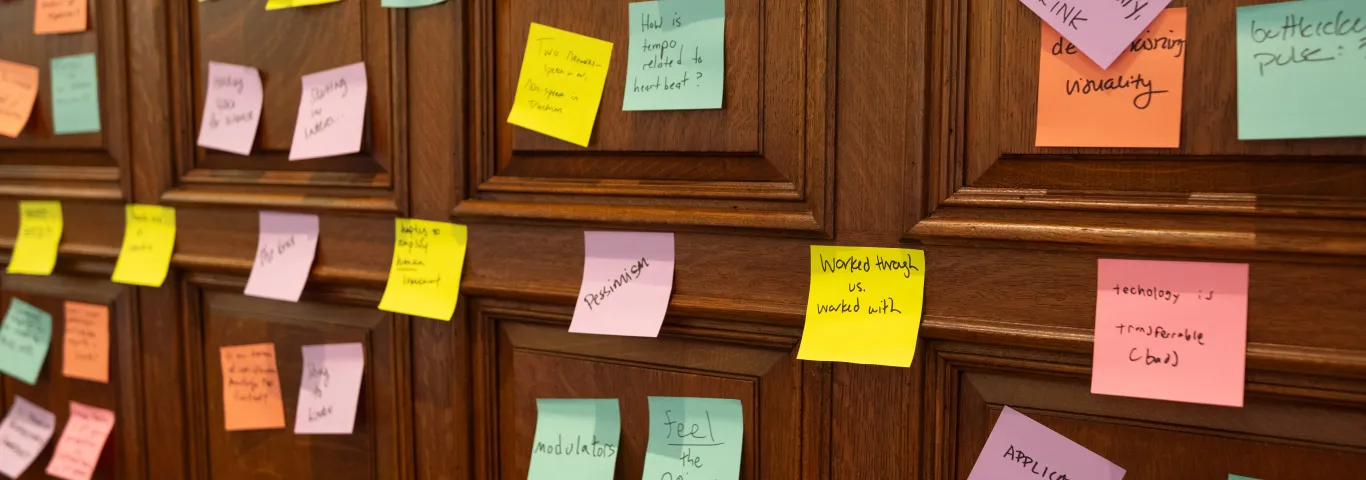
Header image: Attendees at Interpolations 2, another ITF event, filled a wall with sticky notes, capturing ideas, questions, and provocations sparked by hands-on workshops and discussions on the future of performance and immersive technology.