
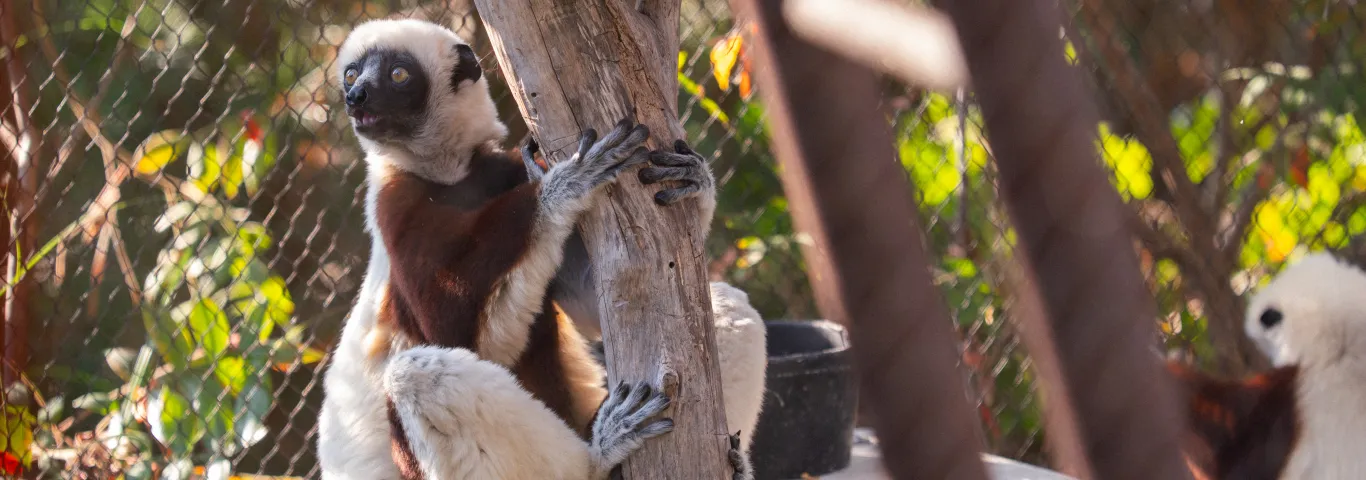
A $1.5 million pledge from Distinguished Trustee Andy Newman will support critically endangered lemurs, gorillas, and chimpanzees through the Living Earth Collaborative.
An ambitious new project will catalyze conservation efforts for critically endangered primates and deploy scalable tools to transform how biodiversity is documented, modeled, and protected worldwide.
The Endangered Primate Information Collaboration (EPIC) will combine on-the-ground expertise and high-tech monitoring to observe and protect populations of diademed sifakas (“dancing lemurs”) in Madagascar as well as western lowland gorillas and chimpanzees across Africa’s Congo Basin. These iconic primates are under threat from habitat loss, poaching, and disease, but it’s not too late to save them, said Crickette Sanz, the James W. and Jean L. Davis Professor in Arts and Sciences and co-director of the Living Earth Collaborative, a driving force for conservation that combines the resources of WashU, the Saint Louis Zoo, and the Missouri Botanical Garden.

“Traditional approaches have provided an extraordinary foundation of ecological knowledge, but they cannot keep pace with the speed of global change and biodiversity loss. We have the opportunity to work together to implement a new generation of tools that has the potential to transform conservation efforts,” Sanz said. “With tremendous gratitude to Andy Newman, this is the time for EPIC solutions.”
Distinguished Trustee Andy Newman made a $1.5 million pledge to support the project through the Eric & Evelyn Newman Foundation. The gift advances the Living Earth Collaborative’s ongoing mission to protect global biodiversity through research and evidence-based conservation actions.
“The scientific strength and expertise of the Living Earth Collaborative is truly one of a kind,” said Feng Sheng Hu, the Richard G. Engelsmann Dean of Arts & Sciences. “Andy’s investment in this project is going to make a tremendous impact not just for these endangered species, but for collaborative conservation science worldwide.”
Jonathan Losos, the William H. Danforth Distinguished University Professor and co-director of the Living Earth Collaborative, said the project will have lasting impacts beyond lemurs, gorillas, and chimpanzees. “These species all depend on healthy forests. By protecting these primates, we’ll be protecting all of the other plants and animals that inhabit these special places.”
New tools for measuring endangered species
By the best current estimates, 600 to 6,000 diademed sifakas remain in the wild, Losos said, a spread that underscores the uncertainties around the elusive animal and its habitat.

EPIC will work closely with local conservationists to conduct surveys of diademed sifakas, gorillas, and chimpanzees in their remaining habitats using a new generation of tools. Researchers will employ camera traps and DNA testing to help clarify the size of the remaining populations, and they’ll employ remote LiDAR sensing and a cutting-edge AI to map and describe the forests in fine detail.
New remote sensing technology now makes it possible for researchers to capture habitat structures in three dimensions, monitor environmental changes in real time, and uncover ecological patterns invisible to the human eye. “We’ll be using entirely new approaches to assess these populations and the condition of their habitat,” Losos said. The comprehensive view will allow researchers, conservationists, and policymakers to forecast how habitats will respond to climate change, land-use decisions, and management plans.
Fueling conservation through collaboration
WashU, the Saint Louis Zoo, and the Missouri Botanical Garden all share a long history of research and conservation programs in Madagascar and other parts of Africa, putting the Living Earth Collaborative in an ideal position to make the most of the EPIC investment. “We are already collaborating with scientists and conservationists throughout these regions to do this vital work,” Losos said. “Few institutions in the world combine the LEC’s scientific depth, global partnerships, and technological reach.”
The Garden manages 13 protected sites in Madagascar, part of a collaboration going back to the 1970s. The Saint Louis Zoo has long played a leading role in the effort to conserve lemurs and their habitat through its Center for Conservation in Madagascar. The Center for the Conservation of Congo Apes, established in 2019, advanced the Zoo’s standing as a leader in the study and protection of African primates.
"The Saint Louis Zoo and its partners have been involved in wildlife conservation efforts in Madagascar since the late 1980s, and we’re excited that EPIC will accelerate important work with critically endangered primates, notably, with the diademed sifakas and African apes,” said Lisa Kelley, vice president of conservation, education & science at the Saint Louis Zoo. Kelley, who is also the Saint Louis Zoo WildCare Institute director and chair of the Madagascar Fauna and Flora Group, an international collaboration of institutions including the Missouri Botanical Garden and WashU, continued, “EPIC further strengthens the Living Earth Collaborative partnership and the conservation work underway through the WildCare Institute Centers."

By fostering an interdisciplinary approach, the LEC can maximize and amplify the impact of the EPIC project. Losos hopes to call on expertise from the McDonnell Genome Institute to help analyze DNA samples collected from the environment, also known as environmental DNA. The research may help identify populations that could merit more concerted conservation actions due to their genetic distinctiveness. “We have one of the world’s great genome centers, and they’re interested in collaborating,” Losos said.
Insights from the research will inform crucial conservation initiatives and policies that involve and empower local communities, governments, NGOs, and tourism operators. One goal is to expand wildlife-friendly tourism to incentivize the protection of primates and other wildlife. The information gathered by EPIC will also be available to inform land-use planning by local communities and governments to ensure the future of these endangered primates.
A gift with global impact
The EPIC project continues the tradition of Andy Newman’s support for wildlife conservation in Africa. In 2021, he established the Newman Madagascar Research Fund to support a LEC project focused on lemur conservation and behavioral ecology. His most recent gift, made through With You: The WashU Campaign, furthers his remarkable impact in sparking innovation, exploration, and engagement from local to global scales and reinforces WashU’s leadership in this global effort.
“The university plays an important role in shaping conservation practices and policies worldwide,” Newman said. “EPIC will advance our ability to confront biodiversity loss and build a healthier planet by supporting some of the world’s most extraordinary primates and their habitats. The work done by our scientists will shape outcomes for communities around the globe.”
Header image: A Coquerel’s sifaka at the Saint Louis Zoo. The Coquerel's sifaka faces an extremely high risk of extinction in the wild. (Photo: Sean Garcia for WashU)


