
Arts & Sciences researchers are working across disciplines to prevent, treat, and ultimately defeat Alzheimer’s disease.
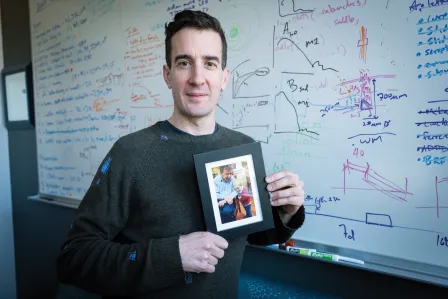
Keith Hengen was a postdoc studying the intricacies of the brain when Alzheimer’s disease began dismantling his father’s mind. Each year, the illness took something new: a memory, a habit, a piece of recognition. Hengen could only watch.
“I felt so powerless and lost,” he said. “The irony was humbling and unavoidable. Here I was, launching a career as a neuroscientist, but I could do absolutely nothing about the most important problem standing right in front of me.”
Steven Hengen died of early-onset Alzheimer’s in 2016, just as Keith was getting started in his academic career.
A decade later, Keith Hengen, now an associate professor of biology, is one of a handful of Arts & Sciences researchers who are approaching Alzheimer’s disease from multiple angles to try to make a difference for patients and their families. “The experience with my dad added a deeply human dimension to my work,” Hengen said. “I love the pure puzzle of the brain, but I also desperately want to shake things up and find real solutions.”
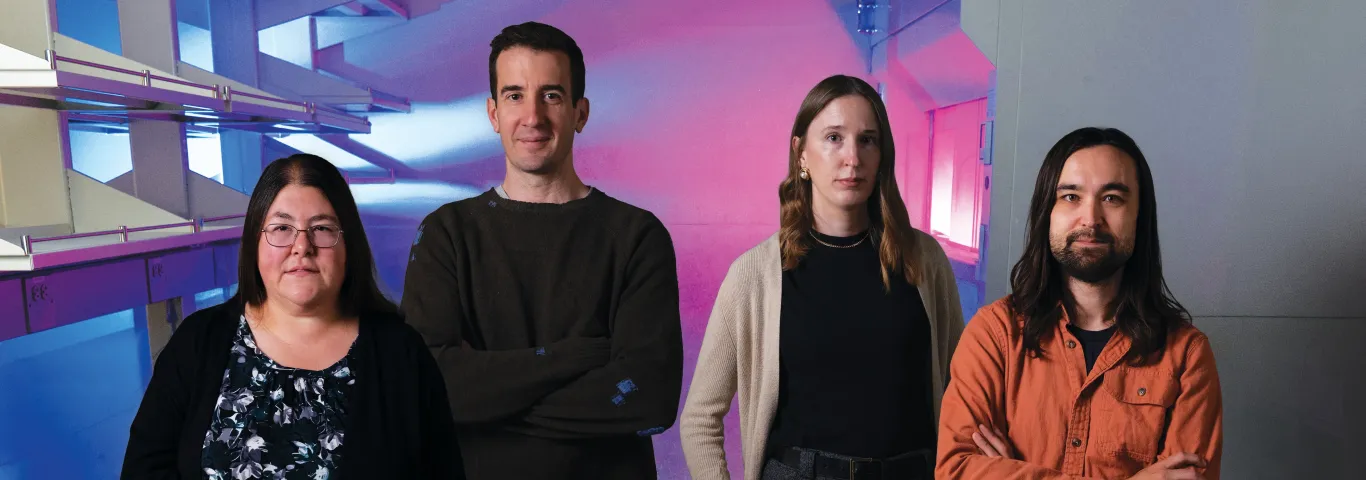
Hengen studies how Alzheimer’s disrupts the computational rules in circuits that support thinking, memory, and learning. Other Arts & Sciences researchers — including Meredith Jackrel in chemistry and Emily Willroth and Zachariah Reagh in psychological and brain sciences — are bringing their own perspectives to a disease that demands a multifaceted approach.
The biochemistry of Alzheimer’s
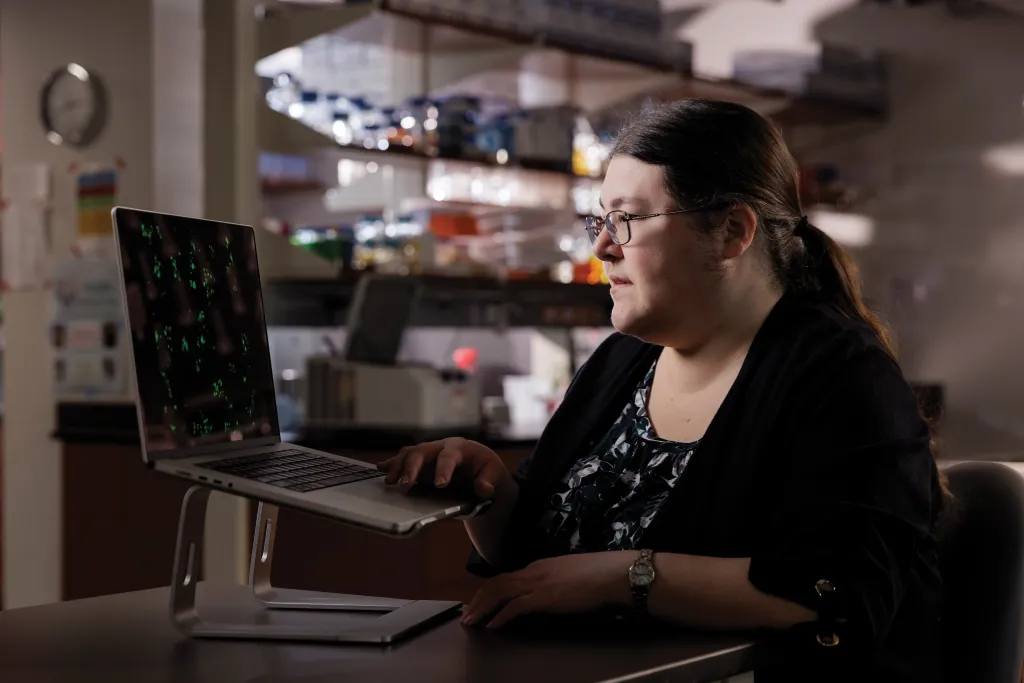
Meredith Jackrel’s lab focuses on the changes that turn normal, healthy proteins into building blocks for plaques and tangles, hallmarks of Alzheimer’s and other neurodegenerative diseases.
Much of her lab’s work is on proteins Hsp104 and HtrA1, so-called disaggregase proteins that can dissolve the clumps associated with diseases like Alzheimer’s, Parkinson’s, and ALS. While some of these disaggregase proteins are naturally found in the body, they aren’t able to prevent the formation of plaques and tangles over time. The lab studies how these proteins might be harnessed to combat disease. Specifically, Jackrel and her team use protein engineering to develop improved versions of these disaggregases to ultimately reverse protein misfolding.
Jackrel, an associate professor of chemistry, is also collaborating with Jai Rudra, an associate professor of biomedical engineering in the McKelvey School of Engineering, on a $2.9 million project funded by the National Institutes of Health (NIH) to develop a novel therapeutic for Alzheimer’s disease. In theory, this therapy — essentially bits of proteins attached to a nanofiber — could train the immune system to clear misfolded proteins that are associated with Alzheimer’s disease.
“The goal is to encourage the brain to produce antibodies against these proteins without triggering inflammation,” she said. “There’s a lot of work left to do, but the hope is that these antibodies could help clear the proteins before they have a chance to accumulate and cause trouble.

Harnessing the power of happiness
Alzheimer’s is a disease of proteins and neurons, but it’s also intricately tied to thoughts and emotions, making it an important target for researchers in the Department of Psychological & Brain Sciences.
As the principal investigator of the Complex Memory Lab, Associate Professor Zachariah Reagh uses neuroimaging and behavioral experiments to track how the brain interprets, stores, and retrieves memories of everyday experiences. By understanding how these processes break down in people with Alzheimer’s, he and his team hope to develop new strategies to protect and preserve memories.
Associate Professor Emily Willroth studies the back-and-forth relationship between Alzheimer’s disease and psychological well-being. In 2024, she led a review study that reached an important conclusion: Happiness and life satisfaction may act as a shield against dementia.
“Well-being seems to protect against cognitive decline,” she said. “But it goes both ways. People who develop dementia can lose their quality of life. We’re looking for specific strategies and interventions that can help people avoid dementia in the first place and support those who are already living with dementia.”
A closer look shows that certain behaviors and lifestyle choices seem to make people especially resilient against dementia, Willroth said. Exercising, eating well, and avoiding smoking are fundamental to good brain health. Beyond that, Willroth and other researchers have found that people who keep their brains busy with challenging tasks coupled with active social lives appear to have additional protection.
“We can tell you who has Alzheimer’s, who will get Alzheimer’s, and who won’t just by looking at a computational fingerprint of the brain.”
—Keith Hengen, associate professor of biology
“Cognitive and social engagement seem to be powerful protective factors,” Willroth said. “The future of Alzheimer’s disease research will be uniting what we know about psychosocial and lifestyle factors with a better understanding of the basic biology of the disease.”
Willroth is a scholar with the Knight Alzheimer Disease Research Center, a consortium of researchers based at the WashU School of Medicine and funded by the NIH. Like other such centers around the country, the Knight Center provides specialized training to select researchers who are committed to studying Alzheimer’s disease in all its facets. As a Knight Scholar, Willroth has been trained in biomarkers, brain imaging, and patient selection for clinical trials. “That experience has enriched my research in Arts & Sciences,” she said. “The expertise at the medical school is an incredible resource for all Alzheimer’s disease researchers on our campus.”
Critical thinking
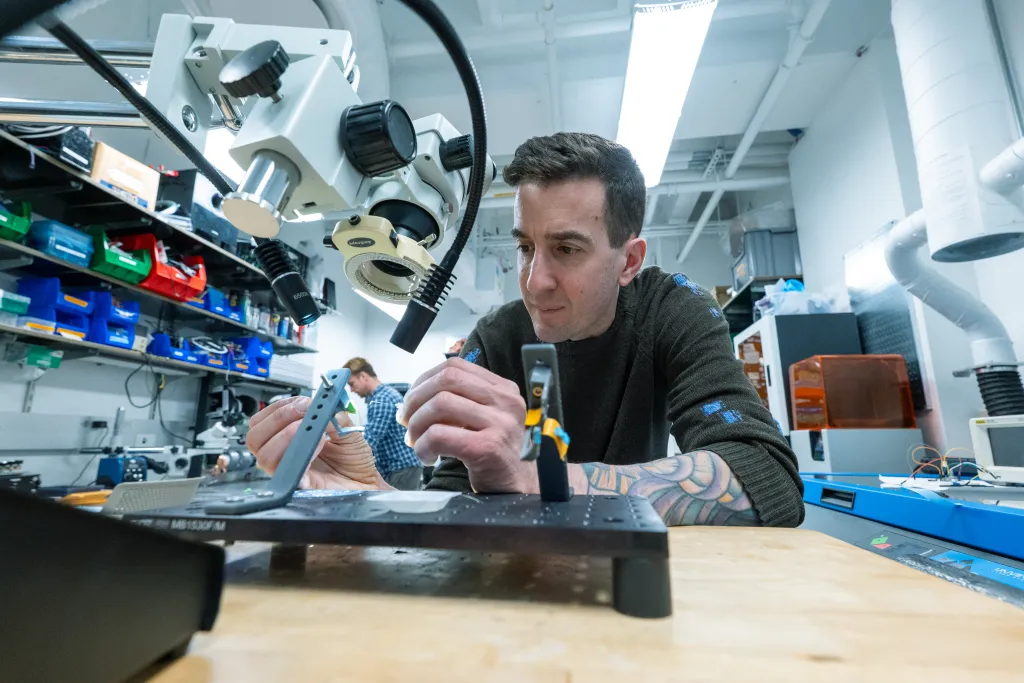
Driven to help more people like his father, Hengen and his multidisciplinary team — including neurologists, mathematicians, and theoretical physicists — have been building on new theories of the brain that could transform the field of Alzheimer’s research.
They contend that Alzheimer’s disease can be thought of as a breakdown in the brain’s operating system. Specifically, they showed that healthy brains are defined by criticality, a state at the razor’s edge between order and chaos. As Hengen and colleagues reported in the journal Neuron, the computational rules of the brain begin to deteriorate long before symptoms arise. “Movement away from criticality is the strongest predictor of future disease,” Hengen said.
With funding from the NIH, the Cure Alzheimer’s Fund, the BrightFocus Foundation, and other groups, Hengen and his team have shown that criticality is a well-defined brain state that can be measured and nurtured. “It took tremendous work with multiple collaborating labs to build up the math and the computational pipelines, but we’ve developed a new way to track how close a brain is to criticality. Now we can make rigorous measurements in clinical data, like fMRI imaging,” Hengen said. “We can tell you who has Alzheimer's, who will get Alzheimer's, and who won’t just by looking at a computational fingerprint of the brain.”
Hengen and collaborator Woodrow Shew, a physicist at the University of Arkansas, are now working to form a company based on this new approach. “I’m not very interested in the world of business, but there’s a moral imperative to make this technology as widely available as possible,” he said. “It doesn’t do anyone any good if it never leaves the laboratory.”
Supported by a $2.7 million grant from the NIH, Hengen and Luis de Lecea of Stanford University have embarked on a five-year investigation into the power of deep, healthy sleep to restore criticality and potentially protect against Alzheimer’s. “We believe the entire purpose of sleep is to preserve criticality, which is necessary for healthy brain function,” Hengen said.
Studies in mice show that experimentally enhancing sleep can push the brain even closer to criticality than normal. “When we give those animals a new, complex task to solve, they learn much more quickly than control mice,” Hengen said. “Imagine yourself on your best day when you’re firing on all cylinders. It seems like we’re consistently inducing that day.” Crucially, even mice bred to show symptoms of Alzheimer’s showed significant improvements in learning and memory after enhanced sleep.
As a complement to pharmacological strategies, sleep offers a powerful and relatively easy platform for fighting back against Alzheimer’s, Hengen said. Focused sleep interventions may be able to help improve cognition in people with Alzheimer’s or those at risk, but even people at low risk can benefit from taking sleep seriously.
“If you spend your day being active and learning new things, you’ll be ready for sleep when the time comes,” he said. “Put the phone away, close the blinds, and sleep until you wake naturally. Good sleep is central to brain health.”
But sleep alone will not stop Alzheimer’s. People with certain genetic forms of the disease may require different, as-yet undiscovered interventions. Even then, they may not be able to escape it.
Despite everything he has learned, Hengen still does not know whether anything could have saved his father. The uncertainty is painful, but it also fuels his work.
“I’ve been on this journey, and I know it’s awful,” Hengen said. “That’s why I get so motivated thinking about Alzheimer’s and the brain. This work is important, and we’re going to keep at it.”


