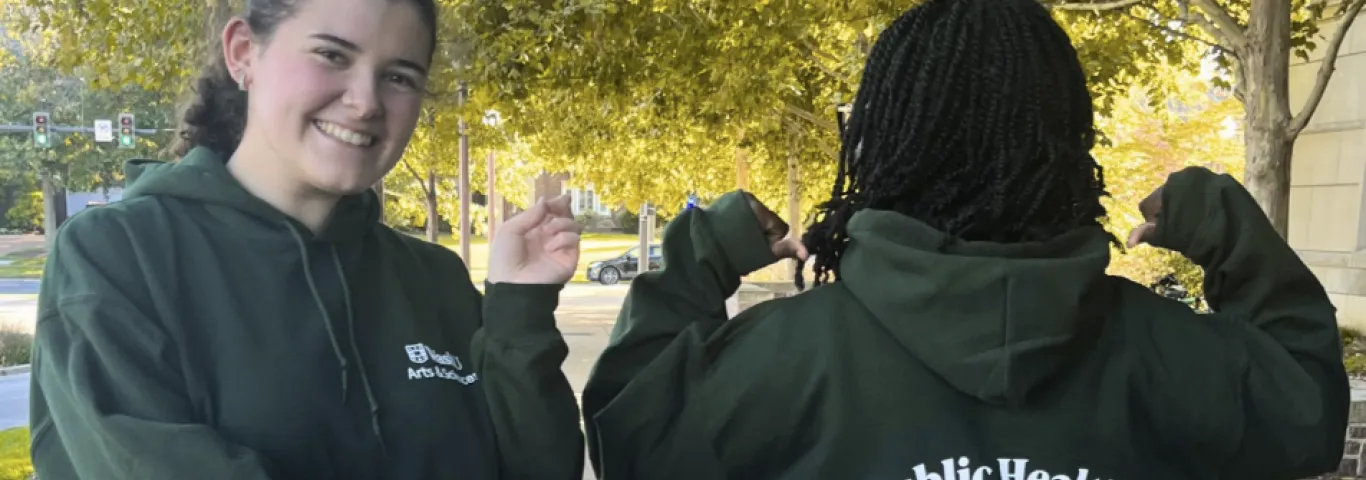
Mia Kouveliotes came to WashU committed to mental health advocacy. Now graduating in the first cohort of the university’s Program in Public Health & Society, she has turned that interest into research, advocacy, and a full-tuition scholarship.

Mia Kouveliotes’s story illustrates the power of an academic minor.
During her junior year, Kouveliotes, a senior majoring in anthropology on the Global Health and Environment track, found the perfect match for her passion with the launch of WashU’s Program in Public Health & Society. While it was too late to add another major, adding the public health and society minor reshaped her studies and how she approached her remaining time at WashU.
After graduating this May, where she will be one of the undergraduate recognition ceremony speakers, Kouveliotes will continue her education at the University of North Carolina’s Gillings School of Global Public Health, where she earned a full-tuition scholarship as part of the school’s competitive fellowship program.
The Ampersand spoke with Kouveliotes about how she found her path to public health and how the Program in Public Health & Society helped prepare her for what’s next.
Why did you focus your studies on public health?
The summer after my first year at WashU, I interned at an inpatient behavioral health unit in New Jersey. It was a crisis stabilization unit, so individuals were only there for three to five days to get them from their crisis point to treatment.
I went there initially thinking that I was going to become a therapist or work in a clinical mental health field. The staff there was amazing, but I witnessed a lot of mental health stigma and systemic issues that led people to get into crises that could have been prevented. There were serious deficits in follow-up care and continuity of care. So many people couldn’t access the medications they needed.
I left that experience wanting to work in the field at a larger, more population-based level so I could work on rectifying these issues.
How did minoring in public health and society help prepare you to take your next steps? What are you taking away from your time in the program?
The Program in Public Health & Society gave me an outlet to express my passion for public health and be a champion for public health at WashU.
It made me realize that I was not isolated in my frustrations with our health care system. Those systemic issues that I witnessed are, in fact, documented.
I also got a good understanding of how broad public health is through my coursework. Public health really is everywhere. It impacts so many different fields.
The program set me apart when I was applying for grad schools, because there are very few institutions that are creating a public health program like ours right now, despite increased interest. WashU's position is very unique in that sense.
While at WashU, you directed an All Student Theatre production of ‘Next to Normal,’ a musical that tackles mental health issues. What inspired you to take on this project, and how can storytelling help address mental health stigma?
One of my biggest takeaways from working in the inpatient psych unit was how every single story I encountered was unique, but they were underscored by a common thread of systemic deficits and mental health stigma.
Storytelling makes those issues accessible to the public because not everyone has the background knowledge in public health to analyze statistics or comprehend a complex research study — nor should they have to.
For “Next to Normal,” I employed some of the research methods and culturally competent tactics I learned in my public health and society classes. I wanted to conduct that production responsibly, because it's no secret that it's a very heavy show.
To talk about mental health in such a creative way on a college campus was really special. It’s probably the thing that I am most proud of. I felt like we really made a difference for those who saw it.
What would you like to explore in the next chapter of your public health education?
In the next few years, I hope to take up research in North Carolina and make a difference in the mental health sphere. What that looks like, I don't exactly know yet.
But I hope to bring mental health into the conversation and integrate it more into our broader health care structure, because it has been historically neglected and stigmatized. I hope to help rewrite the stories of those who need support in a vulnerable moment of their lives. They deserve to feel human, feel seen, and be taken care of.