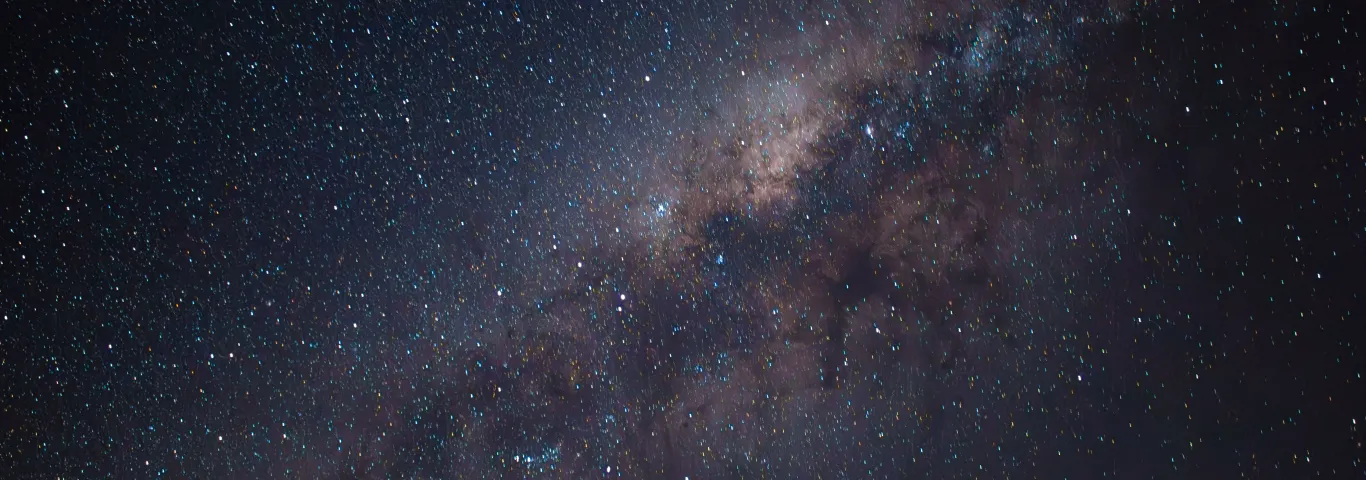
Rising junior Vanya Agrawal combines astrophysics and musicology to create symphonies in novae.

Sound doesn’t travel through a vacuum, but it’s still possible to find music in the cosmos. Vanya Agrawal, a rising junior majoring in astrophysics and minoring in music, thinks about astronomical phenomena in ways that go beyond typical calculations and observations.
Her interest in the musical side of space began in high school in Palos Verdes Estates, California, where she worked with researchers at Palomar Observatory. She helped translate data from 8,000 novae into symphonies in a process called sonification. The brightness of each nova determined loudness, while speed dictated pitch. Using her knowledge of musical composition, she layered on chords and lo-fi beats for an ethereal final product.
At WashU, Agrawal continues developing projects that merge astrophysics and music. She plans to create original compositions using data she has collected at the university. She noted that space sonification creates vast possibilities for outreach, with researchers at the Vera C. Rubin Observatory in Chile sonifying data from distant galaxies to create a soundscape of the cosmos.
In a first-person essay published in Sky and Telescope magazine, Agrawal wrote that sonification can help bridge scientific research and public understanding. Not only can non-scientists listen to the music to get a different perspective on the cosmos, but they can also use sonification tools to make their own music. “It’s a new way for people to interact with data,” she said. “Sonification uses senses to try to understand something we haven’t fully comprehended.”
Agrawal collects her own data as an undergraduate researcher in the lab of Henric Krawczynski, the Wilfred R. and Ann Lee Konneker Distinguished Professor in Physics. Among other things, she works on analyzing the performance of gamma ray detectors and optimizing them for future space missions. “Professor Krawczynski’s lab is amazing because there’s so much going on,” Agrawal said. “It gives me the chance to explore so many different aspects of physics research.”
Alongside her research, Agrawal is a member of the WashU Satellite space mission engineering team and performs with Sur Taal Laya, a campus a cappella group that blends Western and South-Asian music styles. This summer, she will intern with Reflect Orbital, a satellite company focused on developing 24-hour sunlight that can be used to generate solar energy, increase agricultural output, and illuminate emergency zones.
A California native, Agrawal came to WashU after receiving a prestigious full-tuition Ampersand scholarship. She said she was drawn to the university’s collaborative environment. “I was looking for a place where I could combine my interests in music and astrophysics, and WashU was a great fit,” she said. “A lot of universities say they are collaborative, but WashU really means it.”
As she looks ahead, Agrawal is considering a second major in systems engineering as she continues exploring both the scientific and applied sides of space work. “I really love astrophysics, but I've also been getting more interested in the applied side of space studies. I’d like to take a big-picture view of different aspects of a space mission.”