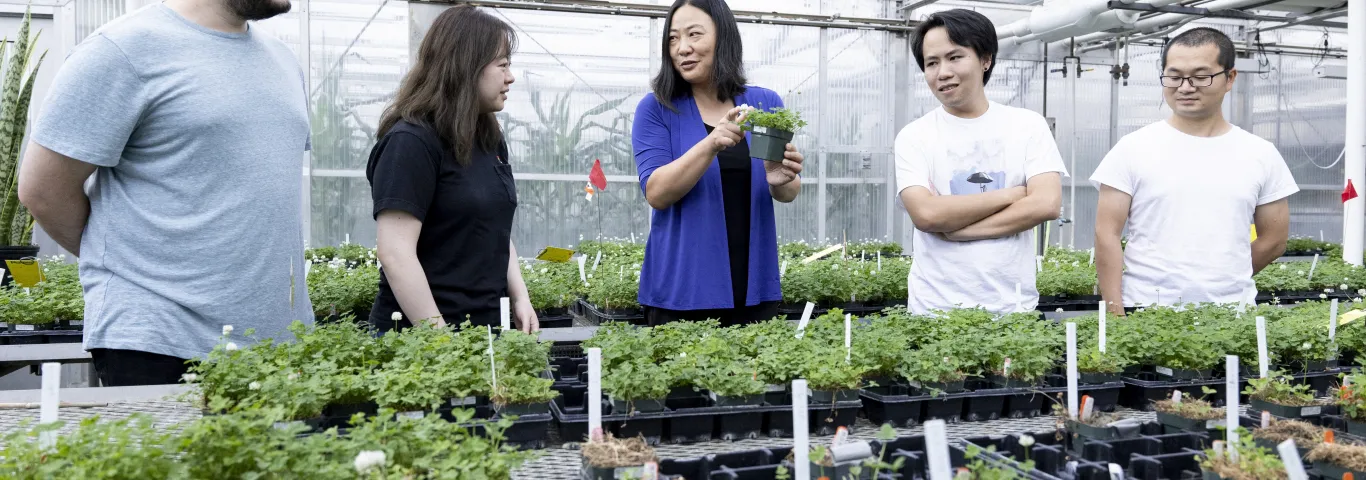
A new study by researchers including Xuehua Zhong discovered how epigenetics helps plants bloom when nutrients run low.

From roses to rice, every flowering plant eventually has to make a crucial decision: When is the best time to produce flowers? The timing matters more when plants face life-threatening stress. Understanding when and how plants decide to flower could also be valuable to agriculture and efforts to feed a growing global population.
A new study led by researchers in the Department of Biology, published in the Proceedings of the National Academy of Sciences, has revealed new insights into the mystery of flowering. This timing largely comes down to epigenetics, the factors beyond DNA that determine when genes are turned on and off.
“Epigenetics regulates everything in a plant’s life from birth to death,” said Xuehua Zhong, a professor of biology and senior author of the study. “We’ve now identified one way that epigenetics helps trigger flowering.”
Postdoctoral researcher Wenwen Tian is the lead author. Other co-authors are Shuiming Qian, an assistant research professor, and Jacob Brunkard, a geneticist at the University of Wisconsin–Madison. The work was supported by the National Institutes of Health (NIH) and the National Science Foundation (NSF).
Studying the go-to model thale cress (Arabidopsis thaliana), a flowering weed that grows quickly and easily in the lab, Zhong and her team found that the epigenetic forces that control flowering are sensitive to the amount of nitrogen in the environment. When nitrogen is scarce, the plant accelerates flowering to complete its life cycle quickly to produce seeds.
Even amateur gardeners know that a lack of nitrogen causes poor flower development and stunted growth, but it took years of experiments and genetic analysis to show exactly how the nutrient affects flowering in thale cress.
Zhong and her team identified two key parts of the puzzle. One is an important enzyme called TOR that acts as an energy and nutrient sensor and regulates cellular growth and metabolism in both plants and animals. The second is EBS, a protein that “reads” epigenetic changes within plant cells.
The researchers showed that when plants detect a shortage of nitrogen, TOR activity drops. This destabilizes EBS, a protein that bonds to chemical marks on histones, the spool-like structures that support DNA in each cell. Sensing these changes, plants bloom earlier, a survival strategy that shifts resources from growth to reproduction under nutrient stress.
The study is the first of its kind to connect the dots between nitrogen, epigenetics, and flowering in plants. “It was a cool puzzle to put together,” Zhong said.
Because EBS is known to exist in important food crops such as rice and barley — and likely many others — the insight could eventually help increase agricultural productivity.

If scientists can find a way to finely tune EBS in crops — perhaps through genetic engineering — they could potentially increase food production without the need for so much nitrogen fertilizer. “Nitrogen fertilizer is expensive and potentially harmful for the environment, so anything that could help farmers cut back would be a huge benefit,” Zhong said.
Zhong and her collaborators have recently received more than $9 million in funding from the NIH, NSF, and the U.S. Department of Energy to study epigenetics and develop new agricultural technologies, reflecting both the importance of the research and Zhong’s leadership in the field.
“Funding agencies are looking to support impactful research and promising technologies, and they know that my lab has a track record of producing high-impact results,” Zhong said.
The latest study underscores the fundamental role of epigenetics in sensing nutrient conditions to modulate plant growth and development, Zhong said. But the implications could reach even farther.
“We know that the TOR enzyme is also important for human cells,” she added. “If epigenetics can control TOR in plants, it very likely has a similar effect in humans. This is an area that needs a lot more study.”
Zhong plans to go beyond thale cress to study the interplay of nitrogen and epigenetics in rice, the world’s most important food crop. She also hopes to identify the receptors that plants use to sense nitrogen levels, another part of the picture that remains unclear.
“We have a lot of other studies in the pipeline,” Zhong said. “This is an exciting time in our lab.”