
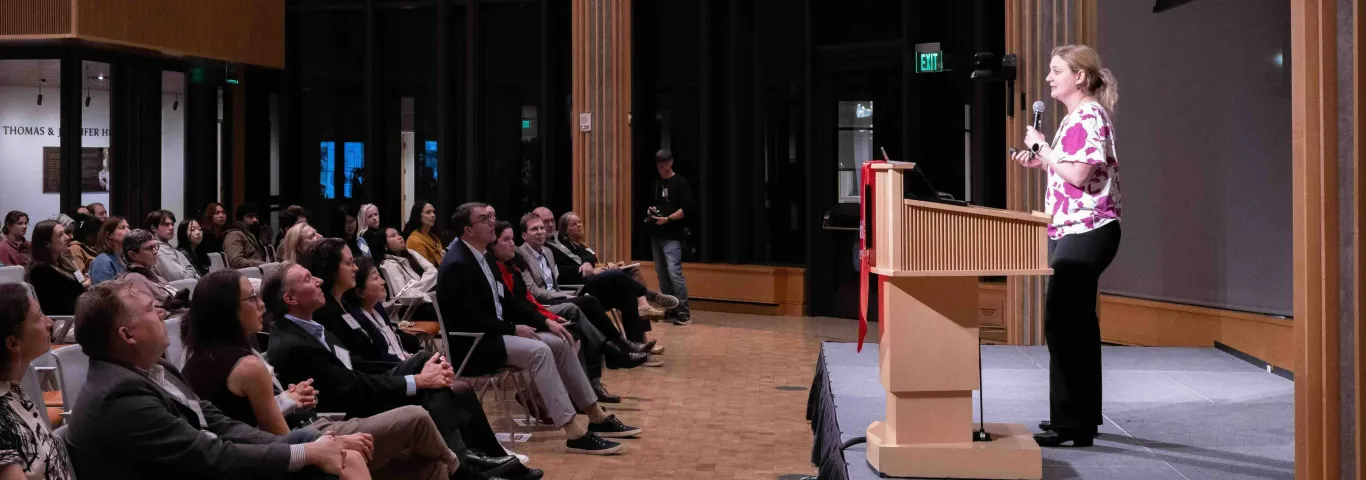
Arts & Sciences faculty are transforming classrooms by taking students into communities, workplaces, and digital spaces, creating lessons that resonate far beyond campus.
When prospective Arts & Sciences undergraduates tour classrooms on the Danforth Campus, they won’t be stopping in alleyways in St. Louis’ Dutchtown neighborhood. But that’s where you’ll find environmental studies instructor Scott Krummenacher’s students, working with community officials to help tackle the root causes of illegal trash dumping.
Across the river in Illinois, you might find Senior Lecturer Kate Wilson’s Latin poetry students on a soybean farm, gaining agricultural knowledge to help them understand a pivotal first-century Virgil poem.
These are just a few of the ways WashU’s classrooms extend far beyond the campus walls through innovative teaching that makes an impact not only on students but on the entire St. Louis region.
“Teaching and learning don’t stop at the campus boundaries,” said Krummenacher, co-director of the “Sustainability Exchange,” a course that pairs undergraduates with civic organizations where they get real-world experience helping solve community challenges. “There are these great positive spillover effects that we get from creative teaching, where students learn to think and interact in new and transformative ways. They take that with them during their studies and as they go forward in life.”
Krummenacher and Wilson were two of nearly a dozen Arts & Sciences faculty members to present their innovative teaching techniques this fall at the inaugural Teaching Innovation Showcase, a lightning-round-style live event before an audience of nearly 140 students, faculty, alumni, and community members.

The showcase provided a peek into novel teaching techniques and their positive effects on students and the St. Louis region, said William Acree, vice dean of interdisciplinary initiatives and innovation.
“One in five WashU students stays in the St. Louis area after graduation,” Acree said. “The active teaching and learning in Arts & Sciences feed the regional ecosystem, and it’s exciting to see teaching methods that break down traditional walls.”
Some of the instructors featured at the showcase found new ways to break down virtual walls, too, including the sometimes-precarious one between pedagogy and artificial intelligence. Several presenters shared AI techniques they developed to foster critical thinking — both about the course material and the use of AI itself.
Spanish instructor Ally Milner presented a novel method of encouraging students to use AI for certain problems — not to get answers, but to judge the quality of AI-generated responses using knowledge from the course. For example, when students see the label “Complete with AI” on a question, they know to feed the question into an AI tool such as ChatGPT and then analyze the quality of the answer based on what they’ve learned in the classroom.
While there is a healthy level of skepticism about AI and teaching, she said, students who learn how to use the technology appropriately can take those skills into the workplace and community.
“Maybe they're sharing that technique with their roommates and family members. Maybe they're internalizing that tool so that when they go out into the workplace, they know when it is — or is not — appropriate, and they can teach that to their co-workers or their bosses,” Milner said. “When it comes to teaching and learning, there’s always a ripple effect.”
That ripple effect goes both ways, said Wilson, the classics instructor who uses farming to help teach Virgil’s “Georgics,” a four-book Latin poem that reflects on rural life in the time of Augustus. Her students visit a crop farm in Illinois and a beekeeping operation in St. Louis to learn about the pressures of farming and how they might have shaped Virgil’s work.
“St. Louis has so much to help us teach with in terms of industry and culture,” Wilson said. The Muny, St. Louis’ outdoor summer musical theater, resembles ancient theater in many ways and is used for teaching by Tim Moore, the John and Penelope Biggs Distinguished Professor of Classics and chair of the department, she said. “Ancient drama is performed in an amphitheater and there’s usually music involved, so the performances there are one of the best modern parallels to the experience of seeing one of these dramas performed.”
The relationship between teaching and research is reflective of Arts & Sciences’ transdisciplinary mission, said political science professor Jacob Montgomery. He presented an AI chatbot resembling his own teaching style, but with one important caveat: The tool does not give students answers. Instead, it refers them to specific course materials that can help them re-learn material or “get unstuck,” he said. “Students want to use AI, but they don’t want to cheat,” he said. Custom chatbots like the one Montgomery built could bridge the gap. “They can hint, they can nudge, they can suggest, they can unstick, but they cannot provide an answer.”
Innovative teaching and problem-solving techniques like those presented at the showcase are key to preparing undergraduates for the future, said Krummenacher of the “Sustainability Exchange” course, which involves multiple teams of students and faculty advisers.
“When students are sitting down for that first job interview, they will inevitably be asked the question, ‘What makes you qualified to work on these big problems?’” Krummenacher said during his presentation. “Instead of talking about their GPA, these students can say, ‘I’m qualified because I’ve done it. I've helped MasterCard advance their sustainability program. I've helped a local government develop their first greenhouse gas inventory. I've helped the Food Policy Council write legislation on urban farming. I've helped Forest ReLeaf create a strategy for replanting trees.’ And that’s a game-changing differentiator on their journeys after they graduate.”
Header image: Kate Wilson presenting at the Teaching Innovation Showcase. (Credit: Sean Garcia)
Teaching Innovation Showcase: The Big Ideas Breakdown
About 140 faculty, staff, students, alumni, and community members voted on their favorite presentations at Arts & Sciences’ inaugural Teaching Innovation Showcase on Nov. 18. Each category winner received a $1,000 prize.
Jacob Montgomery
Incorporating Technologies to Enrich Learning Experiences and Outcomes
Kate Wilson
Integrating Experiential Elements that Facilitate New Skills Development
Scott Krummenacher
Incorporating Cross-departmental/Transdisciplinary Opportunities or Literacies for Life and Career


