
WashU scientists in biology, chemistry, and physics are using new tools to study evolution, design materials, and model cellular behavior.
Some questions in science are too complex for any single human mind to solve alone. At WashU, researchers are increasingly turning to artificial intelligence, using machine learning and neural networks to analyze large datasets, detect patterns, and make predictions across biology, chemistry, and physics.
This shift is reflected in the work of Michael Landis, an assistant professor of biology who studies evolution through deep time and uses AI to reconstruct the history of life on Earth; Zhiling “Zach” Zheng, an assistant professor of chemistry who applies computational tools to discover and predict the behavior of metal-organic frameworks; and Trevor GrandPre, an assistant professor of physics who models how proteins behave and interact inside living cells.
Zheng and GrandPre came to WashU in 2025 as part of the Rules of Life Initiative, a collaboration of the departments of biology, chemistry, and physics that promotes cross-disciplinary research to address fundamental questions of life on Earth. All three will discuss their work at Advances in Digital Innovation Across Arts & Sciences and Beyond, a daylong event scheduled for May 8.
Filling in the gaps

As a biologist studying evolution through deep time, Michael Landis faces a fundamental challenge: Much of the evidence has disappeared. “We can collect living plants or animals and characterize their morphology and genetics,” he said. “But for most groups, when you go back deeper in time, you’re lucky to find even a few fossils documenting their origins. In general, it's hard to know exactly what happened in the past.”
Fortunately, artificial intelligence platforms have a remarkable ability to fill in missing data points. Landis and his team use mathematical models to simulate the morphologies, genetics, and distributions of long-lost plants, animals, and viruses. They then use these simulations to train AI networks to model the histories of living species. “We take hundreds of thousands to millions of simulated examples of what the truth should look like under an evolutionary model and use them to teach the neural network to reconstruct the past,” Landis explained.
Every reconstruction is rooted in reality. “These mathematical models encode the rules of living systems based on what we know about biology and evolution,” Landis said. To validate the process, they run trials on real biological data from well-known scenarios. “In some cases, we know the evolutionary history of a group very well,” Landis said. “If our AI can accurately reconstruct the past in these cases, we know the tool might be able to teach us something new about other understudied groups of species.”
A promising framework
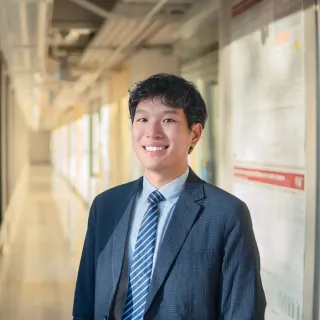
Zach Zheng, an experimental chemist, uses computational power to sort through millions of possible combinations in his quest for new metal-organic frameworks (MOFs). Combining metals with organics creates structures with many empty spaces between atoms, creating crystal sponges with many potential applications, including water purification, carbon capture, and drug delivery.
As Zheng and co-authors recently explained in the journal Matter, artificial intelligence has sent the discovery of new MOF possibilities into overdrive. With AI as a guide, researchers around the world have already created more than 100,000 distinct MOFs, and millions of other potential MOFs have been identified but not built.
Not every potential combination is worth pursuing. “Creating a new material sounds exciting, but we need to make sure it’s a worthy discovery,” Zheng said. “We want to know as soon as possible if a particular combination is even worth trying, so we don’t waste time or resources on a dead end. AI can help us identify potential combinations that have the properties we’re looking for.”
Predicting the properties of a material that has never existed in the known universe is no easy task. “We have to push the AI to go beyond what we already know,” Zheng said. “That starts with giving it as much real-world data as we can. We also try to stick to well-defined questions in specific regions, and we use our own knowledge of chemistry to decide if the conclusions and suggestions make sense.”
Laws of attraction
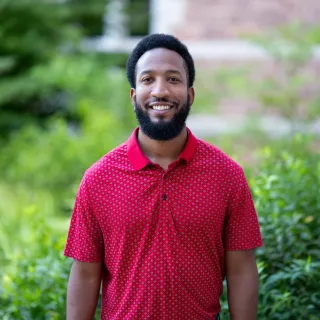
Trevor GrandPre and his team use computation and AI tools in work that bridges physics and biology. He is especially interested in cellular phase transitions, where molecules such as proteins and RNA clump together to form liquid-like droplets known as condensates. These clumps aren’t contained by membranes, but they are still discrete and well-defined, an example of the attractive forces that keep our cells organized and healthy.
“Phase transitions are a fundamental part of life, but we don’t fully understand how or why they happen,” GrandPre said. To learn how and why condensates form, researchers have to look at the architecture of each protein and identify the specific regions that drive attraction and attachment. “A protein could have a thousand amino acids, so the possibilities get very complex very quickly,” GrandPre said. “To simplify things, we’re building experimentally based models to identify the most realistic scenarios.”
GrandPre and his team use physics-informed models to perform large-scale simulations of condensate formation. Most existing models are based on simplified, test-tube conditions and do not fully capture the complexity of condensates inside living cells. GrandPre uses machine learning in combination with high-throughput experimental data to refine these models. The goal is to identify the precise biophysical interactions that govern how condensates form, dissolve, and reform. This combination of experimentally grounded modeling and artificial intelligence enables insights that would not have been possible in previous decades, GrandPre said.
The phenomenon of phase transitions is a recurring theme in biology. From flocking birds to firing brain neurons, the pattern of sudden organization, break-ups, and re-organization shows up again and again. GrandPre has no plans to study starlings, but he is interested in using physics-informed AI to better understand phase transitions in the brain. “The idea is to use information theory derived from physics to study the dynamics of communication between neurons,” he said. “We see a lot of exciting possibilities.”
As AI becomes even smarter and faster, WashU researchers in biology, chemistry, physics, and other fields will be ready to take advantage of the new possibilities. Still, they’re planning to proceed with caution. “There are new developments in AI all the time, but there’s no guarantee that any new tool will be better than the previous one,” Zheng said. “We need to make sure that the technology is actually useful before we adopt it.”
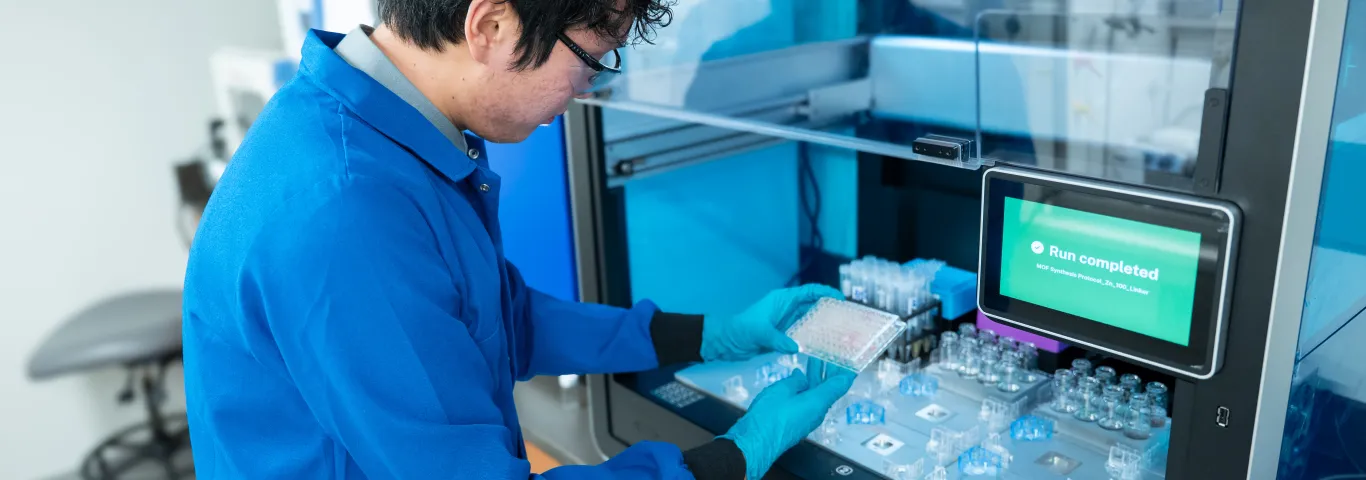
Header image: In his lab, Zach Zheng works through many possible metal-organic framework combinations to find structures with useful properties.


