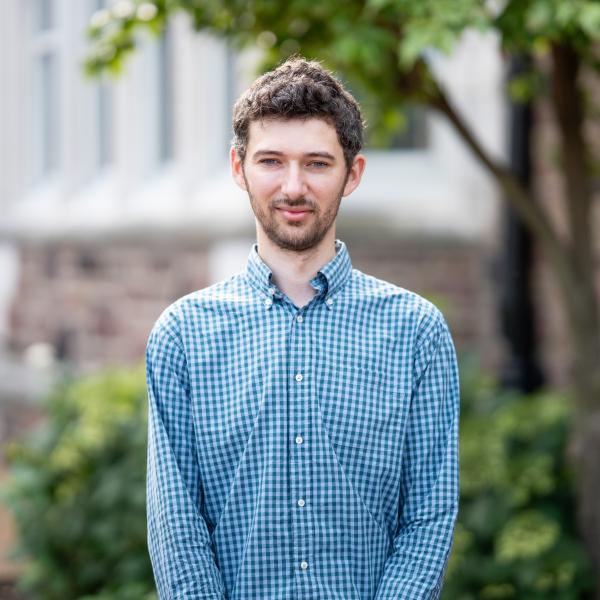
The scholars will present their projects at a Department of History gala in April.
Calvin Crossland and Jennifer Ong have been named 2026 Living History Scholars by the Department of History. The program invites undergraduates to conduct scholarly historical research that engages the past in new, creative ways and fosters learning beyond the walls of campus.
Each selected project must be on a historical topic, with the aim of producing a learning outcome for the broader community. At the conclusion of the project, each scholar presents their research at the annual history department gala in April.
Professor Timothy Parsons directs the program, which is now in its fifth year. Corinna Treitel, the William Eliot Smith Endowed Professor and chair of the history department, has been impressed with the work of this year’s scholars. “Both of these projects embody the spirit of Living History, which seeks to empower our students to formulate their own research projects and present their findings to public audiences,” she said. “These students set a very high bar for research innovation and excellence.”

Calvin Crossland, a junior double-majoring in history and economics, is producing a podcast series that examines the role that British East African colonies played during World War II. The series is divided into four episodes: the first provides an overview of the former colonies' participation in the war, the second explores the individual experiences of the men who served, the third examines the impact on the lives of wives and widows of the soldiers, and the fourth addresses the issue of the war graves of those who served and died. The project emphasizes the mistreatment and racial discrimination these men faced under British colonial authorities — mistreatment that continued after their deaths.
Senior Jennifer Ong, who is double-majoring in chemistry and biology, is creating a documentary short about two well-known St. Louis cemeteries: Bellefontaine and Greenwood. Bellfontaine, known for its distinct architecture and careful preservation, is the resting place of many prominent white St. Louisans. By contrast, Greenwood, the first commercial burial ground for African Americans in St. Louis, remains in a severe state of disrepair. To understand the evolution of these cemeteries and their public perception, this project combines archival research with interviews with historians and organizations working in these locations to capture the intersecting narratives of the past and present.
Despite majoring in STEM, Ong said the Living History Scholars program has been extremely beneficial to her education. “The core of science is communicating findings effectively, and the Living History Scholars program has allowed me to explore many modes of communication, particularly through more artistic means,” she said. “It also connects me to the St. Louis community — the population I conduct health research on — helping to contextualize my results and the historical significance behind my data.”
On April 27, Crossland and Ong will present their projects at “We’re Making History,” the department's end-of-the-year event.
Applications for next year’s Living History Scholars program are due in mid-November. Interested students are encouraged to contact Parsons (tparsons@wustl.edu.)