Graduate student Shravan Menon identified a phenomenon that could catch an extreme case of general relativity in action.

In 1916, Albert Einstein forever changed physics — and our understanding of the universe — by publishing his theory of general relativity. The theory defines gravity as not just a force, but as a consequence of massive objects warping the fabric of spacetime itself. Among other results, he also proposed that rotating objects should drag the surrounding spacetime — a phenomenon known as frame dragging.
A new study led by Shravan Menon, a graduate student in physics, uncovered a unique, previously overlooked approach for testing this phenomenon near rapidly spinning black holes. The study, published in The Astrophysical Journal Letters, was co-authored by staff scientist Kun Hu and Henric Krawczynski, the Wilfred R. and Ann Lee Konneker Distinguished Professor in Physics. The study was supported in part by the McDonnell Center for the Space Sciences.
In the 110 years since Einstein’s theory was published, it has been repeatedly proven correct. But that hasn’t stopped physicists from continuing to search for new opportunities to push the theory to its limits. Some of its most extreme predictions remain difficult to verify directly, Menon said.
In particular, examples of frame dragging near the event horizon of black holes have been very challenging to observe. “In science, we keep testing something as long as there’s still something to be learned,” he said. “In the case of Einstein’s theory of gravity, we’re still unsure how it works in extreme environments.”

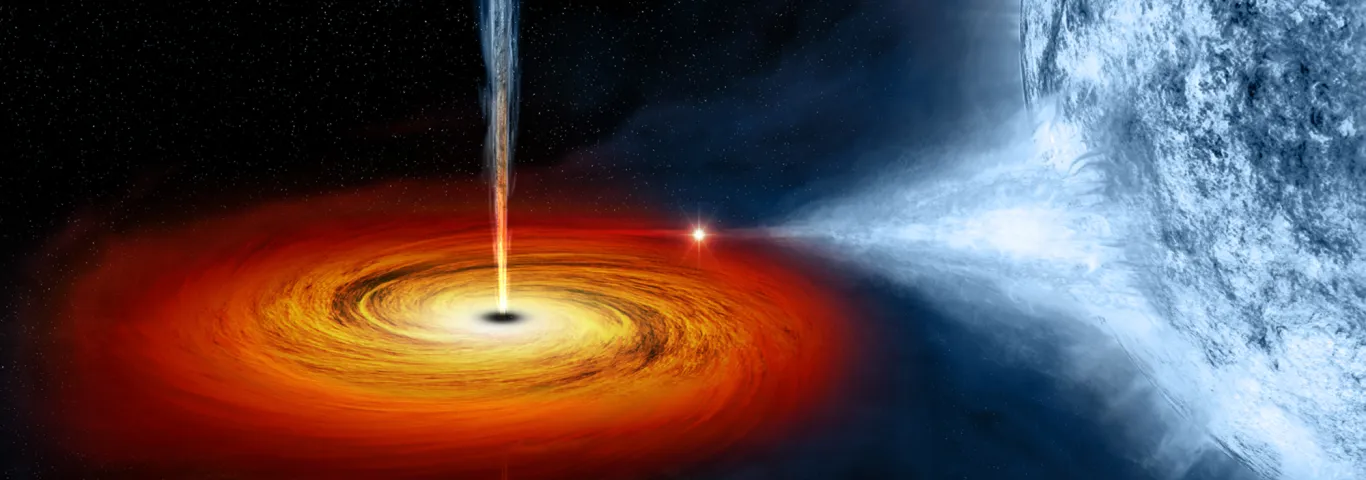
Using computer simulations created by Krawczynski, the team modeled emission from black hole X-ray binaries — systems in which a black hole pulls gas and plasma away from the companion star, creating a swirl of matter around it known as an accretion disk. As a black hole's spin increases, the inner edge of the accretion disk moves closer to the event horizon, Menon said. “This allows the material to probe the deepest parts of the environment, creating an ideal scenario for observing the effects of gravity on light and high-energy particles,” he explained. “The closer you get to a black hole, the more pronounced the effects of gravity become.”
The WashU team focused on gravitationally lensed photons, light bent backward by the black hole's intense gravity. Instead of being pulled into the black hole, some of these photons reflect off electrons in the inner accretion disk, gaining large amounts of energy from the collision and the rotating spacetime. These reflected photons then escape into space, carrying a distinct signature that allows astronomers to differentiate them from other high-energy photons. “In our simulations, we found photons gaining tremendous energy from collisions close to the black hole,” Menon said. “It’s a signature of extreme frame dragging in action.”
This newly identified signature should be detectable in highly spinning black hole X-ray binary systems such as Cygnus X-1, but detecting the phenomenon requires an X-ray telescope with broadband spectral and polarimetric coverage to isolate it from other emission components. “Henric’s simulations are highly accurate, but we would really need observations to confirm our prediction,” Menon said.

Krawczynski is a co-principal investigator of XL-Calibur, a balloon-borne X-ray telescope that gathered data on Cygnus X-1 after launching from Sweden in 2024. The mission successfully measured polarized light to clarify the origin of its hard X-ray emission and accretion disk dynamics, but it was not configured to capture the specific high-energy spectrum needed to isolate the signature described in the new paper.
Menon is developing next-generation detectors for the upcoming XL-Calibur mission, scheduled to launch from Antarctica in 2027. The enhanced X-ray Timing and Polarimetry (eXTP) satellite, currently slated for launch in 2030, will also have the capabilities to measure the signature effect in Cygnus X-1.
Data from these missions will give physicists a clearer view of the effects of gravity in extreme environments. Beyond testing general relativity, Menon noted that the new light signature will offer another crucial insight. “The signature depends on the black hole's rotation, so it will give us a new way to measure how quickly a black hole is spinning.”
Header image credit: NASA, CXC, Melissa Weiss (CXC)