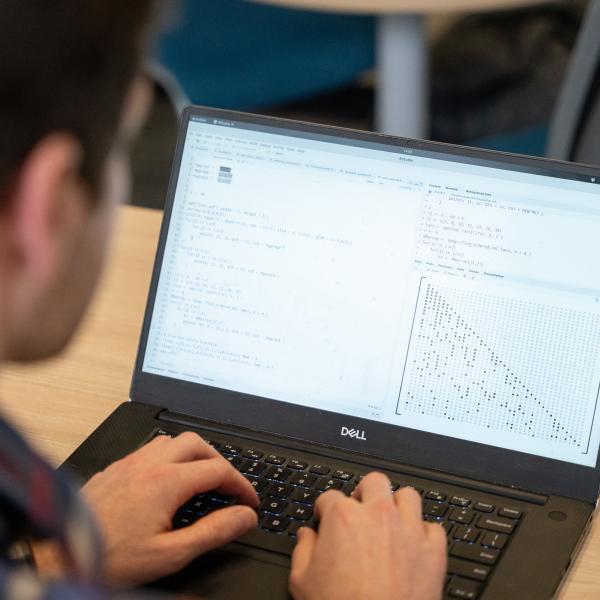
Scott VanBommel led a close-up examination of the dust future astronauts will encounter on Mars.
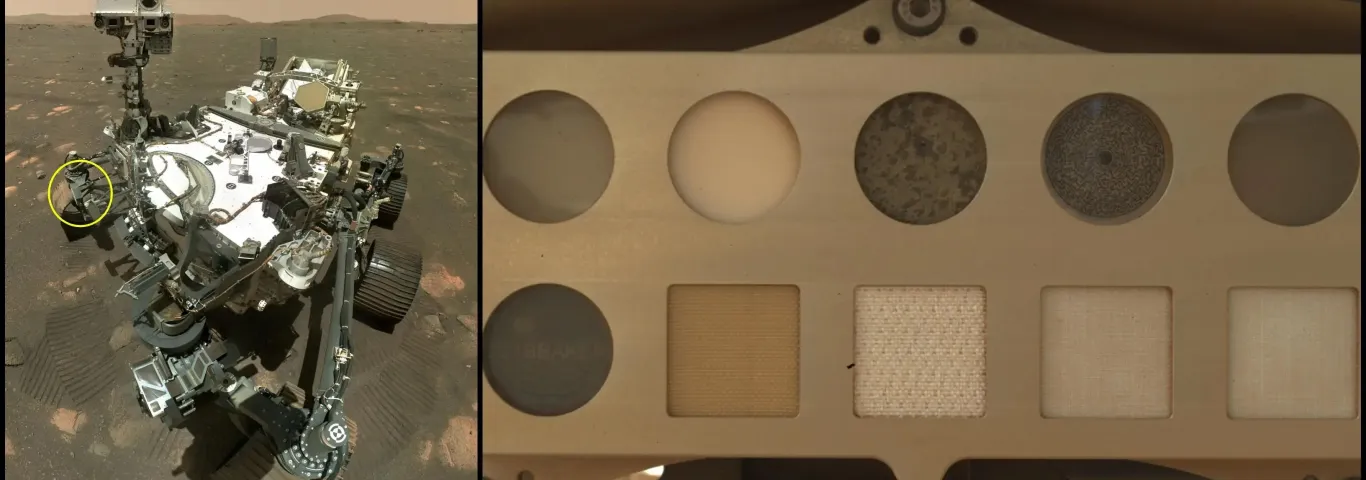
Tucked away among its sensors, cameras, and navigation tools, NASA’s Mars rover Perseverance is wearing small swatches of spacesuit material. A rover doesn’t need a spacesuit, but the swatches — each less than a square inch in size — still serve an important purpose: They’re helping scientists assess the potential damage caused by ubiquitous Martian dust.

“Mars is a very dusty place,” said Scott VanBommel, a research assistant professor of Earth, environmental, and planetary sciences. “Astronauts to Mars will have to be prepared.”
VanBommel is the lead author of a new paper in the Proceedings of the National Academy of Sciences that examines how dust interacts with Perseverance’s spacesuit swatches and other materials, including Teflon. Co-authors include Abigail Knight, a staff scientist who helped conceptualize and conduct the analysis as a PhD student. Both researchers are also fellows of the McDonnell Center for the Space Sciences.
Planners of future Mars missions have good reason to plan around dust. On the Apollo missions, which were far shorter than any potential visit to Mars, lunar dust scratched visors and degraded spacesuits. When the astronauts returned to the lunar module, particles clinging to their suits contaminated the air and eventually entered their lungs, causing hay fever-like symptoms in some cases.
The new study suggests Martian dust may not be quite as abrasive or irritating as its lunar counterpart. The swatches showed little visible wear after 1,645 Martian days, an encouraging finding for future visitors.
Closer inspection revealed that particles on Mars were much smoother than the jagged grains found on the Moon, suggesting they may be less likely to scratch equipment or irritate human lungs. “The particles in the Martian atmosphere have been blowing in the wind for potentially billions of years, so they tend to be well rounded, like pebbles in a river,” VanBommel said.
But there’s another problem: Martian dust can be exceptionally fine. VanBommel developed a method to estimate the size of each particle, some of which were ultrafine specks measuring as small as 100 nanometers (one ten thousandth of a millimeter) across.
On Earth, ultrafine particles from smoke and other forms of air pollution pose a significant health threat because they can penetrate deep into the lungs and enter the bloodstream. Astronauts won’t breathe the Martian atmosphere directly, but engineers will need to account for these microscopic hazards when designing habitats, spacesuits, and air filters, VanBommel said. “The electrostatic properties of Martian dust are likely causing it to preferentially adhere to some surfaces,” Knight added.
The data acquired by Perseverance’s PIXL (Planetary Instrument for X-ray Lithochemistry) instrument, also enabled the researchers to analyze the particles’ chemical composition. Unlike lunar dust, the material on Mars contains perchlorates and other potentially toxic compounds. It is also enriched in sulfur, iron, and silica.
Brief exposure to these substances may not be sufficient to seriously threaten astronauts’ health; a lot comes down to dose and duration, but their presence adds another risk for mission planners to consider, VanBommel said.
Perseverance and previous rovers have given researchers remarkable insights into the history and current conditions on Mars. But beyond their scientific discoveries, these missions also serve as real-world tests of technology that could one day support human exploration.
“We’ve been operating rovers on the surface of Mars continuously for more than 20 years at this point,” VanBommel said. “We know that dust will be a challenge, but it’s something we can prepare for and overcome.”
Header image: The rover Perseverance carries swatches of spacesuit material to test the impacts of Martian dust. Credit: NASA/JPL-Caltech.