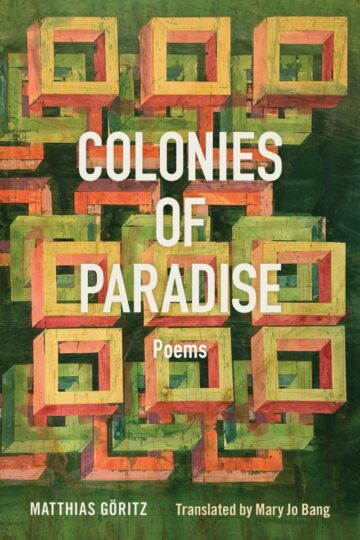
The first book of poetry by Matthias Göritz to be available in English, in a translation by a renowned writer.
Very few books of poetry by contemporary German writers are available to English-speaking readers. In “Colonies of Paradise,” acclaimed poet and translator Mary Jo Bang introduces the poems of novelist, poet and translator Matthias Göritz, one of the most exciting German writers publishing today. The poems in this book, which originally appeared in German under the title “Loops,” take the reader on a tour of Paris, Chicago, Hamburg and Moscow as they explore childhood, travel and the human experience. Unsettling our expectations about adulthood, the book permeates the quotidian with a disquieting strangeness that leads us deeper into our own lives and histories. Göritz’s sly humor, keen insight, and artistry are brought to the fore in Bang’s careful and innovative translation, allowing an English-language audience to enter fully the intricate interiority of Göritz’s work.
See also: Translation as duet
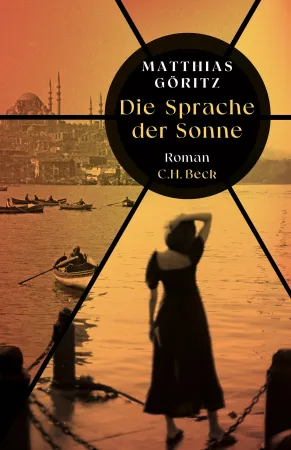
Matthias Göritz is a poet, translator, and novelist. He has written four poetry collections, “Loops,” “Pools,” “Tools” and “Spools”; three novels, including “Der kurze Traum des Jakob Voss (The Brief Dream of Jakob Voss)” and “Parker”; and three novellas. He has received the Hamburg Literature Prize, the Mara Cassens Prize, the Robert Gernhardt Prize, and the William Gass Award. He teaches at Washington University in St. Louis.
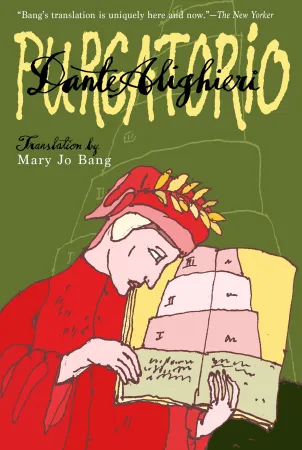
Mary Jo Bang is the author of eight books of poetry—including “Elegy: Poems,” which received the National Book Critics Circle Award—and the translator of Dante’s “Inferno,” illustrated by Henrik Drescher, and “Purgatorio.” She has received a Hodder Fellowship from Princeton University, a Guggenheim Fellowship, and a Berlin Prize Fellowship. She teaches creative writing at Washington University in St. Louis.
“There are no neat stories and anecdotes here: the flashes of perception, of understanding, are given to us via stark metaphors, images, unpredictable syntax, musical structures that are by turns surprising and illuminating . . . This is the kind of art that is never willing to rest, always in motion. Matthias Göritz is an original, talented contemporary German poet, and translator Mary Jo Bang is one of the most interesting poets currently at work in the English language. Bravo.” —Ilya Kaminsky, author of “Deaf Republic: Poems”
“Matthias Göritz’s ‘Colonies of Paradise’ is unlike any book of American poetry I can recall reading. It’s a close-up, high speed tour of life, passing through various world cities—none of them home, yet each haunted by the gargoyle-like figures of Mother and Father. This may be the ‘Giant Redeye Cicada’ eye view of modern human existence—what one can see when one gives up thinking one understands. The book is rendered into sharp, pithy, idiomatic English by the poet and translator Mary Jo Bang, who has recently translated Dante. With her help, Göritz asks, ‘Isn’t it time we went missing?’” —Rae Armantrout, author of “Finalists”
“Matthias Göritz is a poet of tremendous gifts and knowledge. His unique poetic voice is grounded and marked by historical and personal scars and horizons, which make his writing profound, intelligent, musical, playful, and innovative. A must for anyone with interest in contemporary European poetry.” —Aleš Šteger, author of “The Book of Things”