
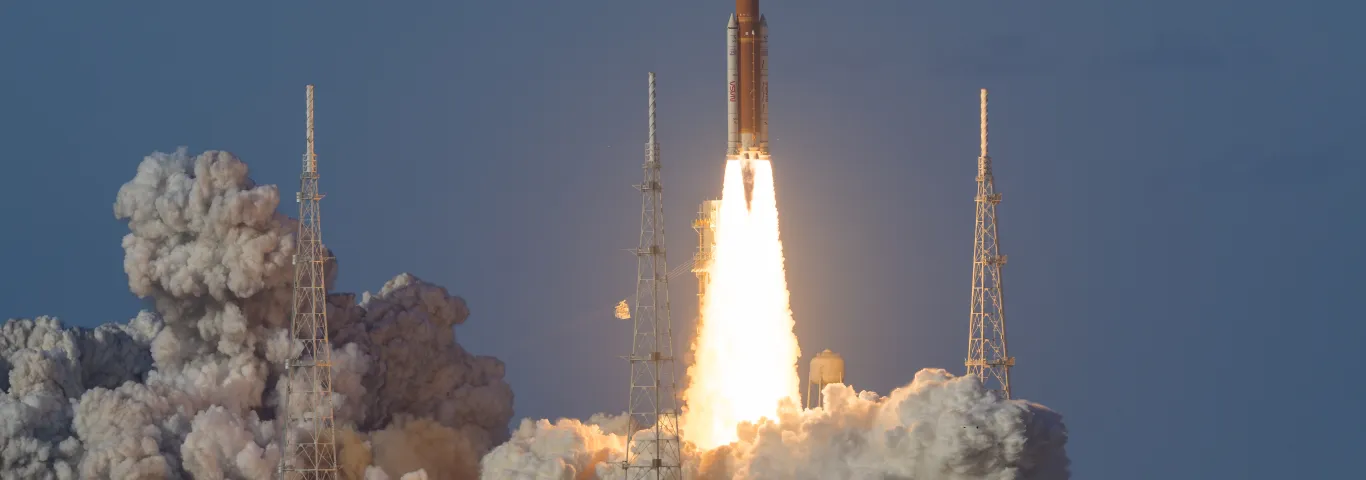
The success of the Artemis II could lead to major advances for WashU and lunar science, says Paul Byrne.

When Artemis II launched from Cape Canaveral, Florida, on April 1, Paul Byrne, an associate professor of Earth, environmental, and planetary sciences, was standing close enough to feel the roar. “It was a picture-perfect launch,” Byrne said. “The plume from the four engines and two boosters was so bright it was like looking into the sun. It was a fantastic thing to see in person.”
Byrne, who is also a fellow of the McDonnell Center for the Space Sciences, was not at the launch in any official capacity. “I was an enthusiastic spectator,” he said. But as the director of the Geosciences Node — a division of NASA’s Planetary Data System (PDS) that has been housed at WashU since 1989 — he was deeply invested in the success of this mission and all future Artemis iterations.
Now that the Orion capsule has successfully traveled around the Moon and returned to Earth, Byrne sees an ideal opportunity for scientists to pursue further discoveries. “Artemis II created a lot of excitement, and we need to build on that momentum,” he said. “NASA has so much national and international goodwill, and there’s so much left to accomplish.”

NASA currently plans to launch Artemis III — a mission in low-Earth orbit — in 2027. Artemis IV is scheduled to return NASA astronauts to the Moon’s surface in 2028, a mission that will put WashU at the center of a significant scientific opportunity. The Geosciences Node will be the main repository for the images and data collected from the lunar surface, offering unprecedented insights into the Moon.
Byrne and other WashU researchers will be responsible for making the data accessible worldwide, a weighty responsibility that he’s eager to embrace. “We expect to receive some data from Artemis II and III, but those missions are really about testing our capabilities in space travel,” he said. “The largest volumes of data will come with Artemis IV, when we’ll have boots on the Moon. We’re honored to have such an important role.”
“The Artemis missions will help St. Louis and WashU stay at the forefront of lunar research.”
—Paul Byrne

WashU’s participation in the Artemis missions continues a long tradition of cooperation between the university and NASA, Byrne said. “People don’t necessarily think of the Midwest when they think of NASA, but the spacecraft for the Gemini and Mercury missions were built in St. Louis. The Artemis missions will help St. Louis and WashU stay at the forefront of lunar research.”

Byrne promotes space science through public talks, media interviews, and social media, often discussing missions involving the Moon, Mars, and planetary exploration. He is scheduled to travel to Capitol Hill later this month with a delegation from the Planetary Society, where he will meet with members of Congress and their staff to discuss NASA’s Artemis program amid ongoing uncertainty around federal science funding.
“We’re making the case that the benefits for science and society are well worth the investment,” he said. “I have a voice, and I use it to help push science forward. I’m fortunate that I can advocate for science in a way that many others can’t.”


