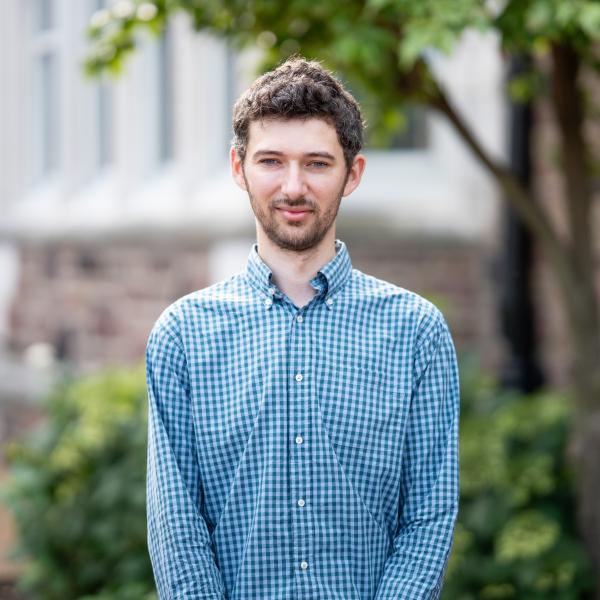
Melanie Micir and Zachariah Ezer are using the spring 2026 semester to focus on alternative history projects that might otherwise have gathered dust. The duo collaborates regularly through the Creative Practice Workshop, exchanging in-depth feedback to push each other’s work forward.

Melanie Micir has a folder full of “someday” projects.
It’s where the associate professor of English collects the book pitches, story ideas, and other creative aspirations that take a backseat to her regular workload as a WashU faculty member.
But thanks to support from the Center for the Literary Arts, “someday” has become “right now” for one of Micir’s most ambitious ideas.
Micir and Performing Arts Department assistant professor Zachariah Ezer are collaborating as part of CLA’s Creative Practice Workshop, which grants Arts & Sciences faculty a semester-long leave from classroom instruction to focus on a book, play, or other creative piece.
Participants meet regularly with workshop director Danielle Dutton to refine their work at every stage of the drafting process, offering insights from differing academic disciplines. Micir and Ezer represent CLA’s third Creative Practice Workshop cohort. A fourth workshop will take place in spring 2028, with applications due in spring 2027.

“This workshop provides a vital, incomparable opportunity for writers across genres, disciplines, and departments to work together,” Micir said. “I am so grateful for this time, space, and community.”
The Ampersand spoke with Micir and Ezer about their Creative Practice Workshop projects and what makes a good creative collaborator.
Tell us about your project. What were some of the influences and experiences that inspired it?
Melanie Micir: ‘After Atascadero’ is a convergence of several obsessions: early 20th-century feminisms, counterfactual and alternate histories, and the absolutely wild early history of University City. The story of University City usually revolves around Edward Gardner Lewis, its founder and first mayor. Lewis and his wife, Mabel, founded the American Women’s League, an organization based in University City with chapters all across the country, and later the more explicitly political American Women’s Republic. With this project, I’d like to imagine the overlooked early history and untold later possibilities of the American Women’s Republic, both here in University City and in Atascadero, California, where the Lewises moved their operations in 1913.
To do this kind of work, I’ve had to become an archive rat. The final form of this project will be an exhibition catalogue, complete with images, excerpts, correspondence, annotations, and essays.
Zachariah Ezer: ‘Pine Bluff, AR’ is an experimental play that is, in some ways, a response to Thornton Wilder’s ‘Our Town,’ and, in others, an examination of what happens to black towns in America. It uses techniques of ergodic and epistolary literature as well as devised and documentary theater to tell its story through the municipal documents of Pine Bluff. So instead of characters in a scene talking to each other, it'll be someone reading from an encyclopedia or a census record or a shipping manifest, something like that.
I think ‘Our Town’ is a wonderful play that is being asked to carry the diversity of the American spirit in a setting where the idea of diversity is a Polish person. I think that it’s a great play that needs to be given an update — it’s been almost 100 years. We should still produce it, but we need a bit more diversity of thought.
How has your work evolved since entering the Creative Practice Workshop? How has feedback from your collaborators helped to shape it and push it forward?
Micir: Zach and Danielle are ideal early readers for me: a playwright working in the documentary theater tradition and an experimental fiction writer who has written a historical novel. It’s incredible to be in the room with them — we come in with vastly different backgrounds but a shared commitment to the project under discussion that day. It’s been a joy to think with them, and it’s refreshing to see my project through their eyes.
Ezer: This has been quite wonderful to do with Melanie and Danielle. Kudos to the Center for the Literary Arts for picking the two of us, because we're both writing these counterfactual, “what-if” histories of things that really happened. In both projects, we want you to believe it's real or real-adjacent for as long as possible. So being able to talk about that specific element, which was something that I was thinking about but had not developed super deeply before entering the workshop, has been really useful.
What do you look for in a creative collaborator?
Micir: The most important thing in any collaboration is generosity of attention. The people I most admire are the very best at giving you all their attention and focus for as long as they can, putting ego aside, and really trying to understand both the current state and eventual possibilities of whatever is in development.
Ezer: I think what works most is rigorous engagement. I want people's opinions. Writing is such a solitary activity. I spend so much time by myself typing on my computer, and I make this thing, and I think, “Did these neural pathways that connect in my brain connect to anyone else's?” So, people being able to really get in the weeds is the most useful thing.
That's what I also try to do as a collaborator. Asking, “What are your goals? How are you, or how are you not achieving all of those goals in this moment?” And in the latter case, “How can I help you achieve those goals better?”
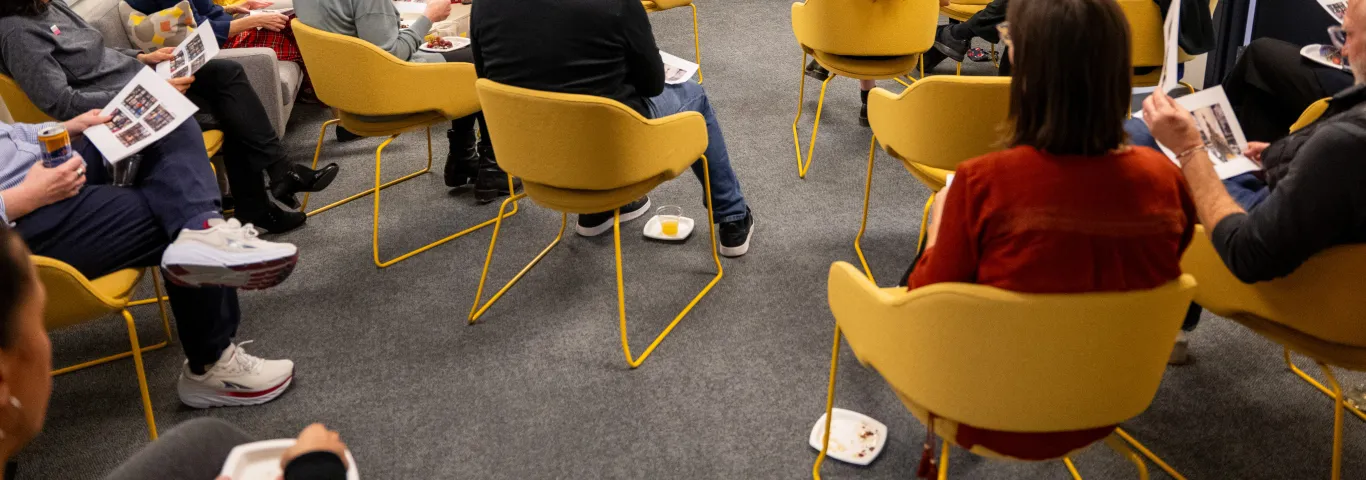
Header image: Former Creative Practice Workshop participant Flora Cassen reads from her work at a workshop celebration event, hosted in 2024 at Jolley Hall.