
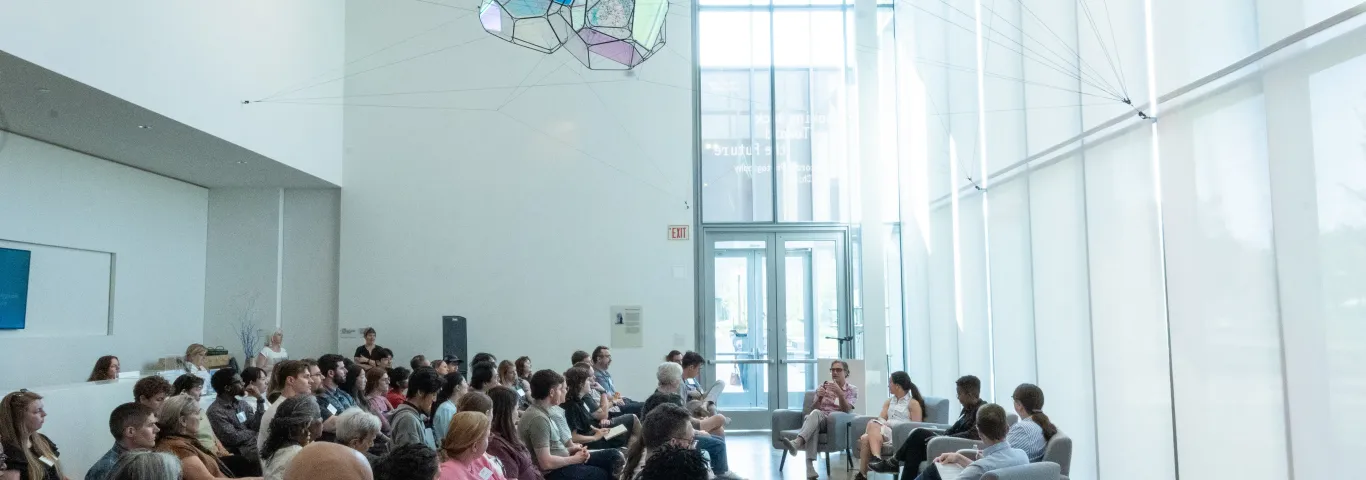
The Incubator for Transdisciplinary Futures brought scholars together to explore the definition of storytelling, who it connects, and how technology is shaping the way stories are told.
If storytelling is one of the fundamental activities that makes us human, what happens when artificial intelligence can tell our stories for us?
Four scholars debated this question in April at the Incubator Unbound, the final event in a yearlong panel discussion series hosted by the Incubator for Transdisciplinary Futures at the Mildred Lane Kemper Art Museum.
Salma Abdalla, an assistant professor of public health, Christopher Schaberg, director of public scholarship, and Betsy Sinclair, the Thomas F. Eagleton University Professor of Public Affairs and Political Science, represented WashU. They were joined by special guest Cat Allman, vice president of open-source research at Digital Science and a former longtime program manager at Google.
The evening’s discourse quickly focused on AI after Schaberg shared a recent experience he had while developing a book proposal. When his curiosity got the better of him, Schaberg asked an AI app to punch up the proposal he’d already written. It sent him a quick revision and even offered to write a sample chapter to help hook an editor.

“I’m working on a new book that’s about the discipline of English, which is how we teach our students how to tell stories,” Schaberg said. “I’m wondering how this all changes with AI. I’m wondering about the ‘muscle’ we use with storytelling and how that changes.”
Sinclair, who is also an assistant vice provost of digital transformation and chair of the Department of Political Science, jumped in with an example of a writing-intensive course she and William Acree, vice dean of interdisciplinary initiatives and innovation, taught this semester, preparing students to use AI as a tool — but not a wholesale replacement — for their own storytelling.
“We want to acknowledge that AI is out there in the world, but we also want our students to think about who they are,” Sinclair said. “So, we developed a course where students would build their own chatbot. They train it on their own writing until it writes in the same narrative mode as them. Then, every week, we ask them to do three things: They have to do some of their own writing. They must ask the chatbot to write something from the same prompt. And then they must compare and reflect on the differences between the two documents.”

The goal is to get students to think about storytelling holistically, not just mechanically.
“By the end of the class, we want students to know their own narrative voice when telling a story,” Sinclair said.
Allman brought her extensive Silicon Valley experience to the discussion, taking a broader view of the massive datasets that feed popular AI apps like ChatGPT and Google Gemini. As broad as this source material seems on its surface, Allman said, it can be prone to biases. That impacts the stories we tell and how they’re told.

“AI agents are training almost exclusively on datasets from North America and Northern Europe,” Allman said. “When you ask AI to expound on something, it’s actually not working from a global perspective, but a specific, limited perspective.”
Even with AI’s limitations as a storyteller, its results can be incredibly persuasive. That’s evident in a story Abdalla shared about her mother’s new favorite doctor: ChatGPT.
Abdalla began the evening’s discussion by sharing how public health practitioners need to do a better job of telling their stories to counteract declining public trust. Her mother’s experience illustrates, in some ways, what they’re up against.
“He’s so patient,” Abdalla’s mother would say of her new, artificially intelligent doctor. “He answers all of the questions I have.”
As alluring as AI’s simple, direct answers can seem, Abdalla wants to push her storytelling in the opposite direction. She named her new public health podcast “Complicating The Narrative,” after all.

“We sometimes think that complexity is something that regular people are not able to handle,” Abdalla said of her podcast. “And I just fully disagree. I think that if we tell the complicated story, that will actually lead people to understand what we do.”
The Incubator Unbound launched in fall 2025 as a new mode of outreach for the Incubator for Transdisciplinary Futures, which has developed numerous successful research projects on campus. With previous sessions themed around human resilience and the scales of life, the events brought free-flowing discussion among panelists with vastly different types of expertise.
“We wanted to start stimulating people, not only from the university, but from a broader audience to engage in new thought,” said Michael Frachetti, ITF co-director and a professor of archaeology. “We’re trying to free you from whatever intellectual or social identity you may have to connect with someone who thinks differently from you.”


