
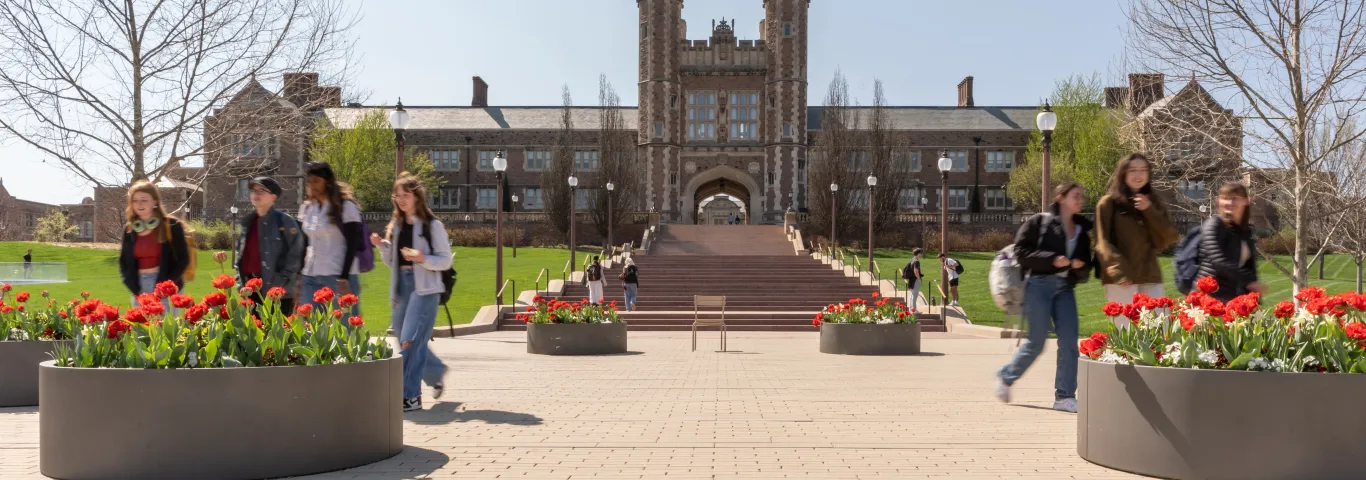
Eight Arts & Sciences graduate students were honored for their achievements in undergraduate teaching and instruction.
Eight Arts & Sciences graduate students have been named recipients of the 2026 Dean’s Awards for Teaching Excellence, recognizing their outstanding work in undergraduate education. In a highly competitive selection process, juried by members of our teaching faculty, these graduate students were selected for their classroom innovations and significant contributions in roles ranging from Assistants in Instruction (AI) to Mentored Independent Teaching (MIT). Each awardee received multiple nominations from WashU faculty for their innovation, enthusiasm, and impact in the classroom, along with a $1,500 prize and a certificate.
“In Arts & Sciences, we recognize the profound opportunities that teaching and instruction represent, as training for our PhD students,” said Sophia Hayes, vice dean of graduate education and professor of chemistry. “Many find fulfillment in these classroom roles, and serving in an Assistant in Instruction (AI) or Mentored Independent Teaching (MIT) role can be a career-changing experience. It’s a delight to read these nominations and know that such excellence is being supported and elevated by Dean Hu and Arts & Sciences.”
2026 Award Recipients

Alex Avery, Political Science
Nominators praised Avery’s natural rapport with undergraduate students and her ability to connect contemporary, real-world examples with political theory. Building off her graduate teaching experiences, Avery now teaches a course in global gender issues for WashU’s Prison Education Project.

Anna Csiki-Fejer, Chemistry
As a first-year graduate student, Csiski-Fejer rose to the occasion as a student instructor. One of her students wrote that Csiski-Fejer “has been wonderful throughout the semester. I feel incredibly comfortable asking her any type of questions in and out of the lab.”

Kristin Emanuel, English
Emanuel helped students strengthen their writing, while also presenting a variety of well-received poetry education events throughout St. Louis. “I am in awe of Kristin's pedagogical commitment, creativity, and dedication,” one nominator wrote.

Bayla Kamens, Classics
Kamens won praise from nominators for excellent teaching in two radically different courses: one in Latin and another on ancient textile production. “Bayla Kamens is one of the most innovative language teachers I've had the pleasure to observe,” one nominator wrote.

John Naughton, Mathematics
Nominators described Naughton as “a natural teacher” who sets undergraduate students at ease and expertly guides their discussions. While assisting with an honors mathematics course, Naughton suggested a switch to focusing on group work instead of quizzes, an adjustment that won high praise from students on course evaluations.

Qingyi (Emmy) Sun, East Asian Languages and Cultures
Sun helped bring history to life for her students. Assisting with a course on Chinese civilization, she designed a series of interactive assignments that drew from local museum collections. “She demonstrated a remarkable ability to transform museum collections into powerful teaching resources and gallery spaces into dynamic sites of inquiry,” one nominator wrote.

Gemechu Bekele Tolossa, Biology
Tolossa brought the same dedication to teaching as to his work as a scientist and researcher. “Gemechu is one of the most gifted scientist-educators I have encountered in my career,” one nominator wrote, further praising Tolossa’s drive for excellence and investment in student success.

Yue Wang, East Asian Languages and Cultures
A native of China, Wang juggled the Chinese, English, and Japanese languages while teaching a first-level Japanese course — and kept her classes active and invigorating. “Her classes were never static; students moved around the room, reading aloud and conversing,” one nominator wrote.


