
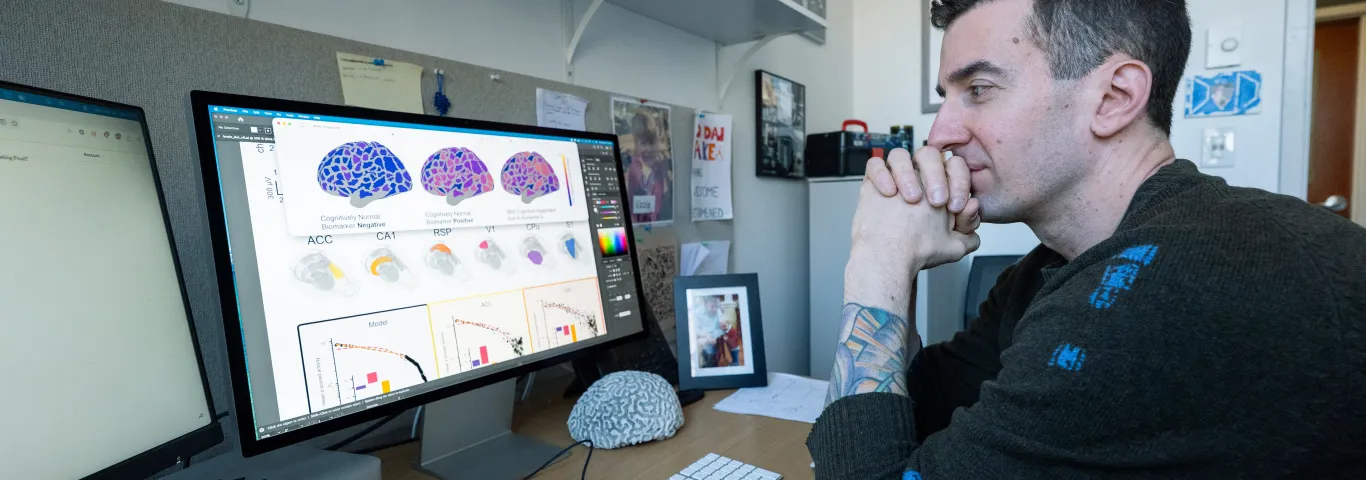
Keith Hengen is applying lessons from the brain to next-generation quantum sensors through a U.S. Department of Energy-funded project.

Keith Hengen, an associate professor of biology who studies the brain’s computational power, has often collaborated with mathematicians and physicists in his quest to understand cognition.
Still, Hengen was surprised when Whitney Armstrong, a physicist at Argonne National Laboratory, approached him about a new endeavor: developing quantum sensors for next-generation computing.
Accepting the challenge, Hengen joined Armstrong as a co-principal investigator of a project called “Superconducting Polychronous Computation Near Criticality.” In late July, the U.S. Department of Energy awarded $750,000 to Hengen and Armstrong as part of its Genesis Mission, a collection of research projects designed to “deliver breakthroughs to secure American energy dominance, accelerate scientific discovery, and strengthen national security.”
Hengen spoke with the Ampersand about his role in the new project and how lessons from the brain could help advance quantum computing.
How did you connect with a physicist at Argonne?
My lab is especially interested in a brain state called criticality. Criticality describes a complex system when it’s balanced at the tipping point between order and chaos. At criticality, information processing is maximized. For obvious reasons, we believe the brain must be tuned near criticality for optimal thinking and learning.
Whitney Armstrong at Argonne was looking for a way to increase the accuracy and reduce the energy consumption of quantum sensors that could be used for next-generation computers and electronics.
He came across a preprint of a paper I wrote with Leandro Fosque, a postdoctoral researcher in my lab, and ShiNung Ching, a professor of electrical and systems engineering at the McKelvey School of Engineering. Woodrow Shew, a physicist at the University of Arkansas, was another co-author. That paper established criticality as a universal principle that could be applied to other systems, including simple systems, that process information. As a result of translating the ideas of criticality to simpler systems, Whit realized the theories and equations in our paper should apply perfectly to his work, so he asked me to join the project.
What can the brain teach us about quantum sensing?
The brain is an incredible computational machine, but it still has to follow the laws of math and physics. If you discover a fundamental law of computing that applies to the brain, it likely applies to other complex systems as well.
We’ve shown that the brain constantly adjusts itself to stay close to criticality, and that the closer a brain is to criticality, the faster it can learn. We think that quantum sensors will also work best if they’re tuned very close to a critical point. Instead of manually adjusting each chip within the sensor, the chips could self-tune, just like brain circuits do.
What type of sensors will the project be using?
Whit (Armstrong) is building superconducting nanowire single-photon detectors (SNSPDs) that can sense single photons, which are quantum particles of light. In this case, the photons are released from helium nuclei. SNSPDs are an important component of quantum computers that use photons to encode, transmit, and process information.
What are the next steps?
In the early phase of the project, most of my lab's work is going to be purely theoretical and computational. We want to show that these quantum sensors will be maximally effective when they're tuned to criticality. That work should take about nine months. If it goes well, we’ll consult on the actual construction of the chips, which will be made at MIT. Then we can help analyze the data to see how well the chips are working.
Are you surprised to find yourself working on quantum electronics?
This is definitely not something I envisioned when I started developing theories of cognition. I certainly didn’t expect to hear from Whit about this project. But when he explained his interest in our work, it all made sense – kudos to him for the insight and ability to make connections between disciplines! Criticality could be crucial for the next generation of quantum computing;I hope that my group can offer something useful.


