
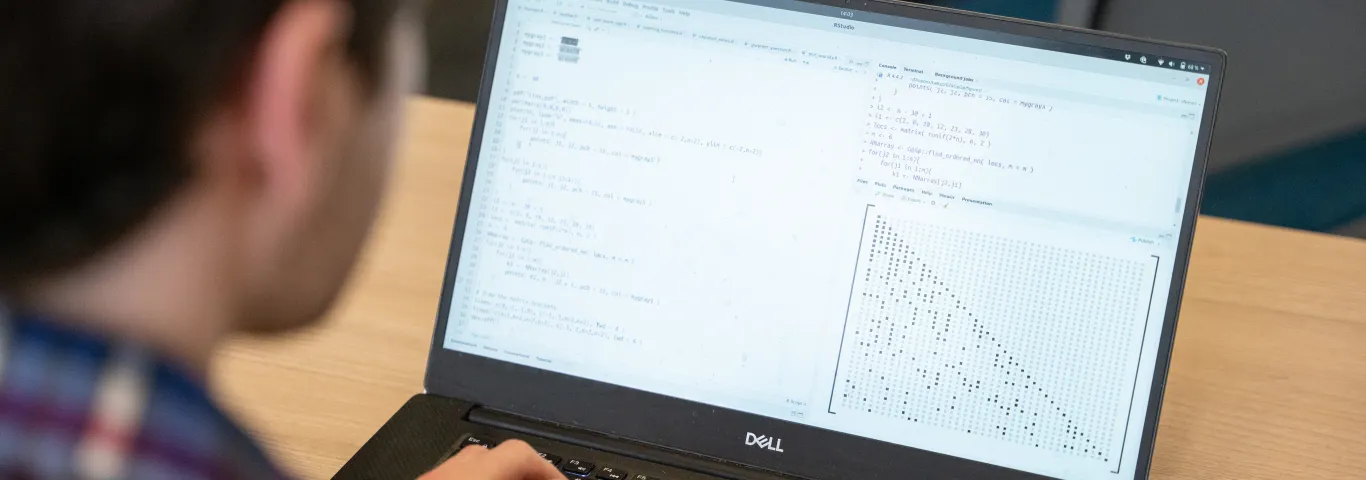
With a new accelerated master’s program and research spanning artificial intelligence, public health, and environmental science, WashU’s Department of Statistics and Data Science is expanding opportunities for students to apply data science across disciplines.
The Department of Statistics and Data Science has launched an Accelerated Master’s with a Concentration in Applied Data Science. Beginning in fall 2026, the 4+1 program is open to WashU undergraduate students.

Designed for students across a wide range of majors, this 4+1 pathway allows students to build advanced technical skills in statistical modeling, computation, and data science. By applying up to 12 units of eligible undergraduate coursework toward the graduate degree, students can complete the master’s in just one additional year, saving time and tuition.
Graduates will be prepared for high-demand careers in data science, machine learning, statistics, biostatistics, bioinformatics, quantitative research, business intelligence, and other fields that value both data expertise and domain knowledge.
Interested sophomores can begin enrolling in prerequisites. Juniors should enroll in prerequisites, speak with their adviser, and meet with the director of the master’s program to confirm eligibility.
The new program builds on the momentum of a department established in 2023 to advance statistical research, expand educational opportunities, and foster collaboration across disciplines. Led by inaugural chair Xuming He, the Kotzubei-Beckmann Distinguished Professor, faculty are developing statistical methods to address questions in artificial intelligence, medicine, public health, environmental science, and beyond.
From advancing artificial intelligence to tackling complex challenges in public health and environmental science, the department’s faculty are demonstrating the growing reach and impact of statistics and data science.
Making artificial intelligence more trustworthy
As artificial intelligence becomes increasingly integrated into everyday life, statisticians have an essential role to play in ensuring its accuracy and reliability. He is working to make AI more ethical, accurate, and fair. By identifying bias, evaluating AI-generated findings, and developing more reliable statistical methods, researchers can help ensure the technology produces trustworthy results across fields ranging from medicine to environmental science.

Bringing an alumnus back to campus
For Joe Guinness, AB ’07, joining the Department of Statistics and Data Science in 2024 was a homecoming. Now an associate professor, Guinness is helping expand the department’s curriculum and prepare students for careers in a variety of fields. His own research demonstrates the versatility of statistics, with projects ranging from predicting corn harvests and modeling weather patterns to studying how running shoes affect marathon performance.

Exploring the future of AI and statistics
Artificial intelligence and statistics are becoming increasingly intertwined, creating new possibilities for scientific discovery alongside new challenges for researchers. During the Spring 2026 Dean’s Distinguished Lecture, He explored how AI-generated data are transforming statistical research and why human expertise remains essential to ensuring accurate results. He also predicted that AI would bring profound changes to higher education, with 2027 marking a turning point for teaching and learning.

Using data to solve complex problems
From understanding the health risks of flooding to improving medical treatments, faculty in the Department of Statistics and Data Science are applying their expertise to some of society’s most pressing challenges. Sean McGrath uses statistical methods to investigate public health questions, including the risks of medication side effects, while Joe Feldman developed sophisticated models that revealed a stronger link between childhood lead exposure and academic performance than previously thought.
Environmental science is another major focus. Bo Li studies climate patterns, environmental risks, and maternal health. She is also collaborating with fellow statistician Maxine Yu and engineering researchers on a $1 million NSF-funded project using AI and statistics to better understand how wildfire smoke affects marine clouds. The research could improve predictions of rainfall, climate change, and extreme weather.
Other faculty are finding new ways to extract meaningful insights from complex data. Soumendra Lahiri is exploring factors associated with crime and traffic accidents in St. Louis, while Nan Lin is using anonymized mobile phone data to study how natural disasters affect travel and mobility across the region. Apratim Dey, who joined WashU in fall 2026, is developing statistical methods to make AI-assisted scientific research more reliable, helping researchers generate sound hypotheses and draw valid conclusions from increasingly complex data.
Together, their work demonstrates how statistics can help researchers tackle problems across public health, environmental science, medicine, and artificial intelligence.
Learn more about the Department of Statistics and Data Science and its Applied Data Science concentration.


