A new mosaic exhibit organized by WashU physicist Ralf Wessel brings artists’ differing perspectives on artificial intelligence together, inviting visitors to consider the impact of AI on humanity, including what creativity means in the age of AI.
When it came time to title her latest piece, California-based mosaic artist Yolanda Bergman did not mince words. She called it “AI can’t.”
WashU physics professor Ralf Wessel had recruited her and several other prominent mosaic artists to contribute to a new exhibit exploring the relationship between artificial intelligence and human creativity.

“I thought about Winston Churchill’s famous quote: ‘I have nothing to offer but blood, toil, tears and sweat,’” Bergman said. “Long story short: AI can’t bleed, toil, or cry. AI just can’t be human.”
Bergman is one of 10 artists who contributed works to “humAnIty,” a new exhibit that opens Nov. 19 at WashU’s Steinberg Hall Gallery. Organized by Wessel with support from the Incubator for Transdisciplinary Futures, the exhibit brings together a range of perspectives on AI’s growing role in art and everyday life.
Wessel hopes visitors will come away with questions rather than answers.
“The artists all have very different perspectives on this topic,” Wessel said. “Those range from sustainability, like the water consumption of data centers, all the way to how AI may change how we make decisions in life.”
The exhibit builds on Wessel’s earlier efforts to bring artists into conversation with emerging AI technology. In December 2025, Wessel’s Incubator-funded AI & Neuroscience group hosted a symposium that brought scientists, scholars, and artists into the same room to discuss AI’s role in creating art.
“The people working in generative AI had never really considered mosaic art, while the mosaic artists came in very skeptical about generative AI and how it would invade the art world,” Wessel said. “But over the course of the day, people’s body language changed and they really listened to each other.”

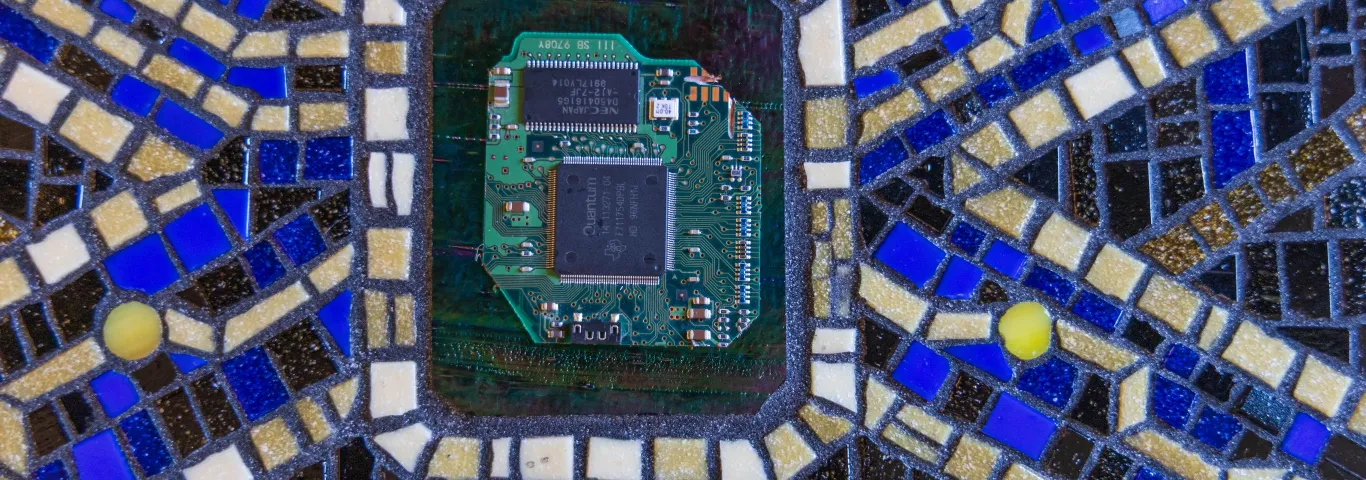
Mosaics offer a particularly striking way to explore that tension. Mosaic artists painstakingly assemble individual pieces of glass, stone, and other materials into a cohesive image. An AI image generator, meanwhile, can produce an image that resembles a mosaic in seconds, without the physical labor involved in creating one.
“With mosaic, it is manual labor,” Bergman said. “It’s gritty. It’s taking what’s on the ground, like pebbles, and using them to paint. So the earth itself becomes your medium.”
To Bergman, generative AI’s reliance on existing human-created art amounts to high-tech plagiarism.
“I can see through anything done with AI,” Bergman said. “It’s just too easy with mosaics. You have to see the cut glass, or the ripples in the glass. It has to be tactile.”

While several of the featured artists share Bergman’s skepticism toward AI, others turned to the technology for inspiration. That includes Wessel, who created a mosaic exploring human identity with the help of an AI chat program.
His piece, “YOU: magnificent humanity through AI’s eyes,” began as a conversation with the program about what makes us human. The exchange produced a list of eight traits associated with human identity, including self-awareness, social connectedness, and narrative identity. Wessel incorporated those traits into a mosaic based on an AI-generated outline.
But turning that digital starting point into a physical work of art still required an estimated 160 hours of labor.
For Wessel, whose interests span scientific inquiry and artistic expression, the exhibit is an opportunity to explore complicated questions through a different medium. He hopes projects like “humAnIty” will continue to bring scientists and artists into conversation.
“AI is a very touchy topic in the art in the creative world, and it's very divided,” Wessel said. “There’s camps. Some want to talk about it, and some just feel really threatened. It's an existential crisis for some of them. There are a lot of feelings at play, and it's complex. But I love art, and I think art is a great way of talking about and exploring complex topics.”
“humAnIty” opens with a reception at 5 p.m. Thursday, Nov. 19, at Steinberg Hall Gallery. RSVP to attend.