
Ampersand Programs immediately immerse first-year students in the very best of WashU, blending classroom study with experiential learning while fostering tight-knit cohorts and close connections with faculty.
Conner Yamnitz, 19, stood amid the jagged stone markers of the Treblinka memorial and thought about the lives they represented.
Nestled deep in the woods of eastern Poland, the memorial marks the site of a former Nazi extermination camp where more than 800,000 people were killed. Its stones rise from a flattened circle of dirt like a makeshift cemetery, each one honoring a different Polish Jewish community whose inhabitants were erased from history.
Yamnitz visited Treblinka in summer 2023 with a small cohort of classmates as part of the Arts & Sciences Ampersand Program “History, Memory, and Representation of the Holocaust.” Standing side by side with his peers and guided by world-leading Holocaust scholars Erin McGlothlin and Anika Walke, he quietly traced the stones, reflecting on the history they had studied over the two-semester course. It was one of the final stops on a transformative journey through Berlin, Krakow, and Warsaw, with each site bringing to life lessons from the classroom.
Before this experience, Yamnitz had a limited understanding of Holocaust history.
“If you had asked me at the time, I probably would have said the Holocaust happened in Germany,” Yamnitz said. “That’s not entirely untrue, but it’s missing 80% of the picture. I learned that the vast majority of victims were Eastern European and that all the major killing centers, like Auschwitz and Treblinka, were in Eastern Europe. I was shocked by that.” Standing at one of those sites, Yamnitz wasn’t looking at a dot on a map; he was immersed in history. The silence, the stones, and the weight of what had been lost hit him harder than anything else he had seen on the trip.
“It helped me visualize the scale of the communities that were completely destroyed at this one, tiny place,” Yamnitz said. “It was overwhelming.”
Unforgettable experiences

McGlothlin, vice dean of undergraduate affairs, has taught “History, Memory, and Representation of the Holocaust” for a decade. Despite its heavy subject matter, she describes it as a reenergizing labor of love. Like all Ampersand Programs, it is open exclusively to first-year students. Their energy and fresh perspectives provide a jolt from her typical administrative duties.
“This is my way to really connect with students,” said McGlothlin, who is also the Gloria M. Goldstein Professor of Holocaust Studies. “They’re so smart, they care so deeply, and they’re so engaged. Looking at the world through the eyes of these first-year students is transformative.”
Her students, in turn, receive an experience that is intimate, in-depth, and unforgettable. With their small, cohort-based model and opportunities to work closely with some of the school’s most distinguished scholars, Arts & Sciences’ Ampersand Programs counter the stereotypical image of a first-year college course: a large auditorium packed with hundreds of students, passively absorbing a lecture. A recent survey of similar offerings at peer institutions found that what WashU offers first-year students is truly one of a kind.

Students are invited to apply to Ampersand Programs and other first-year opportunities in the spring, soon after they’re admitted. Each Ampersand Program unfolds across two or more semesters, blending classroom and experiential learning while linking multiple academic disciplines. Students studying cancer care meet with St. Louis oncologists, nurses, and survivors. Those studying the history and culture of ancient Rome travel to see its enduring landmarks in person. “Ampersand Programs have become our signature feature for first-year students,” McGlothlin said. “It attracts them to WashU. It gets them into small-group classes right away. They get to know their faculty. They get to know each other. And it sticks with them. I still text some of the people from the first cohort I taught 10 years ago.”
Seizing opportunities
First-year student Rui “David” Zhang was drawn to Ampersand Programs because of their intimate class size. He attended a small, private high school in the Boston area, so the idea of learning alongside a close group of classmates appealed to him.

“I like that learning style, where you know everybody in the class and you know the professors really well,” Zhang said.
Zhang gravitated toward “People, Planet, Health,” an Ampersand Program that explores the many links between planetary ecosystems and human health. Students conduct numerous case studies, take trips to a wastewater treatment plant and the Saint Louis Zoo, and hear directly from professionals working to preserve planetary biodiversity and fight the spread of diseases.
One of those speakers, Professor Michael S. Diamond from the WashU School of Medicine, gave a talk on vaccines that inspired Zhang to pursue a research opportunity. Zhang shared his passion for virology and immunology, and asked if Diamond needed help in his laboratory over the summer. After discussions and a formal application, Zhang landed a role: This summer, he’ll help Diamond study the tick-borne Powassan virus.
“I’m really excited to be there this summer,” Zhang said. “It’s the kind of opportunity I wouldn’t even know about without being part of an Ampersand Program.
Blazing new pathways
Like McGlothlin, Joseph Jez has also passed the decade mark of running an Ampersand Program.
Jez, the Spencer T. Olin Professor in Biology, leads “Biotech Explorers Pathway,” a program that brings students directly to the startups, laboratories, and international corporations that are driving innovations in biotechnology. With a heavy emphasis on entrepreneurship, the program encourages students to draw inspiration for their own business ideas.

“Some of our students will become art majors, some will go into business or engineering, and some will find a different branch within Arts & Sciences,” Jez said. “I think this program helps them to realize all the things that they can do as a WashU student. They start to take their at-bats earlier because they’re around other students who are trying new things.”
To encourage that environment of positive peer reinforcement, Jez often brings back past Biotech Explorers as guest speakers. He now has 12 cohorts to draw from.
One of those graduates is Dani Wilder, now a fourth-year WashU medical student. She is also the co-founder and managing director of nCase Technologies, a company that sells a keychain-style carrying case for naloxone, a life-saving drug used to rapidly reverse opioid overdoses.
“Biotech Explorers introduced me to skills like drafting project plans, the Skandalaris Center and all the resources available there, drafting a CV, and taking part in practice interviews,” Wilder said. “I definitely ended up more in the startup and innovation sphere than I expected as a result of that program.”

Carrying lessons forward
Last year, inspired by his experiences with “History, Memory, and Representation of the Holocaust,” Yamnitz began the process of becoming a museum educator at the St. Louis Kaplan Feldman Holocaust Museum.
“As I learned, there’s this discrepancy between what’s popularly known about the Holocaust and what’s true,” Yamnitz said. “I wanted to teach about that in my own way.”
After completing his docent training, Yamnitz now leads tours for high school and middle school students. He’s also writing his senior thesis in history on how the museum gathered its testimonies of St. Louis-based Holocaust survivors.
It’s the culmination of a one-of-a-kind academic journey that spanned the Danforth campus in St. Louis to the quiet fields of Poland.
“Taking this Ampersand Program opened up a new interest for me, one that has shifted my career path,” Yamnitz said. “I’ve been able to explore it through trips, museum work, and my senior thesis, all with amazing support from my professors.”
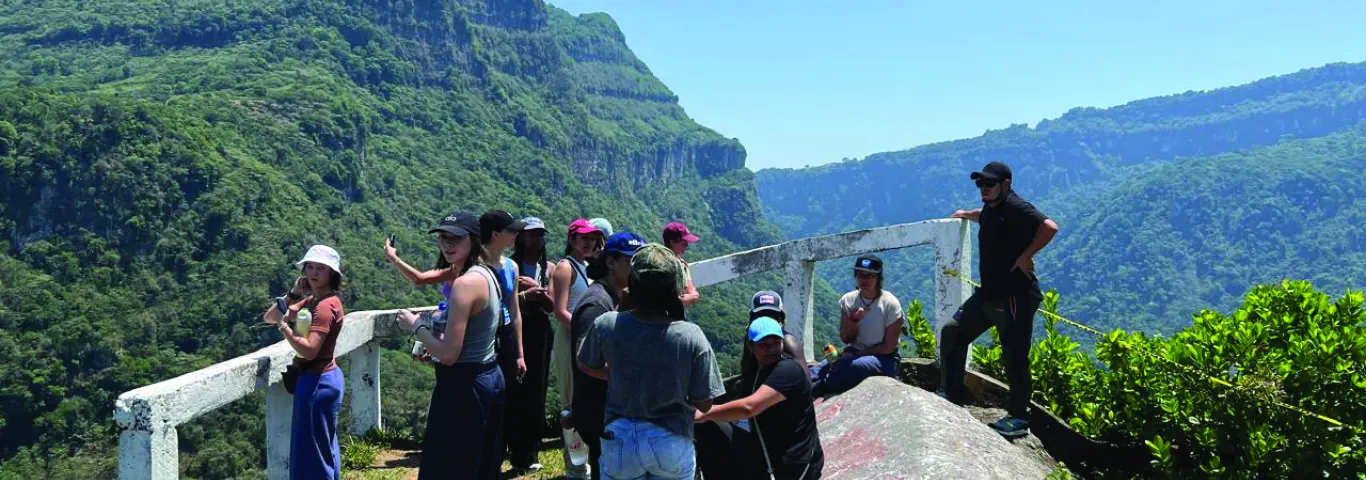
Header image: In the “Global Citizenship” Ampersand Program, students traveled to Parque Mirador Independencia in Guadalajara, Mexico, where they engaged with local communities and organizations to explore cultural perspectives.


