
The Center for Quantum Leaps has joined the Midwest Quantum Collaboratory, expanding the opportunities for collaboration and boosting WashU’s reputation in quantum science.
WashU’s Center for Quantum Leaps has joined a network of midwestern universities that seeks to harness the untapped potential of quantum science.
The Midwest Quantum Collaboratory was formed in 2021 as a partnership between Purdue University, the University of Michigan, and Michigan State University’s quantum institutes. The Center for Quantum Leaps is the first official addition to that core trio.
In addition to collaborative research projects between its members, the Collaboratory hosts an annual conference called Entanglement. Erik Henriksen, a professor of physics, made a presentation outlining WashU’s rapidly expanding efforts in the quantum realm at last year’s conference. That presentation doubled as a pitch for Collaboratory membership, and it proved successful.
WashU will have a significant presence at this year’s Entanglement conference, hosted by Purdue University in July, with both faculty and students presenting research and networking with collaborators.
Joining Henriksen at Entanglement 2026 will be newly hired professor of physics Shaffique Adam, as well as graduate student Zack Rehfuss, who will present on his startup, FacetLab, which focuses on diamond fabrication. Jonathan Brestoff, an associate professor with the School of Medicine, will also attend.
“It’s really the in-person activities at Entanglement where I think we’ll see the initial payoff from joining the Collaboratory,” Henriksen said. “We all need to sit down and talk to each other and see where those collaborative opportunities are. ‘Do I need to send a student to you? Should we write a paper or proposal together?’ From there, it should snowball.”
An initiative of the Arts & Sciences Strategic Plan, the Center for Quantum Leaps has gained momentum through cluster hiring and increased university investment. As promising as its internal collaborations have been, joining the Collaboratory will significantly grow the Center’s footprint and notoriety.
“Joining the Midwest Quantum Collaboratory signals that WashU is not only building a strong internal quantum program, but is also actively shaping the future quantum ecosystem of the Midwest,” said Chuanwei Zhang, co-director of the Center for Quantum Leaps and the Wayman Crow Professor of Physics. “This opens the door to new research collaborations, stronger student recruitment, broader industry and institutional partnerships, and increased visibility for CQL.”
Henriksen said that this reputational boost makes a significant impact on all of the Center’s activities.
“When papers and proposals are sent out for review, there’s a better chance that someone is going to look at them if they know who you are and what you’re doing,” Henriksen said. “It doesn’t necessarily mean they’re going to approve it more easily, but they’re going to interact with it on a closer level.”
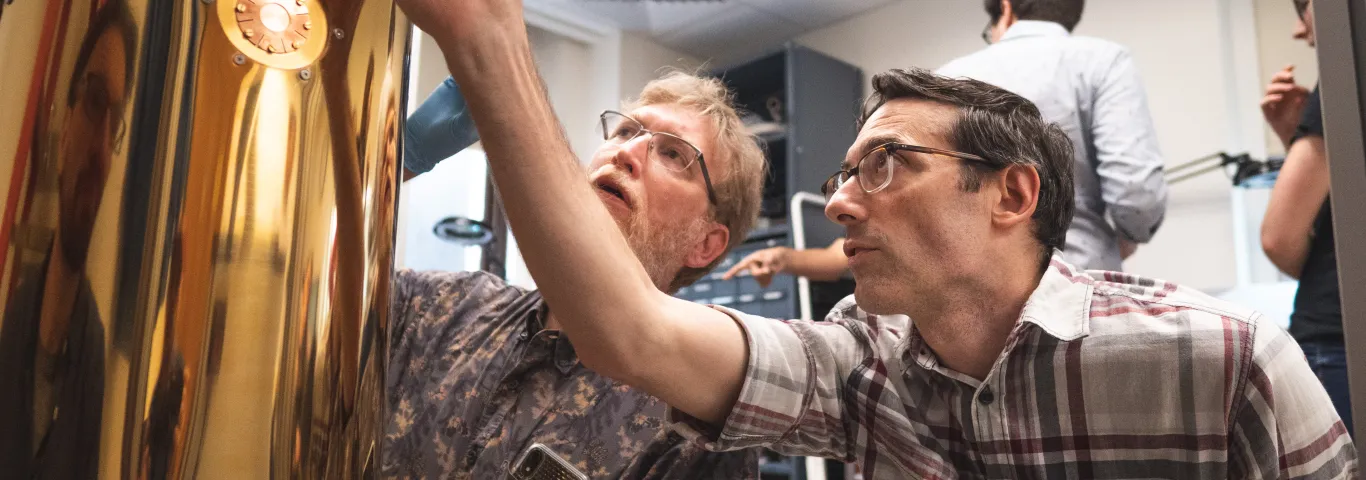
Header image: Professor Erik Henriksen works with researchers in WashU’s Center for Quantum Sensors to develop next-generation quantum sensing technologies.


