At the second annual Teaching Innovation Showcase, WashU Arts & Sciences faculty showcased how creative approaches to teaching are preparing students for today’s workforce.
In Kasey Grady’s college writing class, students face an unlikely competitor: artificial intelligence.
Inspired by the NBA playoffs, Grady, a senior lecturer in college writing, created a bracket-style competition in which AI-generated opening sentences go head-to-head with student-written ones. Here’s how it works: A student shares a draft essay with the class, then four students write their own opening sentences while four others generate theirs using AI. Across seven head-to-head matchups, the class debates topic, tone, audience, and style before voting on a winner in each round.
Though AI rarely pulls off an upset — it has won just once in seven semesters — the lines that stand out are typically human-generated. For Grady, who has taught at WashU for 12 years, the exercise demonstrates not just what AI can and cannot do, but also the value of creativity, collaboration, and taking risks.
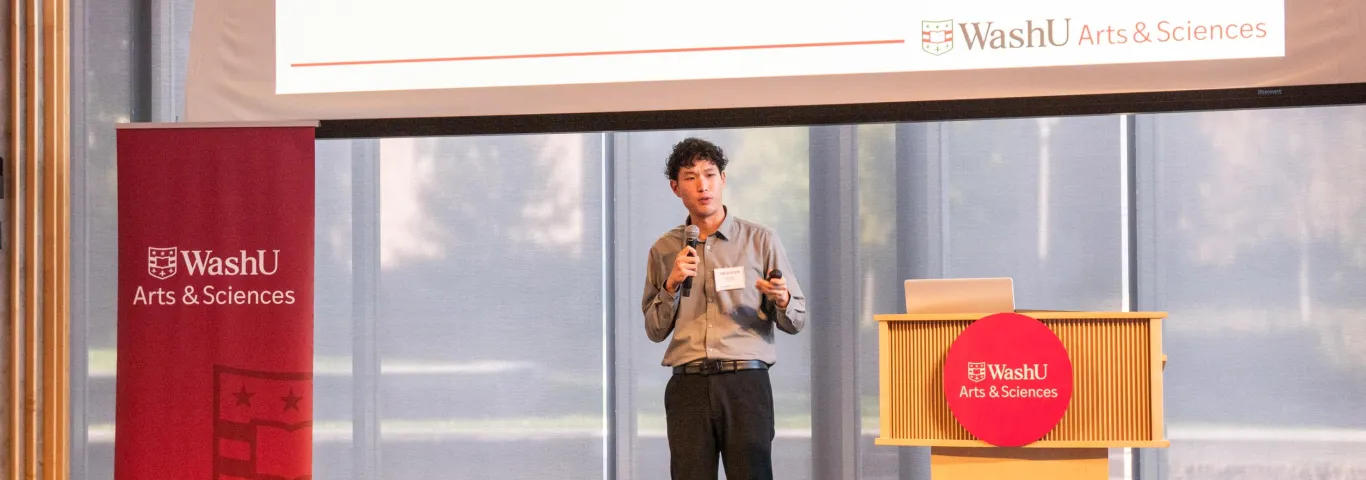
Grady’s approach earned her one of three audience-selected awards at the second annual Arts & Sciences Teaching Innovation Showcase, hosted by WashU on Oct. 22. Held in the Clark-Fox Forum, the competition brought together 12 faculty finalists who were each given three minutes to pitch an inventive approach to teaching in a format that resembled a mash-up of “Shark Tank” and TED Talks. After the presentations, audience members voted for their favorites, selecting Grady, Wouter Kool, and Anthony Smith as this year’s three winners.

Launched in 2025, the showcase highlights the creative approaches changing how courses are taught across Arts & Sciences, the largest school on WashU’s main Danforth Campus. This year’s presentations reflected two complementary themes: helping students harness emerging technologies while developing the human skills and understanding they’ll need long after graduation. From AI-powered research tools to films that reveal the politics of everyday life, WashU faculty are finding new ways to connect what students learn in the classroom to the world they’ll enter.
“Almost every WashU undergraduate student takes classes in Arts & Sciences, and we have approximately 1,000 graduate students in close to forty different programs. What students learn in the courses featured at the Teaching Innovation Showcase and others that Arts & Sciences faculty offer every day extends far beyond the classroom,” said William Acree, a professor of Spanish and vice dean of interdisciplinary initiatives and innovation in Arts & Sciences. “Given that around 25% of WashU graduates remain in St. Louis after graduation, there is a very strong connection between innovations in the classroom and the kinds of transformative thinking our graduates carry into their places of work — both here in the St. Louis region as well as beyond.”
For Grady, who knows her students will enter a workplace increasingly shaped by AI, that means helping them understand when technology is useful and when human judgment is essential. AI can deliver polish, she said, but it cannot replace the creativity and risks that make writing memorable. Her students also discover that some of their best work comes from thinking through ideas with one another.
“These are students matriculating into a world completely saturated by AI,” Grady said. “But in this class, they learn not only how to stand out, but that their best collaborator isn’t only technology; it’s their team.”
Learning to think critically about AI
With the increasing importance of artificial intelligence in both education and the workplace, several showcase finalists tackled the question of how to use it constructively. Rather than simply teaching students to generate answers, WashU faculty are helping them understand what the technology can accomplish, where it falls short, and how to make it work for them.

Wouter Kool, an assistant professor of psychological and brain sciences at WashU and another of the evening’s winners, shared a counterintuitive approach with his students: “Don’t believe in yourself.”
“AI can give an answer that’s completely plausible, but completely wrong,” Kool said. Rather than trust their own assumptions or accept AI-generated answers without question, he encourages students to follow a system: predict, check, and fix.
The process teaches students to approach both AI and their own ideas with an appropriate level of skepticism. “A little bit of distrust can build a lot of confidence,” Kool said. By learning to question results and work through errors, WashU students develop the judgment to use AI with greater confidence and independence.
In the Department of Chemistry, assistant professor Zhiling “Zach” Zheng noticed a different problem. His students were excellent chemists. They knew how to design molecules and grow crystals but, when it came to AI, many had little idea where to begin. As AI coding becomes increasingly important in chemistry, that knowledge gap presents a significant barrier.
Most online coding tutorials have little to do with chemistry. Zheng began to wonder: What if students could learn AI through examples drawn from the work they were already doing in the lab? Using familiar problems, they could begin to appreciate AI’s potential and see how it might help them analyze chemical data with greater precision and power.

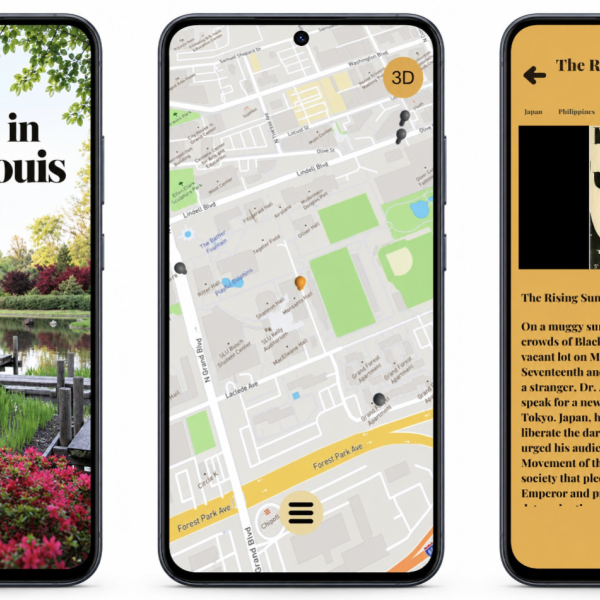
To put that idea into practice, Zheng created a free, browser-based, interactive tutorial that guides students through AI coding step by step, using real-world chemistry examples. Students can see how AI approaches actual research problems, experiment with code, make mistakes, and learn to correct them — just as they would in a chemistry lab. Along the way, they discover both the limitations of AI and the ways it can expand their research capabilities.
The resource isn’t just for Zheng’s own students. Any educator or student can access and use it for free. Ultimately, Zheng hopes to shift the question students ask about AI, moving them from uncertainty about the technology to curiosity about what they might be able to accomplish.
“At the beginning of the semester, students ask themselves: ‘Is AI relevant to me?’ As time progresses, they begin to ask themselves, ‘How can I work with AI to think bigger?’”
Connecting knowledge with human experience
While some faculty are helping students navigate new technologies, others are bringing the human side of research into sharper focus. At the heart of a liberal arts education is the understanding that knowledge cannot be separated from the people and communities it affects. Several showcase finalists demonstrated how they are helping students make those connections, whether through popular films or conversations with cancer patients.
Michael Olson, an associate professor of political science at WashU, sees politics in the everyday. As he explains to his students, social scientists study how political phenomena vary across space and time to understand their effects. In his own research, he examines pivotal moments in history, but he wondered how he could help his students adopt that approach. His solution was to bring movies into the classroom.
In his course “American Politics Over Space and Time,” Olson screens films that, on the surface, might seem to have little to do with politics. By introducing students to stories that capture the essence of a particular time and place, he encourages them to connect with the characters and the worlds they inhabit.
Students may not live in a Chicago housing project in the 1990s (“Candyman”), in West Texas amid the rural economic decline that followed the 2008 financial crisis (“Hell or High Water”), or in the suburbs during the urban-suburban divide of the 1980s (“Adventures in Babysitting”). But through these films, they begin to recognize how politics shapes the characters’ daily lives and, in turn, their own.
“Film offers a uniquely immersive way to put oneself in a new time and place, to see yourself in other people's shoes,” Olson said. Through the stories, students see how public policy, race relations, economic conditions, and other political forces shape the choices and opportunities available to people.
When students see politics in everyday life, the subject becomes less abstract and more relevant. They come to understand that politics isn’t just about watching a map turn red or blue on election night. It’s also about potholes, bus routes, and whether they can afford a home. By connecting the more theoretical aspects of political science to lived experience, Olson helps his WashU students develop a more intuitive understanding of the forces shaping their world. This kind of kitchen-table knowledge, grounded in everyday realities and combining theoretical insight with practical savvy, serves them in the workplace and beyond.

The Showcase’s third winner was Anthony Smith, a senior lecturer in biology at WashU who also set out to help his undergraduate students connect scientific knowledge with human experience. In 2020, he created “The Hallmarks of Cancer and Patient Care,” a two-year course sequence that explores cancer as both a biological disease and a patient experience.
Students begin in their first semester with a deep dive into cancer biology, then move on to study the language of cancer: how physicians, scientists, patients, and their families use words to describe the experience of illness. Next, they study the mechanics of an oncology care team in a clinical setting. But it’s the final semester that seems to affect students the most, Smith said.
In the final course, students make art alongside cancer patients and survivors. Undergraduates, many of whom go on to pursue advanced health degrees and become practitioners, describe the lasting impact of meeting patients and engaging in the creative process with them.
For Smith, the experience helps students confront a question that goes beyond understanding cancer as a disease: What does it mean to truly care for another person? The answer has implications far beyond oncology, shaping how future health professionals might approach the people whose lives are affected by the conditions they study.
“We want our students to learn that expertise and empathy belong together,” Smith said. “Cancer is cells. It is also people. And here at WashU, we teach both.”
To explore the other faculty members’ innovative approaches to teaching, watch all the Teaching Innovation Showcase presentations.